Showing posts with label Indonesian. Show all posts

Monday, September 16, 2013

Ayam Panggan Setan--The Devil's Grilled Chicken


While satay may be what comes to most people's minds when they think of Indonesian grilled chicken, it is not the only grilled chicken on the block in Java.  Indonesians have numerous ways of enjoying grilled yard bird, and in Indonesia the chicken very often is from a nearby yard.  Ayam kampung, village chicken, is a rangy, flavorful bird, smaller and generally tastier than its American free range cousin.  Throughout Indonesia one can find hawkers selling quarters of grilled chicken.  A whole chicken may not weigh more than two pounds, so the quarters are a nice bite.

Indonesians have an approach to cooking chicken that I have not seen elsewhere.  It's one that particularly makes sense for food vendors that have limited or no access to refrigeration.  Rather than simply frying or grilling the chicken, the birds are first simmered in a spiced liquid until cooked and the liquid reduced.  Sometimes the liquid is merely water with salt and other spices.  Other times coconut milk is used.  The cooked pieces of chicken can then be finished to order.  For kaki lima (the pushcarts hawkers use to transport and cook their foods) sellers, this allows them to get out orders fairly quickly and not have to worry about keeping raw chicken refrigerated in the tropical heat.


Precooking in the seasoned liquid also results in a moist, well spiced piece of chicken.  It is essentially cooking in a brine.  For a picnic or when you want to prepare chicken to feed a crowd, this method allows you to have a large quantity of chicken ready to finish off on the grill in minutes.  Consider it Indonesia's answer to sous vide.


When you see a restaurant or warung advertising ayam panggang setan, the only thing you can be assured of is that the chicken is going to be spicy hot.  Some places may simmer in coconut milk, others may not.  The sambal may use red or green chilies.  It may be suuuppperrrr pueeeedas (the more drawn out the syllables, the hotter the sambal) or simply pedas betul.  If you don't want or can't get a beer with it, have some young coconut juice.  This is one of the dishes that would likely be served with sambal lalapan

Ayam Panggang Setan

2--3 pounds of chicken pieces (I like thighs)

Spice Mixture:
5 shallots, peeled and chopped
3 cloves of garlic, peeled
2 inch piece of turmeric, peeled (or use 1 tsp ground turmeric)
3 kemiri (candlenuts)
1 TBS kosher salt
1 tsp peppercorns

3 lemongrass stalks, roughly chopped and pounded
6 kaffir lime leaves
half a thumb of galangal (laos) sliced and pounded
3/4 cup water

Sambal:
8 large red chilies
8 Thai red bird chilies
7 shallots, peeled
5 cloves of garlic, peeled
1 tomato
1 tsp salt
1 tsp shrimp paste (terasi/belacan), roasted
2 TBS vegetable oil

kecap manis

In a mortar or food processor, grind the ingredients for the spice mixture into a fine paste.  Mix the chicken pieces with the paste.  Add the chicken with the lemongrass, kaffir lime leaves, galangal and water to a wok.  Simmer over medium heat until the chicken is cooked and the liquid has been absorbed/cooked off.  The chicken can be cooked ahead to this point and then held until you are ready to grill.

In a medium saucepan, boil the chilies, shallots, garlic, and tomato a few minutes until softened.  Drain.  Heat the oil in a frying pan or wok and briefly fry the boiled ingredients.  Process in a blender/food processor until smooth.  Add the salt and shrimp paste and pulse until incorporated.

Although you can grill the chicken directly over coals, as they would in Indonesia, I prefer the indirect approach, which allows you to lacquer chicken with the sauce.  In a Weber kettle grill or something similar, prepare a bed of coals on one side of the grill.  Brush both sides of the chicken with kecap manis and then brush on the sambal.  Place the chicken pieces skin-side up on the opposite side of the grill.  Cook for 10 to 15 minutes, until well browned.  Serve with more sambal and rice.


Wednesday, May 29, 2013

Salted Mustard Greens


Mothers-in-law are an apparently universal source of jokes and vitriol.  I've had students from countries throughout the world tell me jokes about mothers-in-law.  I've also heard tales of their viciousness and oppression.  If one were to believe the lore, mothers-in-law transform from ordinary women (if such beings can be said to exist) into a chupacabra-like beast that can suck the blood and life-force from a marriage.  The metamorphosis is said to start with the planning for the wedding, mildly annoying at first, eventually becoming a heinous monstrosity that feeds on slights and rips the flesh from marriages.

It may seem odd then that I regret never having met my mother-in-law, who died before Tjing and I began seeing each other.   I have had the pleasure of meeting her two sisters, both of whom have been very kind to me.  The older one, who also enjoyed cooking, clips recipes and gives them to me when we visit.  Both sisters have good senses of humor, and from all accounts Tjing's mother also managed to maintain her sense of humor and to raise a remarkable family in difficult times.


It's hard for non-Indonesians, and perhaps for younger Indonesians, to appreciate the difficulties of being identified as Chinese in Java, especially in the 60s.  Although my mother-in-law was an Indonesian citizen whose family had been in Indonesia for several generations, and my father-in-law was born in Indonesia, their children did not become citizens until the 80s.  At one point, Tjing's mother was tempted to destroy the birth certificates and her marriage license so that her children would be citizens.  Had she been recognized as the sole parent, her children would have her rights of citizenship passed on to them.  As children follow the husband/father, since Tjing's father was not recognized as a citizen, none of his offspring could be.  He refused to have his children be identified as bastards in order to procure citizenship.  Tjing finally managed to get her citizenship shortly before going to Galang.


After the fall of Sukarno in 1965, between 100,000 and 1,000,000 people were killed, most of them in Central and East Java.  While the targets were ostensibly communists, who were blamed for the failed coup that led to Suharto's ascension, Chinese were also slaughtered in huge numbers.  The town where Tjing's mother was born was largely Chinese and was virtually wiped from the map.  In the following years, Chinese publications and the studying of Chinese were banned.  The Suharto government forced assimilation on the Chinese by erasing cultural ties.  While cleansing them of their Chinese cultural heritage, the policy did not integrate the Chinese Indonesians into the mainstream of society.  There was a limit on the number of ethnic Chinese allowed to study at universities and to work for the government.  The limit was also imposed on multinational companies. 


In this hostile climate, Tjing's mother raised four children and ran a jamu shop.  All children, including her daughters, went to university.  While her life was confined to Kediri and surrounding towns, she ensured that Tjing was able to study in Yogya and enabled her to live and work in Galang.  For Americans this might seem like no big thing, but without her mother's support, Tjing's father would have never allowed Tjing to go to Galang.  Later, when Tjing was offered a full scholarship by the Australian government to get her Master's in Canberra, it was her mother that allowed Tjing to accept the scholarship.  While Tjing was completing her degree, her mother was discovered to have cancer that had already reached a very advanced stage and died within days of entering the hospital, before Tjing was able to get back to see her.


One of the reasons I regret not having known Tjing's mother is that in addition to having a good sense of humor, she also was a skilled cook.  Unfortunately, Tjing didn't take much interest in learning how to cook from her mother.  She can describe dishes her mother used to make, but is very fuzzy with the details.  Rice with salted mustard greens is one of her dishes that Tjing sometimes makes.  Her mother used to make the salted mustard greens, but Tjing didn't know how, so this is my attempt.  They turned out pretty good.  They are certainly cheap to make, and we much prefer them to the ones available in the market that are made in China.  I don't quite trust the safety of Chinese food products.


The recipe I used came from HungerHunger, a blog based in Kota Kinabalu.  Her recipe called for drying the greens before salting them and using water from rinsing rice.  Other recipes omit the drying and use just plain water.  While I'm sure the other recipes may be just as good, HungerHunger's approach seemed much more like what I imagine Tjing's mother would use.  The only change I made was in the drying time, cutting down the amount of time because of Sacramento's heat and low humidity.

Salted Mustard Greens

Several bunches of Chinese mustard greens (I got eight for a dollar at the farmer's market)
salt
water from rinsing rice
glass jar

Wash the mustard greens to remove any dirt.  On racks or strung together and hung, dry the greens outdoors until thoroughly wilted.  This took about 24 hours in 92º heat with low humidity.

Use one tablespoon of kosher salt for each bunch.  Rub the salt well into the greens.  Place the greens with the salt into a large glass jar or container.  

When you make a pot of rice, reserve the water from the first rinse to pour over the greens. Make sure the water completely covers the greens, placing a weight on them if necessary.  

Store at room temperature for 5 to 7 days.  After that, keep in the refrigerator for longer storage.  I vacuum pack the bunches in small bags after using several of the bunches rather than keeping them in the large jar.


Friday, December 21, 2012

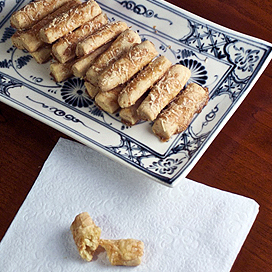
Kastengel--Savory Cheese Sticks


Santa don't want no cookies this Christmas Eve.  All that milk and sugar brings him down with a blood sugar crash, a Christmas day funk that lasts through New Year's.  So this year we're leaving him some kastengel and a glass of thick red wine, or maybe some scotch.

The Dutch didn't leave Indonesia much from 350 years of colonialism.  They were more interested in what they could take from the archipelago than in what they could contribute to it.  One thing they did leave was an appetite for kastengel.  Look at the ingredients and you immediately recognize they did not spring from the Indonesian islands.  Yet, kastengel are a favorite treat to celebrate Lebaran and other major holidays.  Cheesy, buttery, and utterly lacking in nutritional merit, kastengel make tremendous sense as a way to celebrate the end of a month of fasting. 


Kastengel are also a nice change from the overabundance of sweets following Ramadan and during the holiday season in the US.  Cookies are everywhere at this time of year.  Snickerdoodles, ginger snaps, candy cane meringues, almond crescents, and Russian tea cakes abound.  That Santa doesn't slip into a diabetic coma is a Christmas miracle in itself.  Leave a few kastengel in place of the usual cookies and Santa will be pleased.  He may even be extra good to you.


I had never heard of Nyonya Liem or Ibu Liem until Tjing asked me to make some kastengel, but a google search for kastengel resulted in her name appearing again and again.  So I adapted her recipe, simplifying its directions, and translating it into English.  I'm sure the cheddar cheese her recipe calls for is the Kraft processed cheddar that one can find fairly easily in Indonesia.  It makes a more decorative topping of the kastengel as it could probably be baked in a potter's kiln without melting.  A grated parmesan or other relatively dry cheese will produce similar results.  I used a mix of parmesan and a good English cheddar.


Kastengel ala Ny. Liem

I am giving the measurements most Americans are comfortable with; however,  I use a scale when making these as it just makes it easier.  The original recipe calls for equal parts butter and margarine, 150 grams each.

2 cubes butter (8 oz/227 gr), room temperature
6 TBS margarine, room temperature
2 egg yolks
1 tsp salt
3 1/3 TBS (50 ml) half and half
4 oz parmesan cheese, grated
4 oz cheddar/edam/gouda, grated

3 TBS (25 gr)corn starch
5 TBS (25 gr)powdered milk (the original recipe calls for full cream powdered milk, but I used non-fat as that is what is readily available in the US and it worked fine)
3 1/2 to 3 3/4 cups (500 gr) all purpose flour, sifted
1 tsp baking powder

Egg wash of egg yolks mixed with a little oil and water
Finely grated cheddar/parmesan cheese

In a large bowl, cream together the butter, margarine, and egg yolks.  Using a mixer, beat the ingredients for 3 to 5 minutes until light and fluffy.  Beat in the cream to further lighten the mixture.  Add in the cheese and continue to beat until thoroughly mixed in.

In another bowl mix together the dry ingredients.  Slowly add the dry ingredients to the butter/cheese mixture until all the flour has been incorporated.  You will have what looks like a bowlful of crumbly particles.  The dough will not come together until you press it together with your hands.

To make the logs, press together a handful of the mixture and roll it into a rope, like making a playdough snake.  You want the rope to be not quite as thick as an AA battery.  Using an AA battery as a guide, cut the rope of dough into pieces the length of a battery.  Place the cut pieces about 1 inch apart from each other on a baking sheet lined with parchment paper.

Once you have filled a baking sheet with the cut pieces, brush them with the egg yolk wash.  I make a wash with one egg yolk at a time and have found that will usually be enough for one baking sheet (about 50 kastengel).  Sprinkle the finely grated cheese atop the pieces.

Bake in a pre-heated 300º oven for about 20 minutes.  Lower the heat to 200º and bake for another 15 to 20 minutes until the kastengel are cooked through, but not really browned.

This makes a lot.  10 to 12 dozen.  The dough can be frozen.  Bring it to room temperature before attempting to roll it out and make the kastengel.


Saturday, November 17, 2012

Roti Jala


I gather from my nieces that in recent years Malaysia has tried to claim credit from Java for the development of batik.  While I'll definitely side with Indonesia on this issue, I believe Malaysia gets the nod for roti jala.

A crepe-like bread to accompany curries, roti jala is not something I have actually come across in Malaysia or Indonesia.  I first became aware of it several years ago when I bought a copy of Authentic Recipes from Malaysia, which calls them lacy Indian pancakes.  Named for its fishnet resemblance, roti jala is traditionally made with a special funnel with four or five spouts to form the net-like pattern.  I was at a Sundanese restaurant last summer that had several varieties of the funnels as decoration on its walls, suggesting that, at least in the past,  roti jala was enjoyed in Java.  The funnel I use is an inexpensive plastic one that I picked up in Singapore.  One could get much the same effect with more effort using a plastic squeeze bottle.

The recipe here is adapted from Resep Klasik Jajanan Pasar (Classic Market Snack Recipes), which contains 270 recipes for snacks that are often sold in Indonesian markets.  As supermarkets supplant the traditional markets, some of these snacks will undoubtedly disappear. One of the interesting things about the book is that one of the co-authors is a Japanese woman, Tomomi Kimura, who was studying at UGM in Yogya.  She collaborated with a catering company in compiling the recipes.


Roti Jala

1/4 cup thick coconut milk
1 3/4 cup water
2 cups all-purpose flour
1 tsp salt
1 egg, beaten
pinch of turmeric (optional)
vegetable oil to grease the pan

In a bowl, whisk together the coconut milk, water, salt, turmeric (if using), and egg.  Gradually whisk in the flour until you have a smooth batter, about the consistency of whipping cream.  Strain the batter through a fine sieve to remove any possible lumps.  This is important if using a roti jala funnel because even the smallest lumps can clog the spouts.

Heat a large non-stick skillet over medium heat.  Pour in a splash of vegetable oil and rub it into the surface with a paper towel.  Ladle some batter into the funnel (if using), holding the funnel about a half-inch to an inch over the skillet.  Move the funnel in circular pattern to form a lacy, fishnet-like crepe.  Cook until the crepe is set and the edges begin to lift and curl from the pan.  Slide onto a clean plate.  Roll or fold into eighths.  Continue until all the batter is finished. 

This makes about 16-20 crepes.  Serve it with curries or other saucy dishes.  I served it here with an excellent Burmese shrimp curry from Naomi Duguid's Burma: Rivers of Flavor.  I'll be posting my take on this dish soon.


Monday, October 8, 2012

Rengginang--Fried Rice Crackers


When I made some sambal serai--lemongrass sambal--a few weeks back, I thought it needed something other than some grilled food to accompany it.  The sambal is great with a meal, but I wanted to be able to enjoy it as a snack.  Rengginang--which are a kind of rice cracker made from sticky rice--make a perfect accompaniment.  They are light and savory, easy to make, and store well.


Rengginang are nothing like the tasteless puffed rice crackers that were popular with dieters many years ago.  Who knows, maybe they are still popular.  Nutritionally, they were equivalent to eating styrofoam. Unfortunately, styrofoam probably tastes better.  Rengginang taste like toasted rice with a hint of garlic and shrimp.  In Indonesia you can also get a sweetened version, but I've always been partial to the savory ones.  While they are usually about 3 inches in diameter, you can find platter-sized ones that are 10 inches or more across. 

Making these is a multi-step process, but it is not difficult.  Soak, steam, mix, steam, dry, and fry.  There's also a little grinding of garlic, but those are the basic steps.  While I like a little sambal with mine, you could really use them with almost any dip, especially salsas.  The dried disks can be stored until you are ready to fry them.  The fried rengginang will keep for at least a week in an airtight container. 


Rengginang--Fried Rice Crackers

1 kilo glutinous rice (approximately 5 cups)
6--8 cloves of garlic, peeled, and pounded to a paste
2 tsp salt
1 tsp terasi (optional)
2 TBS ebi (dried shrimp) soaked in hot water for 10 minutes, drained, and pounded to a paste (optional)
400 ml (1 3/4 cups) water

Soak the rice in water for two to four hours.  Drain, then steam the rice for 15 minutes.  Remove the rice to a large bowl.

In a mortar, pound the garlic, salt, terasi, and ebi (if using) into a smooth paste. Stir this paste into the 400 ml of water.  Pour this into the partially steamed rice and mix well.  Allow the rice to absorb the seasoned water.

After 15 to 20 minutes, when the rice has absorbed the added liquid, return the rice to the steamer and steam for another 30 minutes.  Remove the rice from the steamer and form into disks about 1/4 inch to 1/2 inch thick (.5 cm to 1 cm). 

If you live in a warm, sunny climate, place the disks in a single layer on some sort of rack or porous surface and allow them to dry.  This may take several days.  I hurried the process by putting them into an oven which I turned on to the lowest possible setting.  I meant to turn the oven off after five minutes, but forgot, so I dried them a little faster and at a higher temperature than was ideal.  Still, they fried up fine.  If you have a dehydrator, I would think that would be ideal for drying these.

Once dried, they are ready to be fried.  Heat oil in a wok or other pan to around 385º, maybe a little hotter.  Slide a disk into the hot oil.  It will sink to the bottom, but should rise almost immediately.  Cook in small batches.  Each only takes twenty seconds or less to cook.  The important thing is to have the oil hot enough so that the disks will rise to the surface almost immediately.  If the oil is too cool, the disks will remain on the bottom and you will have a hard, unpleasant cracker.


Thursday, September 27, 2012

Sambal Serai--Lemongrass Sambal


Sambal is a part of just about every Indonesian meal.  Sambals can be cooked, raw, with vegetables or proteins, complex, or simple.  Some varieties can be found here.  Sambal ulek (usually seen in markets with the Dutch spelling, sambal oelek) is the most basic of sambals, simply freshly ground chilies and salt.  Sambals may be served alone as a snack, or as an accent to spark grilled fish or fried chicken.  You decide how much sambal your bowl of soto needs, but no soto is complete without it.


Sambal sereh is a cooked sambal that is a great accompaniment to grilled chicken, but also tastes great as a dip for rengginang or krupuk.  Although not for the faint-hearted, the level of heat can be adjusted by the types of chilies used.  Here in Sacramento, the Asian farmers market--a few blocks west of the official Sunday farmers market--finds the stalls overflowing with a variety of  chilies, some hot, others blistering.  Cabai rawit--bird chilies--are particularly hot and can be found throughout the year in local markets.  Cabai keriting--curly chilies--are hot, but not as hot as cabai rawit.  They are rarely found in local markets or at other farmers markets, but they do appear in late summer at the Asian farmers market. 


The Indonesian recipe that I adapted this from calls for 100 grams of cabai keriting.  I used about 80 grams and added a gypsy pepper, a mild red pepper.  This made for a very hot sambal, but one that I can still enjoy just eating with rengginang.  If you prefer a milder sambal, use fewer of the curly chilies and more of the gypsy chili or red bell pepper.  I suppose vegetarians could leave out the dried shrimp and terasi, but the sambal would be less complex.  Terasi (belacan) is an acquired taste, but once you've become accustomed to it, you will long for it.


80 grams (a good handful) chilies  (cabai keriting, but any hot red chili may be used), seeded
1 mild red pepper
3 cloves of garlic, peeled and minced
2 tsp ebi (dried shrimp), soaked in 2 TBS warm water for a few minutes and drained
1 tsp salt
1--2 TBS gula jawa (palm sugar)
1 TBS terasi (fermented shrimp paste)
3  tomatoes, roughly chopped
2 TBS vegetable oil
3/4 cup of water
2 stalks of lemongrass, outer leaves removed, crushed with a pestle and tied into a knot

In a blender or food processor, process the chilies and red pepper until you have a fairly smooth paste. Reserve.  Grind the garlic and salt to a smooth paste in a mortar.  Add the drained ebi, gula jawa, and terasi and grind with a pestle until smooth.  Add the tomatoes and continue to grind until all the ingredients are well mixed.
Heat a frying pan.  Add the oil and then the tomato and garlic mixture.  Fry until fragrant, then stir in water.  Add the chili paste and lemongrass. While stirring, cook over low heat until the mixture thickens.  Ideally, you want a sambal that is moist but not too liquid.  Scrape as much of the sambal as you can from the lemongrass.  Suck what remains on the stalks and count your blessings.

Serve the sambal with grilled/fried fish or chicken.  Or add to an omelet.  Or use as a dip for crackers, chips, krupuk, or rengginang.  Any way you serve it, you will enjoy.


Thursday, September 13, 2012

Gokar Kencana--Ayam Goreng-Bakar--Surabaya


Bantam chickens are a breed of chicken that originated in West Java.  A smaller breed of chicken, they are, according to Wikipedia, a popular breed for suburban homes in large part due to their decreased need for space.  That such a chicken should originate in Java is fitting as it is one of the world's most densely populated islands.  Not quite one third the size of California, Java has almost 4 times the number of people as California, just over 136,000,000.  Good luck getting lost on Java; travel half a mile from any spot and it seems there is another cluster of homes.

While tempe is probably the most readily available source of protein on Java as it is cheap enough for everyone except perhaps the most abject poor, chicken is the most common meat of the Javanese diet.  Ayam goreng, sate ayam, soto ayam, and ayam panggang or ayam bakar can be found on just about any street.  Go hiking to get away from the masses and you'll probably find a hawker who has carried his grill and chicken up the mountainside to cater to hungry hikers.  A cold beer is a rare find, but a piece of freshly cooked chicken is never more than a few minutes from wherever you might be.

In Surabaya this summer, Tjing and I enjoyed a lunch at Gokar Kencana, a family restaurant specializing in fried and grilled  chicken. Anyone familiar with Indonesians fondness for acronyms might suss out the restaurant's focus (ayam GOreng) and (ayam baKAR).  In addition to chicken, the restaurant also serves fried and grilled gurame.


The restaurant is located in a suburb near several of Surabaya's universities, Universitas Airlangga, ITS (Institute Technology Surabaya), and Universitas Muhammadiyah Surabaya.  A spacious patio covered by an arching roof, the restaurant would seem to be a great place to grab a meal before or after classes.  It's much more upscale than the typical warung or rumah makan, but the prices seemed very reasonable at around 1500 rp for a serving of a quarter of a chicken with rice.

The fried chicken is not the KFC style with a crisp crust that absorbs grease, but the Indonesian style of chicken that is first simmered in coconut water with a mix of spices before being fried.  This results in a flavorful piece of chicken that is moist but thoroughly cooked without being greasy.  The grilled chicken includes some honey in the mixture that it is basted with while being grilled.  It is grilled on a custom made grill that uses briquettes rather than the lump charcoal that is more commonly used in Indonesia.  Both the fried chicken and the grilled were extremely tasty, as was the fried gurame.  Although I enjoyed all the dishes, I preferred the grilled chicken and its accompanying sambal.


Friday, March 16, 2012

Sambal Udang Kentang--Shrimp and Potato Sambal


Sambal udang kentang is another typical Indonesian sambal that might be one of several dishes to be served with rice. This is a particularly mild sambal, as one member in our current household has a low tolerance for spicy food despite growing up in Indonesia, but it could be enlivened with some additional chilies. It may seem surprising that potatoes would be featured in an Indonesian dish, but in fact, potatoes are quite popular in the archipelago, especially in Java and Sumatra, and are included in numerous dishes.

I used larger shrimp than the dish really calls for, simply because they were on sale and I had them on hand.  I actually think medium large (36--40 per pound) or even smaller are better in a sambal.  Whichever size you use, you want to adjust the cooking time so as not to overcook the shrimp.  I served this with sambal goreng printil  and steamed rice for an easy dinner.


Sambal Udang Kentang (adapted from The Indonesian Kitchen)
printable recipe

1 pound potatoes, peeled and cut into 1/2-inch cubes
1 pound shrimp, peeled and deveined
4 shallots, peeled and minced
3 cloves garlic, peeled and minced
1 TBS minced chili, or sambal oelek if fresh chili isn't available
salt, to taste
1/2 cup tomatoes, cut into 1/2 pieces
1/4 cup peanut oil

Heat the oil in a skillet over medium heat.  Fry the potatoes until softened and cooked through.  You don't want to brown them.  Remove the potatoes from the oil and set aside.  You can do this ahead of time and reserve the potatoes until you are ready to finish the dish and serve it.

Fry the shallots, garlic, chili, and salt in the oil until softened and fragrant.  Add the shrimp and fry briefly, being careful not to overcook the shrimp.  Stir in the tomatoes and potatoes and fry for two minutes more until heated through and covered with the spices.  I prefer to serve and eat this hot, but it may also be eaten at room temperature (as it usually is in Indonesia).


Friday, March 9, 2012

Sambal Goreng Printil


Sambal goreng printil is a nice dish to include when you are serving a variety of Indonesian dishes for a dinner, or to serve on its own with rice.  It can be made spicy or mild, a dish that can be adapted easily to different tastes.  In Indonesia it would include petai--a bean that resembles the fava bean, and is infamous for its effects when eaten--instead of snow peas, but finding petai in the United States is problematic.  The snow peas add a nice splash of color and your acquaintances won't be wondering if something has crawled inside you and died.

This is a relatively quick dish to prepare, taking about twenty minutes to make.  Once the meatballs are formed, it requires little more than ten minutes to cook the dish.  Slicing the shallots, garlic, and chilies instead of grinding them to a paste, as would normally be done in Indonesia, saves some time and provides a slightly different texture when eating this sambal.


Sambal Goreng Printil

1 pound ground beef
1 tsp salt
1/4 cup shallots, peeled and thinly sliced
2 cloves garlic, peeled and thinly sliced
1--2 red chilies, seeded and thinly sliced (or add sambal oelek to taste)
2 salam leaves
2 quarter-size slices of laos
1/2 tsp petis (shrimp paste)
1/2 cup coconut milk
1 tsp sugar
1--2 TBS tamarind water
2 cups snow peas, washed and trimmed
1/2 cup cherry tomatoes, sliced in half (or 2 ripe plum tomatoes, seeded and diced)
4 TBS oil, divided

Mix the ground beef with the salt.  Form into marble-sized meatballs.  Heat a wok or frying pan over medium high heat.  Add three tablespoons of the oil.  When oil is hot, brown the meatballs quickly; the interiors should still be rare.  Drain and set aside.

Pour off the fat from browning the meatballs.  Add the remaining tablespoon of oil to the pan and fry the shallots, garlic, and chilies until softened, about two minutes.  Add the salam leaves, laos, petis, coconut milk, sugar, and tamarind water together with the browned meatballs.  Cook for about five minutes, stirring to coat the meatballs with the liquid. 

Add the snow peas and tomatoes.  Cook another 3 to five minutes, stirring constantly just until snow peas are cooked.  Serve immediately.

Sunday, February 19, 2012

Sambal Goreng Kering--Crispy Potato Sambal


When most Americans hear the word sambal, they immediately think of a chile sauce such as sambal ulek or sambal bajak.  In Indonesia there are several hundred varieties of sambal, and many of them are not sauces at all.  Instead, they are dishes which complement the "main" dish and rice.  A plate of nasi rames, for example, might contain rice, a piece of chicken, and several sambals, some with coconut milk, others dry like this one.  The result is a meal that is a balance of flavors and textures--sweet and savory, saucy and crispy. 

This particular sambal is very similar to tempeh kering.  The final steps are the same, the only difference is the ingredients.  While tempe is almost as cheap as potatoes in Indonesia, unless you make your own tempe in the US, you'll find this version is much cheaper with potatoes than with tempe.  You could also make this with kettle style potato chips; I'd suggest using the unsalted variety.  If you don't like your food looking back at you, you can eliminate the ikan teri (anchovies).  They provide an interesting crunch and flavor, but your sambal will be no less authentic without them.

Wandering Chopsticks, whose blog was one of the first to make me aware of food blogs and inspired me to start this blog, recently posted about enjoying this sambal at a food court in Southern California. In her post she mentioned she wanted to learn how to make it, so here it is as a small token of my appreciation for her assistance over the years.  While most Indonesians might enjoy this with rice, it is an excellent accompaniment to beer or cocktails.


Sambal Goreng Kering
printable recipe

6--8 potatoes (about 2 lbs.), peeled, julienned or thinly sliced with a mandoline
14 oz peanuts (if raw, fry in oil for five to six minutes until cooked)
60 -- 120 grams ikan teri, dried anchovies
oil for frying

2 TBS  oil
3--4 shallots, about 60 grams, peeled and minced
2 cloves garlic, peeled and minced
3 fresh red chilies, stemmed, seeded, and chopped
6--9 TBS gula jawa (palm sugar)
2 TBS tamarind pulp dissolved in 3/4 cup water
3 daun salam (if you can't find them, leave them out)
4 slices fresh (or frozen) galangal
1 tsp salt

In batches, first fry the potatoes several minutes in oil around 300º F.  Drain and let cool.  Heat the oil to 375º and fry the potatoes a second time until crisp, about two minutes more.  It's important that the potatoes be very crisp before you put them in the sauce.  Drain on paper towels.

You also have to fry the ikan teri in oil.  Once you have done so, you will not want to use this oil for anything else.  So, you may want to pour off and reserve some of the oil used to fry the potatoes before frying the anchovies.  These should be fried around 350º F for just a minute or two.  Drain on paper towels.

With a food processor or mortar and pestle, process or grind the shallots, garlic, and chilies to a paste.  Stir fry the paste in the 2 TBS of oil until softened and fragrant.  Add 6 TBS of palm sugar and stir until melted.  Add in the tamarind water, daun salam, galangal, and salt.  Stir and cook over medium heat until this becomes the consistency of a thick syrup.  Taste and adjust sweetness to your preference.  Fold in the potatoes, peanuts and ikan teri until all are covered with and have absorbed the sauce.  If your potatoes were crisp, the sambal should remain crisp in an airtight container for several days. 


Monday, November 28, 2011

Javanese Nuts and Bolts


Nuts and bolts (AKA Party Mix) is a seasonal snack in my family, something that pops up around this time every year.  Although the recipe makes a generous amount, it disappears as fast as it is put out.  The combination of toasted cereals, pretzels, and nuts with butter and worcestershire sauce produces an incredibly addictive, not too salty snack (although I've always found the packaged versions to be overly salty and nowhere nearly as tasty).  As much as I love the original version (or at least the version that my mother makes), I decided to try giving it a little Javanese flavor.

Instead of butter, I substituted fresh pressed whole kernel virgin coconut oil.  To be honest, I was worried that the coconut oil would overpower the mix.  Fortunately, it proved to be a fairly subtle back note to the mix, not at all overwhelming or cloying.  In addition to the coconut oil, I added some crisp tempe, some fried kaffir lime leaves, and some fried, finely chopped lemongrass.  Instead of using worcestershire sauce, I used kecap manis, some fish sauce, and some panang curry paste.  Although not my mother's party mix, this proved to be just as addictive.  If you're looking to give a different twist on an old standby, I'd certainly recommend giving this a try.


Javanese Nuts and Bolts

2 stalks of lemongrass, inner lower third only, very finely chopped (easiest to do in a food processor)
14 kaffir lime leaves

2 cups bite-size wheat square cereal (such as Wheat Chex®)
2 cups bite-size corn square cereal (such as Corn Chex®)
2 cups bite-size rice square cereal (such as Rice Chex®)
2 cups toasted oat cereal rings (such as Cheerios®)
2 cups pretzels
1 1/2 cups lightly salted dry roasted cashews
1 1/2 cups tempe sliced into pieces 2" x 3/4" x 1/3" and deep fried until crisp

1 cup fresh pressed virgin coconut oil
1/4 cup kecap manis
1 TBS fish sauce
2 tsp panang curry paste

Preheat your oven to 225º F.

In a pan over medium low heat, fry the lemongrass in several tablespoons of the coconut oil until browned and crisp, like when making tofu with lemongrass.

Fry the kaffir limes in hot oil until crisp.  Alternatively, crisp in a microwave.  You want to be able to crumble them easily.

Heat the remaining coconut oil in a small saucepan.  Stir in the curry paste until it is dissolved in the oil, and then stir in the kecap manis and fish sauce.

In a large bowl mix the cereals, pretzels, cashews, and fried tempe.  Pour in the coconut oil mixture. Mix well, tossing and stirring the cereals so all get coated.  Stir in the browned lemongrass and the crumbled kaffir lime leaves.  Mix well and pour into a large roasting pan.

Bake in the preheated oven for about an hour, stirring every fifteen minutes or so.  Cool before serving.

I've found the kaffir lime flavor to become more pronounced the longer the mix sits.  This is a flavor I think can be overbearing--as I find it is in Trader Joe's Thai-spiced cashew nuts.  You can taste the kaffir lime leaves in this mix, but they don't dominate it. 

Tuesday, October 25, 2011

Kue Soes Kopi Kapulaga--Cardamom Coffee Cream Puffs


As my blog is entitled Javaholic, many people assume that I focus primarily on coffee.  As much as I enjoy a good cup of coffee, which I do several times a day, this blog is more interested in exposing people to Indonesian food. However, after having gone more than two years without a post specifically related to coffee, I find myself having two coffee related posts this month.
 
When the Foodbuzz Tastemaker program offered interested bloggers a chance to create a post about a dish that would pair with some new blends Peet's was promoting, I leapt at the opportunity.  For one thing, I got two bags of Peet's coffee from the deal.  Yes, I can be had cheap.  I wouldn't have done it, however, if Peet's weren't already my choice for coffee.  It seems to be one of the few places where I can get a good cappuccino that is not just a frothy latté.  I also appreciate that it uses a lot of Indonesian textile motifs in its decorations.


The new blends--Café Domingo, which is a blend of Central and South American coffees, and Café Solano, which is a blend of African, Indo-Pacific and South American coffees--are medium roasts. Interestingly, Indonesian coffee drinkers tend to favor medium roasts.  During my visit to Kediri this past summer, my brother-in-law couldn't appreciate the dark roast Sulaweisi I brought, preferring a medium roast from Flores.  He would definitely appreciate the Café Solano.

I don't generally drink much coffee past noon, but I do enjoy it sometimes with dessert.  As one of the desserts that Tjing likes is kue soes, which is what Indonesians call cream puffs, I decided to make some with an Indonesian spiced pastry cream.  Topped with a simple dark chocolate sauce, these pair very nicely with the medium roast blends.


1 cup of bread flour (although all-purpose will also work)
1 TBS sugar
1/4 tsp salt
3/4 cup milk
1/4 cup water
1/3 cup butter (5 1/3 TBS) 
4 large eggs (at room temperature)

Sift together the flour, sugar and salt.  In a medium saucepan bring the milk, water and butter to a boil over medium heat.  As soon as the liquid comes to a boil, dump in the flour mixture and stir well to form a soft dough.  Off the heat, stir in one egg at a time, making sure that each egg is thoroughly incorporated before adding the next egg.  By the time the last egg has been incorporated, the dough should be satiny and smooth.  Using a pastry bag or two tablespoons, place twelve balls of dough on a parchment or silicone lined cookie sheet.  Bake for ten minutes at 400º F, then lower the oven to 350º F and bake another 20 to 25 minutes until golden brown.  Cool before filling.

Cardamom Coffee Pastry Cream

1 1/4 cups whole milk
1/4 cup espresso
1/2 cup sugar
4 egg yolks
3 TBS corn starch
the seeds from 4 cardamom pods, finely ground in a mortar
1/2 tsp freshly ground nutmeg

Whisk together the egg yolks with the sugar until light and creamy.  Stir in the corn starch, making sure there are no lumps.  
Meanwhile, bring the milk, espresso, cardamom and nutmeg to a boil.  Pour the hot liquid into the egg yolk mixture while whisking steadily to temper the eggs.  Then add this back to the rest of the milk in the pan and stir over low heat for several minutes until it thickens.  Chill the pastry cream until you are ready to fill the cooled puffs.

Dark Chocolate Sauce

1/2 cup light corn syrup
1 cup whipping cream
8 oz dark chocolate (I use Trader Joe's) finely chopped

In a small sauce pan heat the corn syrup and whipping cream just until it comes to a simmer.  Pour over the chopped chocolate and stir to melt the chocolate.  Drizzle warm over the filled cream puffs.
Enjoy with a cup of coffee or the beverage of your choice.


 I'd like to thank Foodbuzz and Peet's for the coffee and coupons they sent me for taking part in this promotion.  


Friday, October 7, 2011

Indonesian Red-Braised Beef Shanks


Red-cooked dishes are popular Chinese  dishes although they are not often found in restaurants in the US.  Most commonly featuring chicken or pork, the "red" stock they are cooked in is often a master stock that has been used and refreshed numerous times, becoming ever more flavorful and nuanced.  Unlike those dishes, this red-braised beef is a simpler affair, with its flavors similar to those of beef semur


Although Tjing doesn't much care for beef, her cousins are big meat eaters.  As their kitchen is currently undergoing a major renovation, I've been asked to cook some dinners for them.  With a recent cool down and light showers bringing an end to our summer, it seemed like a good time to make some stew.  This is a stew any meat and mushroom lover would appreciate.  The recipe is adapted from Terrific Pacific Cookbook, a cookbook with many delicious recipes influenced or inspired by Asian cuisines.


1/4 cup peanut oil
1 TBS roasted sesame oil
3 to 4 pounds meaty beef shanks
1/2 pound crimini mushrooms, sliced
2/3 cup shao hsing rice wine
6 TBS kecap manis
1 TBS dark soy sauce
3 slices ginger, crushed
10 dried shitake mushrooms, stems removed, rinsed to remove any grit
1/3 cup tamarind water (from 1 TBS tamarind pulp dissolved in boiling water, strained)
1 stick of cinnamon
4  1/2 cups beef stock or canned broth

2 tsp cornstarch mixed with 1 TBS cold water

Tie in a piece of cheesecloth or place in a spice bag:
2 star anise, crushed
1 tsp black peppercorns, lightly crushed
1 tsp coriander seeds, lightly crushed
5 cloves, lightly crushed
3 pieces tangerine peel

In a dutch oven or large pan heat the oils over medium-high heat until almost smoking.  In batches, brown the beef shanks.  Remove the beef from the pan and fry the mushrooms until browned.  Remove the mushrooms and place with the browned beef. 

Pour off the fat from the pan and add the rice wine, scraping the pan with a wooden spoon to get up all those good brown bits.  At this point I pour all of this liquid into a Chinese claypot and cook over medium heat until the liquid is reduced by about half, but you can simply continue cooking in the same pot if you like.  Add the soy sauces, tamarind water, ginger, shitakes, cinnamon, spices in the cheesecloth or spice bag, along with the stock, and bring this to a boil.  Add the beef and sliced mushrooms, cover the pot,  and simmer for 1 1/2 to two hours, until the beef is tender and falling from the bones. 

Uncover the pot and simmer on low until the liquid is reduced and thickened to your liking.  Stir in the cornstarch slurry and cook for several minutes.  You don't want a gravy-like sauce, but something approaching that of a good beef bourguignon. 


Tuesday, September 13, 2011

Choy Sum Stir Fried with Eggs--Cah Caisim Orak-arik Telur

Indonesian food is a marvelous melange of ingredients and influences from around the world.  Peanuts, native to South America, were brought to Asia by the Portuguese.  Although nutmeg and cloves are native to Indonesia, many other spices commonly used in Indonesian dishes, including coriander and cumin, drifted to the islands from traders to the west.  Dutch, Portuguese, Arabic, Indian, Chinese and Champa influences are evident in the culture and cuisine of Indonesia.  Although  Chinese were reported to comprise less than 2% of the the population in the 2000 census, they have had a disproportionally large impact on Indonesian society and culture.  Of course, one of the greatest areas of impact is on the food.

There are countless recipes entitled orak arik.  Simply meaning scrambled, these are simple stir fry dishes in which eggs are scrambled with vegetables.  They are quick, flavorful, and a good source for protein for people unable to afford or not wanting to consume meat.  The ingredients as well as the cooking method point to the obvious Chinese origin of this dish.  Along with some steamed rice it makes for a most satisfying meal.


This is another recipe adapted from 240 Resep Hindangan Sehari-Hari untuk 2 Bulan 
(240 Recipes of Dishes for Every Day for 2 Months).


1 bunch of choy sum (about 1/2 pound) cut in 2-inch lengths
2 eggs, beaten
2 cloves of garlic, thinly sliced
4 shallots, thinly sliced
2 red chiles, thinly sliced on the diagonal
1 tsp fish sauce
1 TBS oyster sauce
pinch of salt
1/4 tsp white pepper
1/4 tsp sugar
2 TBS water
2 green onions, sliced into 1/2-inch pieces on the diagonal

2 TBS oil for stir-frying

Heat the oil in a wok and stir in the garlic, shallots and chiles.  Briefly fry until fragrant, then push to the side of the wok.  Add the beaten eggs and stir until scrambled.  Then add the choy sum, stirring until limp.  Add the fish sauce, oyster sauce, salt, pepper, and sugar.  Fry quickly, tossing the vegetables and eggs to coat thoroughly with the sauce.  Add the water and cook for a minute or two so everything is well cooked.  Stir in the green onions.  Remove from heat and pour into a serving dish.  Serve immediately.  (Although in Indonesia this might well be cooked at noon and not be eaten until several hours later, most Americans will probably enjoy this dish served hot.)