Other than using demerara sugar instead of white sugar to sprinkle on the fruit, and the substitution of the kaffir lime chili jam for the red currant preserves, I stuck to the Times recipe. The crust is a straightforward pate sucree, a crust that is pretty much foolproof. As the fruit is front and center, it's important that you use the best that you can find. I wouldn't attempt to make this tart with any fruit that you wouldn't be as happy eating fresh.
Showing posts with label vegetarian. Show all posts
Friday, August 16, 2013
Peach and Nectarine Tart
After a month in Indonesia visiting family, Tjing and I returned to summer here in Northern California. It's the towards the tail-end of the season for stone fruits, and peaches and their clean shaven cousins, nectarines, are at peak sweetness. Going to the farmers market the morning after we got back, I picked up several pounds of perfectly ripe yellow peaches and white nectarines. Although they were fine eaten fresh without any adornment, I decided to use some to make this tart which I came across while surfing the web in Java. I liked the simple directness of the tart, its focus on the fruit, but I thought I'd give it an Indonesian tweak by using some lemongrass kaffir lime pepper jam instead of the red currant preserves it calls for. I thought a touch of heat with the fruit would be a nice touch.
Other than using demerara sugar instead of white sugar to sprinkle on the fruit, and the substitution of the kaffir lime chili jam for the red currant preserves, I stuck to the Times recipe. The crust is a straightforward pate sucree, a crust that is pretty much foolproof. As the fruit is front and center, it's important that you use the best that you can find. I wouldn't attempt to make this tart with any fruit that you wouldn't be as happy eating fresh.
I served this with some crème fraìche, as suggested in the original recipe, but a good vanilla ice cream would also go well with it. It is also fine just on its own.
Other than using demerara sugar instead of white sugar to sprinkle on the fruit, and the substitution of the kaffir lime chili jam for the red currant preserves, I stuck to the Times recipe. The crust is a straightforward pate sucree, a crust that is pretty much foolproof. As the fruit is front and center, it's important that you use the best that you can find. I wouldn't attempt to make this tart with any fruit that you wouldn't be as happy eating fresh.
Thursday, June 20, 2013
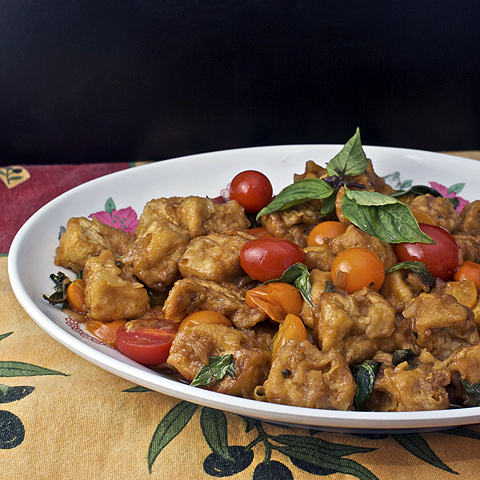
Tofu with Tomatoes and Thai Basil
With several eyes of round curing for some bresaola and some freshly sliced coppa sitting in my refrigerator, I can hardly be confused for a vegan. I am a creature of the flesh and enjoy eating meat on a fairly regular basis. At the same time, I enjoy tofu and tempe. While the bresaola is curing in the fridge, I have a batch of tempe coming together in the oven (off, with the oven light on). I'm complicated.
Actually, I am a slave to taste. If something tastes good, I'll eat it. While I admire vegetarians and vegans for their adherence to a diet that does without meat or animal products, I savor the taste of grilled pork and a succulent piece of brie. Although fish sauce was foreign to my childhood, my enjoyment of life would be lessened without it. The same with tofu and tempe. My first tastes of tofu were probably as a dish that would be good for me, and I was underwhelmed. It wasn't until I experienced it in refugee camps in Malaysia and living in Indonesia that I came to appreciate tofu. That my wife is from Tofu City (Kediri) in Indonesia may be another reason for my fondness for tofu. Tempe is probably unfamiliar to most Americans, and that is a shame. What's worse is that most will only taste the health food type of tempe that is commonly available in the United States. Javanese tempe is simple and exquisite. It is the protein of the masses in Indonesia, and a good piece of tempe is every bit as ambrosial as that buttery piece of brie.
I can understand vegetarians and vegans abhorrence for meat. As much as I might enjoy a quivering steak fresh off the grill, they view it as a moral abomination; I get that. It's not going to make me enjoy my steak any less, but I understand how disgusted they may be by my choice. Perhaps there's a Hell where pigs will be grilling pieces of my flesh on a spit, flames rising and dancing from the dripping fat. Oh well.
What I can't understand is how animated some meat eaters get about vegetarians and vegans. They refuse to eat vegan dishes on principle. Indignant perhaps that vegans would have them sentenced to Hell, they denounce the trappings of veganism as righteously as fundamentalists of one religion decry another. "I'll eat a salad as a side, perhaps, but forget that tofu." Tofu is viewed as an inferior meat, a poseur, and vegetarians should accept some of the blame for this in that too often tofu is used as a meat substitute. However, if you appreciate tofu for what it is, a velvety flavor sponge, you can enjoy it just as much as that grilled steak.
For vegans, vegetarians, and gastronomic agnostics, this is a wonderful dish. You could spice it up by adding some minced chilies, but even without the chilies it is full of flavor. For a variation, you can use nuoc cham (fish sauce with lime, garlic, and chilies) in place of the soy and vinegar based sauce in this recipe, but then it would no longer be a vegetarian dish.
Tofu with Tomatoes and Thai Basil
4 or 5 blocks of Chinese tofu (approx. 4" x 4" x 1")
2 cups of cherry tomatoes, larger ones slice in half, smaller ones left whole
1/2 cup of Thai basil leaves
1/4 cup minced shallots
3 cloves of garlic, minced
scant 1 cup of water
2 TBS soy sauce
1 TBS rice vinegar
2--3 tsp sugar
1/2 cup all-purpose flour
1/4 cup rice flour
2 TBS corn starch
1/2 tsp salt
water
oil for frying
Cut the tofu in 1/2-inch to 3/4-inch cubes. Drain on paper towels. Make a batter by mixing together the flours, corn starch, salt, and water in a bowl until the consistency of heavy cream.
Heat oil to the depth of 1 1/2 inches to 350º F in a wok or other vessel. Working in batches, dip the cubes of drained tofu in the batter and then gently fry in the hot oil, stirring to keep the pieces from sticking together. Each batch should take about two minutes to produce golden brown cubes that retain custard-like centers. Remove the fried cubes and drain on paper towels while frying the rest of the tofu.
Remove all but several tablespoons of oil from the wok. Fry the shallots and garlic until just softened. Add the cherry tomatoes and fry for a minute or two. Mix together the water, soy sauce, vinegar and sugar. Taste and adjust for a sweet/sour/salty tang. Add this to the tomatoes and shallots and increase the heat so the mixture is boiling vigorously. After the mixture has reduced some, stir in the tofu. When the liquid is absorbed and the tofu is heated through, stir in the basil leaves. Remove from heat and serve.
Wednesday, May 29, 2013
Salted Mustard Greens
It may seem odd then that I regret never having met my mother-in-law, who died before Tjing and I began seeing each other. I have had the pleasure of meeting her two sisters, both of whom have been very kind to me. The older one, who also enjoyed cooking, clips recipes and gives them to me when we visit. Both sisters have good senses of humor, and from all accounts Tjing's mother also managed to maintain her sense of humor and to raise a remarkable family in difficult times.
It's hard for non-Indonesians, and perhaps for younger Indonesians, to appreciate the difficulties of being identified as Chinese in Java, especially in the 60s. Although my mother-in-law was an Indonesian citizen whose family had been in Indonesia for several generations, and my father-in-law was born in Indonesia, their children did not become citizens until the 80s. At one point, Tjing's mother was tempted to destroy the birth certificates and her marriage license so that her children would be citizens. Had she been recognized as the sole parent, her children would have her rights of citizenship passed on to them. As children follow the husband/father, since Tjing's father was not recognized as a citizen, none of his offspring could be. He refused to have his children be identified as bastards in order to procure citizenship. Tjing finally managed to get her citizenship shortly before going to Galang.
After the fall of Sukarno in 1965, between 100,000 and 1,000,000 people were killed, most of them in Central and East Java. While the targets were ostensibly communists, who were blamed for the failed coup that led to Suharto's ascension, Chinese were also slaughtered in huge numbers. The town where Tjing's mother was born was largely Chinese and was virtually wiped from the map. In the following years, Chinese publications and the studying of Chinese were banned. The Suharto government forced assimilation on the Chinese by erasing cultural ties. While cleansing them of their Chinese cultural heritage, the policy did not integrate the Chinese Indonesians into the mainstream of society. There was a limit on the number of ethnic Chinese allowed to study at universities and to work for the government. The limit was also imposed on multinational companies.
In this hostile climate, Tjing's mother raised four children and ran a jamu shop. All children, including her daughters, went to university. While her life was confined to Kediri and surrounding towns, she ensured that Tjing was able to study in Yogya and enabled her to live and work in Galang. For Americans this might seem like no big thing, but without her mother's support, Tjing's father would have never allowed Tjing to go to Galang. Later, when Tjing was offered a full scholarship by the Australian government to get her Master's in Canberra, it was her mother that allowed Tjing to accept the scholarship. While Tjing was completing her degree, her mother was discovered to have cancer that had already reached a very advanced stage and died within days of entering the hospital, before Tjing was able to get back to see her.
One of the reasons I regret not having known Tjing's mother is that in addition to having a good sense of humor, she also was a skilled cook. Unfortunately, Tjing didn't take much interest in learning how to cook from her mother. She can describe dishes her mother used to make, but is very fuzzy with the details. Rice with salted mustard greens is one of her dishes that Tjing sometimes makes. Her mother used to make the salted mustard greens, but Tjing didn't know how, so this is my attempt. They turned out pretty good. They are certainly cheap to make, and we much prefer them to the ones available in the market that are made in China. I don't quite trust the safety of Chinese food products.
The recipe I used came from HungerHunger, a blog based in Kota Kinabalu. Her recipe called for drying the greens before salting them and using water from rinsing rice. Other recipes omit the drying and use just plain water. While I'm sure the other recipes may be just as good, HungerHunger's approach seemed much more like what I imagine Tjing's mother would use. The only change I made was in the drying time, cutting down the amount of time because of Sacramento's heat and low humidity.
Salted Mustard Greens
Several bunches of Chinese mustard greens (I got eight for a dollar at the farmer's market)
salt
water from rinsing rice
glass jar
Wash the mustard greens to remove any dirt. On racks or strung together and hung, dry the greens outdoors until thoroughly wilted. This took about 24 hours in 92º heat with low humidity.
Use one tablespoon of kosher salt for each bunch. Rub the salt well into the greens. Place the greens with the salt into a large glass jar or container.
When you make a pot of rice, reserve the water from the first rinse to pour over the greens. Make sure the water completely covers the greens, placing a weight on them if necessary.
Store at room temperature for 5 to 7 days. After that, keep in the refrigerator for longer storage. I vacuum pack the bunches in small bags after using several of the bunches rather than keeping them in the large jar.
Labels:
Chinese,
Indonesian,
preserves,
vegetables,
vegetarian
Thursday, February 7, 2013
Lumpia Basah Khas Bandung--Fresh Lumpia Bandung Style
In the United States, most people think of Filipino-style fried lumpia when they hear of lumpia. Long, thin spring rolls packed with pork and shrimp and fried until crisp, Filipino spring rolls are delicious, but they are a totally different animal than these fresh lumpia from Bandung in West Java. Lumpia basah are more akin to the popiah you can find in Malaysia and Singapore. Essentially a crepe with a sweet/savory filling of jicama, beansprouts, and eggs, these are a cheap, satisfying snack hawkers sell in Bandung.
As they are not fried, lumpia basah could be considered a healthful snack. With bean sprouts and jicama both being low in calories and relatively high in fiber, these lumpia can be enjoyed without feeling guilty. The various components of the lumpia can be prepared ahead of time, but they should not be assembled until shortly before you eat them. If they are assembled and rolled hours ahead of time, the wrappers are prone to split and come apart.
Although you could purchase the lumpia wrappers from an Asian market (look for "pastry wrappers" made in the Philippines in the frozen section) making your own is not difficult. The frozen ones are very thin, but they also are more brittle, without the flexibility of fresh wrappers. The recipe I use for the skins does not produce as thin a wrapper as the commercial ones, but Tjing prefers it to the frozen ones.
Lumpia Basah Khas Bandung--Fresh Lumpia, Bandung Style
For the wrappers
1 1/3 cups (200 grams) all-purpose flour3/4 cup + 2 TBS (200 ml) water
2/3 cup egg whites (5 to 6)
1 tsp salt
In a medium bowl, mix together the flour and salt. With a whisk, stir in the egg whites. Then add half the water, stirring until fairly smooth. Whisk in the remaining water and continue stirring for about five minutes. Set the mixture aside and allow to rest for at least 40 minutes.
Heat a non-stick frying pan over medium-low heat. Lightly brush with oil. Ladle enough batter in to form an 8-inch crepe, using the bottom of the ladle to spread the mixture as needed. As soon as the edges begin to lift from the pan, flip the crepe and cook briefly on the other side. Each crepe should take about 25 to 30 seconds total. Continue until all the batter is used. This should make around 10 wrappers.
For the filling
1 jicama (about 1 pound/ 450 grams) peeled and cut into matchsticks2 cups beansprouts
2 eggs, lightly beaten
3 1/2 ounces (100 grams) palm sugar (gula jawa), grated
1/3 cup water
1 tsp +/- salt
2 TBS tapioca starch
7 cloves of garlic, pounded to a paste
1 tsp ground white pepper
2 TBS oil
In a large pan that will hold the jicama easily, dissolve the palm sugar in the water and bring to a boil. Remove two tablespoons of this syrup and mix with the tapioca starch in a small bowl. Add the jicama to the remaining sugar mixture and stir to coat well. Cook over medium heat until the liquid is absorbed, and the jicama has softened and browned.
Heat a wok or large frying pan. Add the oil and stir-fry the garlic and white pepper until fragrant. Stir in the beaten eggs and scramble them. After eggs are lightly scrambled, stir in the cooked jicama. Cook for a minute or two before adding the beansprouts and salt. Taste and adjust the seasonings if necessary. As soon as the beansprouts begin to become limp, transfer the mixture to a bowl.
To assemble the lumpia, spread the bottom half of a wrapper with a spoonful of the tapioca starch thickened syrup. Place a generous amount of the filling atop the wrapper. Fold and roll like a burrito, folding in the two sides and then rolling until enclosed. If you like, you can cut them into three or four pieces, but I think they're best enjoyed by scarfing the lumpia whole, bite by bite.
Thursday, August 23, 2012
Zucchini Ratatouille Roll-Ups
While I don't derive pleasure from killing any living beings, I do derive pleasure from their deaths. This is true for anyone who eats of the flesh. Were I a nobler human being, one further along on the path to transcendence, I suppose I would be a vegan and eschew all animal products. Let the bees enjoy their honey! Let the foxes eat the hens eggs!
Alas, I am but a base creature who savors the flesh of other creatures. Smoke the bees out of their hives and harvest their combs. Break those eggs and fix me a frittata. Flay that beast so that I may have a belt and shoes. Much as I might wish I were more enlightened, I am borne with the desire for blood and marrow.
I have evolved enough that I do not insist on animal sacrifice for every meal. I am a big fan of dairy products, but they need not be present in every dish. Fresh, seasonal vegetables properly prepared are no less satisfying than a well cooked piece of meat. Salt and pepper tofu is not better than salt and pepper shrimp, but can be as delicious. In summer in northern California we are blessed with an abundance of great produce. This appetizer takes advantage of the local bounty.
Having recently received some wonderful zucchini, Japanese eggplant, and tomatoes from a former colleague who has been forced into retirement by an adult education program managed by a mean-spirited and vengeful drunk, I decided to try these out. The filling is not a true ratatouille, but a simple sauté of the vegetables you would find in one. Unless you possess amazing knife skills, a mandoline is needed for slicing the zucchini. The zucchini are grilled, allowed to cool, and then rolled around a spoonful of the sautéed vegetables. The end result is a tasty appetizer packed with the flavors of summer.
Zucchini Ratatouille Roll-Ups
1 medium size zucchini
1 large red pepper
1/2 yellow onion, peeled, finely chopped
3-4 tomatoes
2-3 Japanese eggplant, chopped into a small dice
1 clove of garlic, peeled, minced
3 TBS olive oil
salt, to taste
1/2 tsp --1 tsp herbs de provence
chives (I used garlic chives because I had them in) blanched and drained
finely julienned fresh basil (optional)
With a mandoline, slice the zucchini lengthwise into pieces about 1/8" thick. You will have some odds and ends of zucchini leftover. Cut these into a small dice and reserve them. Brush the zucchini slices with olive oil and grill on a medium hot grill 4 to 5 minutes. You don't want to overcook these, but you do want to have good grill marks on at least one side. Remove from the grill and cool.
Char the pepper on the grill. When the skin is blackened on all sides, place in a bowl and cover with plastic wrap for fifteen minutes or so. Rub the charred skin off the pepper. Cut the pepper into a small dice.
At the same time the pepper is on the grill, char the tomatoes. They will probably take less time. Peel and chop into small dice.
Heat the olive oil in a sauté pan. Add garlic and onions and cook until softened, but not browned. Add the eggplant and continue cooking until softened. Stir in the reserved zucchini bits. Add in the diced peppers and tomatoes along with the herbs de provence, season to taste with the salt, and simmer over a low heat until almost all of the liquid is cooked off and you have this wonderful ratatouille jam. Remove from the heat and let cool. If you like, julienned basil is a nice addition.
Take a heaping teaspoonful of the vegetable mixture and place on the wide end of a zucchini strip. Roll up and secure the roll by tying it with a blanched chive. These can be made several hours before serving. Serve at room temperature.
Obviously, this recipe is very flexible. Use what you like and adapt it to your taste. I got nine slices out of the zucchini. There was more filling, but I ended up just eating that by the spoonful.
Sunday, June 17, 2012
Tofu and Garlic Chive Turnovers
Garlic chives (kucai) appear in many dumpling recipes. They are much more fragrant, some might say odorous, than regular chives although their flavor is not overpowering. They are particularly nice when cooked with shrimp. In this recipe from Andrea Nguyen's Asian Tofu, they are paired with tofu. Nguyen's recipe actually calls for the use of seasoned pressed tofu, but I used some fresh tofu from a local tofu maker after first draining the tofu in a colander under weight and then wrapping the tofu in cheesecloth and wringing out every bit of moisture that I could.
These are substantial, much larger than potstickers. They are about the size of empanadas. The dough is easy to make and work with, and it produces a chewy crust. Although best served warm (and what fried food isn't?), they are not bad at room temperature.
I am not someone who eats tofu as penitence. While I would never choose to eat a tofu, lettuce and tomato sandwich instead of a BLT, I certainly might opt for tahu lontong or tahu telor rather than a BLT.
Tofu and Garlic Chive Turnovers
printable recipe
2 cups unbleached all-purpose flour, plus extra for dusting
1/2 tsp salt
2/3 cup warm water
4 tsp vegetable oil
1 small bundle (they come eight to a package) cellophane noodles, soaked in hot water to soften, drained and chopped
2 blocks of fresh tofu, drained, squeezed in cheesecloth to drain all the moisture you can from it--or 4 to 5 ounces baked pressed tofu, finely chopped (about one cup)
1 1/2 cups garlic chives, chopped
3/4 tsp salt
1/2 tsp white pepper
1/2 tsp sugar
1 TBS cornstarch
1 TBS sesame oil
1 large egg
vegetable oil for panfrying
In a large bowl or food processor, mix together the flour and salt. Combine the water and oil and add to the flour mixture. Process in the food processor until the dough forms a ball and continue for another 30 seconds or so. If mixing by hand, stir in the liquid until the dough comes together. You should have a fairly soft, supple dough.
Knead the dough until it is smooth and elastic, maybe about ten minutes if doing the entire process by hand, less time if starting with the food processor. Once the dough is smooth, wrap well with plastic and let rest at room temperature for at least 15 minutes and up to 2 hours.
While the dough is resting, make the filling. In a medium-sized bowl mix together the noodles, tofu, and garlic chives. Mix together the salt, pepper, sugar, and cornstarch in a small bowl. Stir in the egg and sesame oil into the seasoning mixture and mix well. Pour this into the tofu mixture and stir until well combined.
Make the turnovers in 2 batches. Cut the rested dough in half. Wrap the half you are not using in plastic. Cut the half you are using into 4 equal size pieces about the size of golf balls. Flatten each ball into a 3-inch wide disk. Dust both sides of each disk with flour. Use a rolling pin to roll the disks out to approximately 6 1/2-inch diameters.
Place approximately 1/4-cup of filling just off center of a rolled out piece of dough. Bring over half of the circle and press to seal. Lightly wetting the bottom edge of the circle helps ensure a secure seal. Make sure the filling is distributed evenly within the closed turnover.
Dust the bottom of each filled turnover with flour and place on a parchment lined baking sheet. Cover the filled turnovers with a dishtowel while rolling out and filling the others.
When all have been rolled and filled, heat about 1/4 cup of oil in a large nonstick frying pan over medium to medium-high heat.
When the oil is shimmering, panfry the turnovers for 3 to 4 minutes on each side, frying 2 to 3 turnovers at a time. Fry until they are brown and crispy on both sides. Nguyen suggests using tongs to hold the turnovers upright and brown the spines.
Friday, November 25, 2011
Orak Arik Wortel--Carrots and Cabbage with Eggs
After the excess of feasting that is Thanksgiving in the United States, this is a simple, restrained vegetarian recipe. As in many countries where animal protein is expensive and not a part of the daily diet of much of the society, in Indonesia eggs are a relatively inexpensive source of protein. Orak arik are simple scrambles of vegetables and eggs.
While a lot of Indonesian food is generously spiced, orak arik dishes tend to be rather tame. The ingredients and the spicing indicate a Dutch influence. According to this site, the orange carrots we are used to today evolved from varieties cultivated by the Dutch in the late 16th and early 17th centuries. The Indonesian word for carrot--wortel--is taken directly from the Dutch.
Although this could be served as an accompaniment to a meat dish such as grilled chicken or fish, it also is satisfying on its own with some rice. Especially after the glut of indulgence these last few days, a dish like this is simply satisfying.
Orak Arik Wortel
1 1/2 cups julienned carrots (about 3 medium carrots)
1 1/2 cups shredded cabbage
2--3 shallots, peeled and thinly sliced
2 cloves of garlic, minced
1 tsp salt
1/2 tsp ground white pepper
3 eggs, lightly beaten
1 TBS oil for stir frying
Heat oil in a wok or frying pan over medium-high heat. Add shallots and garlic and fry until fragrant. Then add carrots and cabbage and stir fry until carrots soften, around five minutes. Stir in eggs, salt and pepper, and scramble until eggs and vegetables are well mixed and eggs are thoroughly cooked. Serve with steamed rice.
You may notice I added sliced chiles, but those are strictly optional.
Tuesday, September 20, 2011
Cherry Tomato Clafoutis
I first encountered Patricia Wells while working in Sungei Besi refugee camp in Malaysia. Having little else of interest to read, I would read every inch of the International Herald Tribune, including the financial news and coverage of test cricket, two subjects I remain woefully ignorant of. Patricia Wells' articles came out once or twice a week as I recall.
While almost all the writing in the paper was of a very high standard--even the cricket coverage could be compelling--I particularly enjoyed Wells' articles. Mostly reviews of Parisian eateries, her writing was informative and informed. When she praised a particular chef's handling of bouillabaisse, she placed it within the context of other chefs' treatment of the dish, not only pointing out the differences, but explaining why each chose the approach they did. It was obvious when reading her that Wells had a great knowledge of and keen passion for the food she wrote about. Living on a $500 a month salary, working in a rather bleak refugee camp on the outskirts of Kuala Lumpur, I found myself transported to the bistros and restaurants Wells assayed in her articles.
Although I tend to cook mostly Asian food and thus my collection of cookbooks skews towards recipes from those countries, I do have a handful of other cookbooks I enjoy. For French and Italian food I am partial to Wells and Joyce Goldstein. Both authors not only write clear, tasty recipes, but also include information on the background of the dishes and useful tips along with a clean prose style. I have seldom been disappointed in any of the recipes I have tried from either of these authors.
1 1/2 cups cherry tomatoes, halved
fine sea salt
1 large egg
1 large egg yolk
3 TBS heavy cream
1/4 cup freshly grated Parmesan cheese
1 tsp fresh thyme leaves
Preheat the oven to 375º F.
Place the halved tomatoes in a colander, cut side up. Sprinkle them with the salt. Set aside for 30 to 60 minutes to allow the salt to draw the liquid from the tomatoes. Then place the tomatoes in a bowl lined with paper towels.
In a small bowl, bet together the egg, yolk, cream, half the cheese, and half the thyme leaves.
Divide the tomatoes between two four-inch ramekins. Pour the batter over the tomatoes. Top with the remaining thyme and cheese.
Bake in the oven until the batter is set and the clafoutis is golden. Serve warm or at room temperature.
Labels:
baked,
Mediterranean,
starter,
tomatoes,
vegetarian
Tuesday, September 13, 2011
Choy Sum Stir Fried with Eggs--Cah Caisim Orak-arik Telur
There are countless recipes entitled orak arik. Simply meaning scrambled, these are simple stir fry dishes in which eggs are scrambled with vegetables. They are quick, flavorful, and a good source for protein for people unable to afford or not wanting to consume meat. The ingredients as well as the cooking method point to the obvious Chinese origin of this dish. Along with some steamed rice it makes for a most satisfying meal.
This is another recipe adapted from 240 Resep Hindangan Sehari-Hari untuk 2 Bulan
1 bunch of choy sum (about 1/2 pound) cut in 2-inch lengths
2 eggs, beaten
2 cloves of garlic, thinly sliced
4 shallots, thinly sliced
2 red chiles, thinly sliced on the diagonal
1 tsp fish sauce
1 TBS oyster sauce
pinch of salt
1/4 tsp white pepper
1/4 tsp sugar
2 TBS water
2 green onions, sliced into 1/2-inch pieces on the diagonal
2 TBS oil for stir-frying
Heat the oil in a wok and stir in the garlic, shallots and chiles. Briefly fry until fragrant, then push to the side of the wok. Add the beaten eggs and stir until scrambled. Then add the choy sum, stirring until limp. Add the fish sauce, oyster sauce, salt, pepper, and sugar. Fry quickly, tossing the vegetables and eggs to coat thoroughly with the sauce. Add the water and cook for a minute or two so everything is well cooked. Stir in the green onions. Remove from heat and pour into a serving dish. Serve immediately. (Although in Indonesia this might well be cooked at noon and not be eaten until several hours later, most Americans will probably enjoy this dish served hot.)
Labels:
240 Resep,
Chinese,
Indonesian,
stir fry,
vegetables,
vegetarian
Friday, September 2, 2011
Fried Tofu with Flowering Chives
There are two places I like to go when I visit any city. One is the bookstore, the other the supermarket. Those two places give a good feel of the city and what the tastes of its population lean towards. A city that only has a bookstore stocked almost entirely of popular generic fiction and spiritual/financial/home decorating self-help tomes is likely to have a supermarket that has preformed taco shells and rice in the "Ethnic" aisle. A proper bookstore is a place one can lose oneself in, drifting from find to find, discovering books and authors scattered throughout the aisles, one discovery leading to the next.
While Indonesian bookstores (and really there is only one major chain that operates throughout the country--Gramedia) have limited offerings in the realm of fiction (the government having long suppressed critical voices--although it is now possible to buy copies of Pramoedya Ananta Toer's novels in Indonesia), the cookbook selection is fairly extensive. A large number of the cookbooks have a slant towards home industry--collections of snacks and variations that can be sold for profit. The rest of the cookbooks tend to be for the home cooks who wants to expand their familiarity with traditional Indonesian dishes.
As many Indonesian families employ maids to help with cooking and cleaning, a lot of Indonesians grow up not learning how to cook. A maid from Central Java is going to cook soto ayam different from a maid from West Java. My father-in-law (who is from East Java) is famous for complaining about the food when he stayed with his son in Bandung, West Java. Nothing ever tasted right to him. The cookbooks with 30 variations on soto help the beleaguered housewife soothe her family's tastes.
One of the cookbooks I picked up during our stay in Indonesia this summer is 240 Resep Hindangan Sehari-Hari untuk 2 Bulan (240 Recipes of Dishes for Every Day for 2 Months). The book presents four recipes for each day, one for breakfast and the other three for lunch/dinner, with photos. It has a number of recipes that look promising and I'll be posting in the coming months. The coconut milk used in this one gives the fried tofu a lushness that is not usually associated with tofu. I served it with Lingham's Hot Sauce with Garlic, but a Thai sweet chili sauce would also work, and I think Vietnamese ginger-lime sauce (nuoc mam gung) would be really nice with this.
Fried Tofu with Flowering Chives
(Tahu Goreng Tepung)
1 large block of regular tofu cut into 1-inch cubes
3/4 cup all-purpose flour
1/4 cup rice flour (do not use glutinous rice flour)
1 tsp fine sea salt
1/2 tsp ground white pepper
1 1/4 cup coconut milk
1 large egg, beaten
10 flowering chives, cut into 1-inch lengths
oil for frying
In a large bowl mix the flours, salt, and pepper. Whisk in the coconut milk and beaten egg until you have a fairly smooth batter. Stir in the chives and about a third of the tofu cubes.
Heat the oil in a wok. With a fork or slotted spoon remove pieces of tofu that have been covered in the coconut batter and carefully lower into the hot oil. Gently fry until all the pieces are a golden brown. Remove and drain on paper towels. Repeat until all of the tofu pieces have been battered and fried. As with all fried foods, these are best served hot.
Monday, January 24, 2011
Roasted Carrot Cumin Dip
Epicurious is a site I often go to when looking for an idea for something to cook. The recipes are usually clearly written and there's a wealth of them. I generally have an idea if I'll like the recipe or not based on the ingredients used. If I have bought something I want to cook but haven't decided what to do with it yet, I'll search the database for ideas. This dip is one that evolved from one I discovered from one such search.
The original dip at the Epicurious site is actually easier and equally delicious. It uses raw carrots and doesn't include cumin. It takes about five minutes to make and tastes wonderful, if you like carrots and ginger.
Cumin and carrots seem to have a natural affinity. One of the dishes that appears at almost every class potluck in which at least one student is from Uzbekistan, Kazakhstan, or Kyrgyzstan is plov. A rice dish which includes beef and carrots, it is usually generously spiced with cumin. The combination of the braised carrots and cumin in the plov is always satisfying. This dip attempts to capture the essence of that combination. Roasting the carrots before pureeing them gives the dip an added depth. The dip resembles hummus in texture and can be served with crudities, chips, or crackers.
Roasted Carrot Cumin Dip
5 medium carrots (about 600 gr)
1 TBS olive oil
1/2 cup +/- mayonnaise
1 1/2 tablespoons rice vinegar
1 tablespoon soy sauce
1/2 teaspoon sesame oil
1/4 cup chopped peeled ginger
1 tsp cumin seeds, dry roasted in a pan, cooled, and then ground
salt, to taste
Coat the carrots with the olive oil and place in a baking pan. Cover with foil and bake in a 400º oven for about 15 minutes. Remove the foil, stir the carrots and bake another 15 minutes or so. Remove from the oven and allow to cool.
In a food processor or blender, puree ginger and carrots. Add remaining ingredients and mix until you have a relatively smooth dip. Adjust seasonings to taste.
Sunday, May 2, 2010
Semur Tahu
Although we eat tofu several times a week in our house, I almost forgot to make a dish to post for this month's Weekend Wokking. And I was the one who had selected tofu! So today I decided to make some semur tahu, a quick and tasty dish from Central Java.
For a quick main course, you'd be hard pressed to find something easier than this. A lot of Indonesian recipes include eggs, probably because they are a cheap source of protein. You can add potatoes to it if you'd like, or remove the hard boiled eggs if you are vegan. Served with rice and some stir fried greens, semur tahu is a satisfying meal.
Semur Tahu
4 blocks of tofu in water sold in plastic bags in Asian markets, each block about four inches square and one and a half inches thick or one of those plastic packs of tofu, about 18 ounces
1 small bundle of soun (bean thread or cellophane noodles), soaked to soften in cold water, drained
4 shallots, sliced
3 cloves of garlic, sliced
3 TBS oil
2 roma tomatoes, seeded, diced, or 2 TBS ketchup
4 to 6 TBS (or to taste) kecap manis (sweet soy sauce)
1 1/2 cups water
4 hard boiled eggs (8 to 10 hard boiled quail eggs would be nice if you have them)
Heat a frying pan and add the oil. Fry shallots and garlic until just beginning to brown. Remove to a clay pot or sauce pan. Cut the tofu into 1 1/2-inch cubes. Brown in the frying pan and then add to the shallots and garlic. Stir in the tomatoes, kecap manis, and water. Bring to a boil and cook for 5ive minutes. Add noodles and eggs. Simmer for another 5 minutes or so. Sprinkle with fried shallots and serve with rice.
I'm submitting this recipe to Weekend Wokking, a world-wide food blogging event created by Wandering Chopsticks to celebrate the multiple ways we can cook one ingredient. The host this month is Tasty Curry Leaf. If you would like to participate or to see the secret ingredient, check who's hosting next month.
Labels:
Indonesian,
quick,
tofu,
vegetarian,
weekend wokking
Saturday, April 3, 2010
Spring Garlic and Asparagus Tart
Garlic is one of the mainstays of my diet. I will eat it any time of the day, any day of the year. I can eat slow roasted garlic like candy and have been known to snack on fried slivers of garlic, which are served sprinkled on gado-gado and soto ayam. Despite my fondness for this member of the onion family, I also recognize that sometimes restraint is called for. I don't believe that if a dish tastes good with two cloves of garlic, that it will taste twice as good with four. Subtlety is a good thing.
Spring garlic is subtle. There is no harsh bite to it, no overpowering funk. It has a delicate scent and taste that even people who don't appreciate garlic's allure acknowledge. Paired with asparagus from the Sacramento delta, spring garlic adds a touch of refinement to a simple tart. With a yeasted crust and a light custard filling accented with orange zest, this was a refreshing tart for Easter brunch.
The crust for this tart comes from Fields of Greens. It's a dough that is easy to make, easy to work with, and that goes well with a custard type of filling. I previously posted the recipe here.
Asparagus and Spring Garlic Tart
(adapted from Fields of Greens)
1 recipe yeasted tart dough
2 Tbs oil (preferably olive oil, but canola would also work)
4 to 5 spring garlic stalks, with heads, thinly sliced on the diagonal
1/2 pound of asparagus, sliced into 1-inch lengths on the diagonal
salt and pepper
1 TBS chopped Italian parsley
3 large eggs
1 1/2 cups half-and-half
zest of 1 orange, minced
2 ounces Gruyere cheese, grated
Preheat the oven to 375º.
Line the tart pan with the dough.
Heat the oil in a frying pan and saute the garlic with a pinch of salt and pepper. After the garlic has softened (about 3 to 4 minutes), add the asparagus and cook until tender, another 7 minutes or so. Transfer to a bowl and add the parsley along with salt and pepper to taste. Allow the mixture to cool.
Beat the eggs with the half-and-half, the orange zest, and few pinches of salt and pepper.
Spread the cheese over the bottom of the tart. Spread the garlic and asparagus on top of the cheese and then pour the custard over. Bake for 35 to 40 minutes, until the custard is set.
Subscribe to:
Posts (Atom)