Showing posts with label vegan. Show all posts

Thursday, June 20, 2013

Tofu with Tomatoes and Thai Basil


With several eyes of round curing for some bresaola and some freshly sliced coppa sitting in my refrigerator, I can hardly be confused for a vegan.  I am a creature of the flesh and enjoy eating meat on a fairly regular basis.  At the same time, I enjoy tofu and tempe.  While the bresaola is curing in the fridge, I have a batch of tempe coming together in the oven (off, with the oven light on).  I'm complicated.

Actually, I am a slave to taste.  If something tastes good, I'll eat it.  While I admire  vegetarians and  vegans for their adherence to a diet that does without meat or animal products, I savor the taste of grilled pork and a succulent piece of brie.  Although fish sauce was foreign to my childhood, my enjoyment of life would be lessened without it.  The same with tofu and tempe.  My first tastes of tofu were probably as a dish that would be good for me, and I was underwhelmed.  It wasn't until I experienced it in refugee camps in Malaysia and living in Indonesia that I came to appreciate tofu.  That my wife is from Tofu City (Kediri) in Indonesia may be another reason for my fondness for tofu.  Tempe is probably unfamiliar to most Americans, and that is a shame.  What's worse is that most will only taste the health food type of tempe that is commonly available in the United States.  Javanese tempe is simple and exquisite.  It is the protein of the masses in Indonesia, and a good piece of tempe is every bit as ambrosial as that buttery piece of brie.


I can understand vegetarians and vegans abhorrence for meat.  As much as I might enjoy a quivering steak fresh off the grill, they view it as a moral abomination; I get that.  It's not going to make me enjoy my steak any less, but I understand how disgusted they may be by my choice.  Perhaps there's a Hell where pigs will be grilling pieces of my flesh on a spit, flames rising and dancing from the dripping fat. Oh well.

What I can't understand is how animated some meat eaters get about vegetarians and vegans.  They refuse to eat vegan dishes on principle.  Indignant perhaps that vegans would have them sentenced to Hell, they denounce the trappings of veganism as righteously as fundamentalists of one religion decry another.  "I'll eat a salad as a side, perhaps, but forget that tofu."  Tofu is viewed as an inferior meat, a poseur, and vegetarians should accept some of the blame for this in that too often tofu is used as a meat substitute.  However, if you appreciate tofu for what it is, a velvety flavor sponge, you can enjoy it just as much as that grilled steak. 

For vegans, vegetarians, and gastronomic agnostics, this is a wonderful dish.  You could spice it up by adding some minced chilies, but even without the chilies it is full of flavor.  For a variation, you can use nuoc cham (fish sauce with lime, garlic, and chilies) in place of the soy and vinegar based sauce in this recipe, but then it would no longer be a vegetarian dish. 
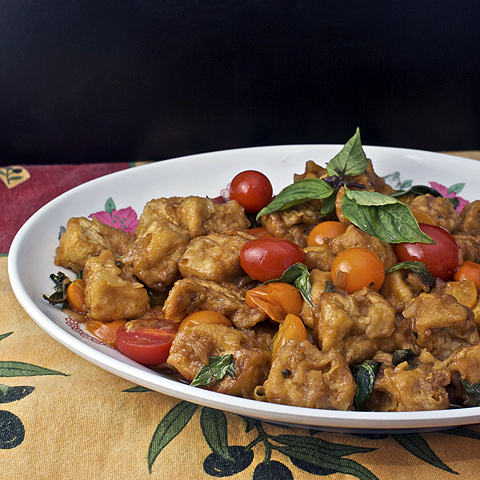

Tofu with Tomatoes and Thai Basil

4 or 5 blocks of Chinese tofu (approx. 4" x 4" x 1")
2 cups of cherry tomatoes, larger ones slice in half, smaller ones left whole
1/2 cup of Thai basil leaves
1/4 cup minced shallots
3 cloves of garlic, minced
scant 1 cup of water
2 TBS soy sauce
1 TBS rice vinegar
2--3 tsp sugar

1/2 cup all-purpose flour
1/4 cup rice flour
2 TBS corn starch
1/2 tsp salt
water

oil for frying

Cut the tofu in 1/2-inch to 3/4-inch cubes.  Drain on paper towels.  Make a batter by mixing together the flours, corn starch, salt, and water in a bowl until the consistency of heavy cream.

Heat oil to the depth of 1 1/2 inches to 350º F in a wok or other vessel. Working in batches, dip the cubes of drained tofu in the batter and then gently fry in the hot oil, stirring to keep the pieces from sticking together.  Each batch should take about two minutes to produce golden brown cubes that retain custard-like centers.  Remove the fried cubes and drain on paper towels while frying the rest of the tofu.

Remove all but several tablespoons of oil from the wok.  Fry the shallots and garlic until just softened.  Add the cherry tomatoes and fry for a minute or two.  Mix together the water, soy sauce, vinegar and sugar.  Taste and adjust for a sweet/sour/salty tang.  Add this to the tomatoes and shallots and increase the heat so the mixture is boiling vigorously.  After the mixture has reduced some, stir in the tofu.  When the liquid is absorbed and the tofu is heated through, stir in the basil leaves.  Remove from heat and serve.


Thursday, August 23, 2012

Zucchini Ratatouille Roll-Ups


While I don't derive pleasure from killing any living beings, I do derive pleasure from their deaths.  This is true for anyone who eats of the flesh.  Were I a nobler human being, one further along on the path to transcendence, I suppose I would be a vegan and eschew all animal products.  Let the bees enjoy their honey!  Let the foxes eat the hens eggs!

Alas,  I am but a base creature who savors the flesh of other creatures.  Smoke the bees out of their hives and harvest their combs.  Break those eggs and fix me a frittata.  Flay that beast so that I may have a belt and shoes.  Much as I might wish I were more enlightened, I am borne with the desire for blood and marrow. 

I have evolved enough that I do not insist on animal sacrifice for every meal.  I am a big fan of dairy products, but they need not be present in every dish.  Fresh, seasonal vegetables properly prepared are no less satisfying than a well cooked piece of meat.  Salt and pepper tofu is not better than salt and pepper shrimp, but can be as delicious.  In summer in northern California we are blessed with an abundance of great produce.  This appetizer takes advantage of the local bounty.


Having recently received some wonderful zucchini, Japanese eggplant, and tomatoes from a former colleague who has been forced into retirement by an adult education program managed by a mean-spirited and vengeful drunk, I decided to try these out.  The filling is not a true ratatouille, but a simple sauté of the vegetables you would find in one.  Unless you possess amazing knife skills, a mandoline is needed for slicing the zucchini.  The zucchini are grilled, allowed to cool, and then rolled around a spoonful of the sautéed vegetables.  The end result is a tasty appetizer packed with the flavors of summer.


Zucchini Ratatouille Roll-Ups

1 medium size zucchini
1 large red pepper
1/2 yellow onion, peeled, finely chopped
3-4 tomatoes
2-3 Japanese eggplant, chopped into a small dice
1 clove of garlic, peeled, minced
3 TBS olive oil
salt, to taste
1/2 tsp --1 tsp herbs de provence
chives (I used garlic chives because I had them in) blanched and drained
finely julienned fresh basil (optional)

With a mandoline, slice the zucchini lengthwise into pieces about 1/8" thick.  You will have some odds and ends of zucchini leftover.  Cut these into a small dice and reserve them.  Brush the zucchini slices with olive oil and grill on a medium hot grill 4 to 5 minutes.  You don't want to overcook these, but you do want to have good grill marks on at least one side.  Remove from the grill and cool.

Char the pepper on the grill.  When the skin is blackened on all sides, place in a bowl and cover with plastic wrap for fifteen minutes or so.  Rub the charred skin off the pepper.  Cut the pepper into a small dice.

At the same time the pepper is on the grill, char the tomatoes.  They will probably take less time.  Peel and chop into small dice.

Heat the olive oil in a sauté pan.  Add garlic and onions and cook until softened, but not browned.  Add the eggplant and continue cooking until softened. Stir in the reserved zucchini bits.  Add in the diced peppers and tomatoes along with the herbs de provence, season to taste with the salt, and simmer over a low heat until almost all of the liquid is cooked off and you have this wonderful ratatouille jam.  Remove from the heat and let cool.  If you like, julienned basil is a nice addition.

Take a heaping teaspoonful of the vegetable mixture and place on the wide end of a zucchini strip.  Roll up and secure the roll by tying it with a blanched chive.  These can be made several hours before serving.  Serve at room temperature.

Obviously, this recipe is very flexible.  Use what you like and adapt it to your taste. I got nine slices out of the zucchini.  There was more filling, but I ended up just eating that by the spoonful.


Friday, August 17, 2012

Steamed Silken Tofu with Ginger, Green Onions, and Cilantro


It might seem odd that after spending much of the summer in Kediri, self proclaimed Kota Tahu (Tofu City) in Indonesia, that one of the first things I cooked upon returning to the States was this silken tofu dish, but this is not something you generally find in Indonesia.  I first tasted something like this dish some years ago in Kuala Terengganu in Malaysia. Tjing and I were at a rather unassuming Chinese restaurant and decided to give it a try.  It was a surprising burst of flavor against the backdrop of the silken tofu.  I have never come across the dish at any other restaurant.  Web searches have been fruitless as well.

When Andrea Nguyen's Asian Tofu came out, I eagerly purchased it hoping to find a recipe for the dish in it.  Alas, although her book has many delicious recipes (and the silken tofu I used in this recipe is made following her directions), it doesn't have this recipe in it.  She has several recipes using silken tofu cold, but nothing like that dish we had in KT. 

Actually, this is similar to the Chinese way of steaming fish.  The tofu is steamed and then sprinkled with finely julienned ginger and green onions, sprinkled with a vinegar-laced soy sauce dressing and chopped cilantro, and then drizzled with smoking hot peanut oil.  The oil flash cooks the herbs and adds a richness to the tofu.  This is one of those dishes meat eaters and vegans can both enjoy.  Indeed, this is one of those dishes that could actually get meat eaters to concede that a vegan diet might be possible, were all vegan dishes this tasty.


Silken Tofu with Ginger, Green Onions, and Cilantro

1 block of silken tofu, sliced into 1-inch thick rectangles
4 tsp kecap manis
4 tsp black vinegar
3 tsp soy sauce
1 inch piece of young ginger, peeled and finely julienned
2 green onions, cut into 2-inch lengths, finely julienned
1/2 cup cilantro, roughly chopped
1 tsp sesame oil
2 TBS peanut oil

Place the tofu on a plate, place half the ginger and green onions on top and steam for 8 minutes.  

Drain accumulated liquid from the plate.  Mix together the kecap manis, vinegar, and soy sauce.  Pour this mixture over the steamed tofu.  Sprinkle the remaining ginger, green onion, and the chopped cilantro on top.  Heat the peanut oil in a small pan until it is smoking.  Add the sesame oil and then drizzle this over the tofu dish.  Serve with steamed rice.

Friday, April 16, 2010

Potato Rendang


One of my favorite Indonesian dishes is beef rendang.  I've posted previously about the first time I had rendang in Indonesia, and what a revelatory experience that was.   There is truly something magical about homemade rendang in Indonesia.  Although I think I dish up a very decent rendang myself, it's not the same as rendang made with fresh coconut milk.  Even when using canned coconut milk, rendang is not a fast food; it takes time.  Like risotto, it cannot be rushed.  But for those willing to put in the time, the payoff is worth it.


In Indonesia I had beef rendang on a fairly regular basis, and had had chicken rendang a few times.  As I mentioned before, the first time I had rendang it had liver as well as beef.  However, that first plate of rendang was so delicious I didn't mind the liver (terribly). While I had rendang somewhat regularly, in all my time in Indonesia I never had potato rendang.  I thought the recipe odd when I came across it in James Oseland's Cradle of Flavor.  Why make rendang without some meat?  It seemed wrong.


My wife also thought it seemed wrong.  "Put some shrimp in it.  Put some chicken in it. Where is this recipe from?  I've never heard of such a thing!"  My wife is from Kediri, also known as Kota Tahu--Tofu City.  She and our niece tried to persuade me to add some animal protein to the dish.


I held out against adding meat.  As much as I savor the cooked flesh of sentient beings, there are times I think it doesn't add to a dish.  There are times when less is more.


Potato rendang is a dish that requires no meat.  There is a richness to it, an expansiveness, that transports it beyond a simple potato curry.  It's remarkable how the rendang base, which is very close to the base used in beef rendang, infuses the potatoes with an other worldly piquancy. 


I served these potatoes with stir fried pea shoots and rice.  Although it might seem odd to most westerners to serve rice with potatoes, the rice helps tame some of the chili heat of the dish.  The greens help balance the richness of the rendang.  While I resisted my housemates call for meat, this would make a nice side to some simple roast chicken or a grilled pork tenderloin. Because of the time it takes to cook rendang, I doubled the recipe that is in Oseland's book.  I also added a few kemiri.  People who shy away from spicy food might want to cut back on the number of chilies. 


Potato Rendang
adapted from Cradle of Flavor

3 pounds of baby yukon gold or fingerling potatoes (about 1-inch in diameter)
40 ounces of coconut milk
3 stalks of fresh lemongrass, white and pale green parts only, chopped
8 shallots (about 6 ounces) chopped
4 cloves garlic, chopped
8 fresh red chilies, stemmed, seeded, and chopped
10 fresh green, or green and red, Thai chilies, stemmed, seeded, and chopped
4 tsp fresh turmeric, peeled and chopped  (or 3 tsps ground)
1/4 cup  fresh ginger, peeled and chopped
3 TBS fresh laos, peeled and chopped
4 kemiri (candlenuts, optional)

5 daun salam leaves (optional)
4 to 6 stems fresh kemangi (preferred), or Thai basil
1 1/2 tsp kosher salt
peanut oil, as needed

First, reduce the coconut milk slightly by simmering over low heat for about 15 to 20 minutes.  Oil from the coconut milk should begin to appear on the surface.

While reducing the coconut milk, make the spice paste.  In a small food processor, mix together the lemongrass, shallots, garlic, chilies, turmeric, ginger,  laos, and kemiri.  Pulse until you have a smooth paste.  There should not be any large chunks of any of the spices.  If there are, continue to pulse, adding a tablespoon or so of the coconut milk to facilitate the process.

Add the spice paste, salam leaves, and kemangi to the simmering coconut milk and stir to combine.  Allow to simmer uncovered, stirring occasionally to prevent the bottom from scorching, until the liquid has reduced by about half.  This could take from 45 minutes to over an hour.  Be patient and don't try to rush it by cooking at too high of a heat, for this will cause the coconut to boil and possibly separate and curdle.

While the coconut milk is simmering, wash and scrub the potatoes. Cut them about half way through to allow the flavors from the rendang base to penetrate. 

After the coconut milk has reduced by about half, add the prepared potatoes and salt to the mixture, and stir well.  Cook the potatoes in this  liquid until the liquid  has reduced and become thick.  Stir often to keep the potatoes and liquid from sticking to the bottom of the pan.  It will probably be necessary to add a little peanut oil  as the paste becomes thicker. 

Reduce the heat to low and saute the potatoes in the rendered oils and fats, stirring frequently.  You really need to pay attention at this point and continue to cook until the paste turns a rich, fairly dark brown.  It does not become as dark as beef rendang, but it is not too light either. 

Oseland recommends allowing the dish to rest at least 30 minutes before serving to allow the flavors to intensify. Bir Bintang in a glass with a large chunk of ice would be the perfect accompaniment to a meal with these potatoes.

Sunday, February 28, 2010

Salt and Pepper Tofu


My wife and I are suckers for salt and pepper dishes. Any time we go to a Chinese restaurant for dinner, we have at least one salt and pepper dish. Although we both prefer shrimp, our niece is allergic to seafood, so we usually order salt and pepper spareribs. These are easy dishes to put together, consisting of a deep fried main ingredient that is later tossed with a stir-fired blend of minced shallots, garlic, ginger and peppers before getting a liberal sprinkling of a salt and szechuan peppercorn mixture.


The szechuan pepper and salt mixture is simply a two to one mixture of kosher salt to szechuan peppercorns. Heat the mixture in a skillet or wok over medium heat until you begin to smell the peppercorns. Cool the mixture and grind until you have a fine blend. Make enough so you don't have to make it each time you make a salt and pepper dish, but not so much that it loses its freshness. A 1/4 cup of salt and 2 tablespoons of peppercorns will make enough for 4 to 6 dishes.


Making salt and pepper tofu is a three stage process. First, cut the tofu into approximately 1/2-inch cubes. Allow the cubes to drain on paper towels for half an hour before deep frying them in batches, stirring to keep the cubes separate.

After removing all but two or three tablespoons of oil from the wok, briefly stir fry the shallot, garlic, ginger and chile mix until fragrant and beginning to soften. The blend can be varied to personal taste and preference. I like to use about a half cup of minced shallots (three to four) with a tablespoon and a half each of minced garlic and ginger. I adjust the amount of chiles I add according to their heat and who I'm cooking for. I might also add green onions, cut to 1/2 to 1-inch lengths if I have some fresh ones on hand.


As soon as the shallots begin to soften, stir in the tofu and mix thoroughly. Turn off the heat and add about 1 1/2 tablespoons of the szechuan pepper and salt mixture, stirring well to ensure even distribution of the ingredients. Serve with steamed rice.

I'm submitting this recipe to Weekend Wokking, a world-wide food blogging event created by Wandering Chopsticks to celebrate the multiple ways we can cook one ingredient. The host this month is Kits Chow. If you would like to participate or to see the secret ingredient, check who's hosting next month.

Saturday, January 23, 2010

Dau Hu Chien Sa--Fried Tofu with Lemongrass


The first time I tasted this dish, I was working on Pulau Galang, an Indochinese refugee camp in the Riau province in Indonesia. After it first appeared among the dishes in the staff dining hall, it became a standard that was served several times a week. Not only was it delicious, but it was cheap and popular with all the staff.

When my wife and I moved to Vietnam for a year in 1993, the family we lived with occasionally made this for me when they learned how much I loved it. One of the older aunts in the house was (is) a devout Buddhist who was strictly vegetarian, and she often had this. Although I am too weak of the spirit to give up eating the flesh, were I to become vegetarian, this would be my go to dish. In fact, even now I would choose this over a grilled hamburger any day of the week.

Although this is a simple dish, it does take some time to prepare, especially if you don't have some sort of food processor. Chopping lemongrass is a chore. Chopping it finely takes a great deal of time and effort. And this dish requires a great deal of lemongrass for just four cakes of tofu.

I had tried to make this many times before I finally learned how to do it. I had always assumed the lemongrass and the tofu were cooked together. No. When you do this you end up with burnt lemongrass, and that's not a good thing. When we returned to Vietnam the summer before last, I asked our friend Phuong, whose family we had lived with, to show me how to make it. Not only did she show me, but during the several weeks we stayed with them she cooked it for us about every other day. Heaven!

This is a dish I've never found on any Vietnamese menu. I never had it in Vietnam, except at the house where we lived. I did find a recipe for it in a cookbook I found in Vietnam, but that recipe added five-spice, which I feel detracts from the dish.


Try this along with some baby bok choy stir-fried with garlic and some jasmine rice. You won't miss the meat.

Dau Hu Chien Sa--Fried Tofu with Lemongrass

5 stalks of lemongrass, tough outer layers and green tops removed
2--3 cloves garlic, finely minced (optional)
1 small red chili, seeded and finely minced (optional)
4 cakes of fresh tofu from an Asian market (if you buy tofu in plastic tubs, cut the loaves of tofu into slices a little more than 1-inch thick)
oil
salt

Heat about a half cup of oil in a nine-inch frying pan, preferably non-stick or well seasoned. Shallow fry tofu on both sides. Make four slices three-quarters of a way through, or make an X three-quarters of the way through each cake of tofu.

Finely chop the lemongrass. Pour off about half the oil. Add the lemongrass, garlic, and chili, and fry until golden and crisp. Add a slight sprinkling of salt to taste.

Stuff the fried lemongrass mixture between the "leaves" of tofu. Serve with steamed rice.

Get the flash player here: http://www.adobe.com/flashplayer

Monday, September 28, 2009

Tahu Lontong

Tahu lontong is streamed-lined gado-gado. It doesn't have the cabbage, the krupuk, the eggs and other vegetables that gado-gado has. It is simply fried cubes of tahu (tofu), blanched bean sprouts, green onions and slices of lontong in a sweet and piquant peanut sauce.

In Java, tahu lontong is frequently sold by hawkers who specialize in just this dish. It is cheap, nutritious, and tasty. This is what becak (trishaw) drivers often have for a meal during the day because it is so cheap yet also provides protein and energy.

Once you have the lontong on hand, making this dish is easy. Fry four or five cakes of fresh tofu that have been quartered. Blanch two cups of bean sprouts by pouring boiling water over them and letting them remain in the water for about 2 minutes. Then drain them. Slice three to four green onions in half-inch lengths. Toss all the ingredients together and drizzle with sambal kacang. Enjoy.
Get the flash player here: http://www.adobe.com/flashplayer

Monday, July 6, 2009

Grilled Vegetable Salad

Although there are times traditional mayonnaise based potato salads taste good to me, in general I avoid them. Too often they are uninspired conglomerations of glop, with nothing to pique one's interest or appetite. Comfort food perhaps--if your idea of comfort is a massive intake of carbohydrates, fat, and cholesterol--but unappetizing. On the other hand, grilled vegetables with cherry tomatoes in a basil vinaigrette are a Koko Taylor soul shake shout out to summer. Wang dang doodle indeed.

The inspiration for this recipe is from the Fields of Greens cookbook, a collection of vegetarian recipes that even meat-eaters can enjoy. Although I am hardly vegetarian, this is one of my favorite cookbooks. From salads to desserts, its recipes are creative, attractive, and delicious.

Grilled Vegetable Salad
Vegetables of your choice to grill
Baby new potatoes
Zucchini
Green beans, boiled 2-3 minutes until just cooked
Cherry tomatoes, halved

Wash new potatoes. Place in foil with 3 to 4 peeled cloves of garlic and 1/4 cup of oil. Close foil packet and cook on grill over indirect heat for about 40 minutes. Open packet, remove potatoes and slice in half when cool.

Slice zucchini in half lengthwise. Brush zucchini and potato halves with reserved oil from potatoes. Grill over medium-high 3 to 5 minutes until just cooked but still firm. Cut zucchini into 1 to 2 inch pieces.

Combine grilled vegetables with green beans and cherry tomatoes. Pour basil vinaigrette over and turn vegetables gently to cover evenly. Plate and serve.

The salad can be served warm, at room temperature, or chilled.

Basil Vinaigrette

6 TBS extra virgin olive oil
2 TBS rice wine vinegar (Fields of Greens calls for champagne vinegar)
1/2 cup fresh basil leaves
1/2 tsp salt
1 clove of garlic, coarsely chopped

Put all ingredients in a blender and puree until smooth.

Thursday, May 21, 2009

Pepes Tempe (Tempeh paste steamed and grilled in banana leaves)


With all the recent posts on tempeh, you'd think I was vegan or something. Not that there's anything wrong with that. However, I like meat. Fish, flesh, and fowl. And I like butter, eggs, and a gamut of dairy products. It's just that I also really like tempeh (and tofu) and have had some in that had to be used up, so I've posted about that.

I generally prefer my tempeh fried. Thick or thin, marinated in garlic, salt, and water or plain, dipped in batter or naked, I like fried tempeh. Frying transforms the tempeh into a nut-like substance. The texture and taste of fried tempeh makes it the perfect side to an Indonesian meal.

In Indonesia there is a large variety of pepes, packets of steamed, then grilled pastes or meats that have been rolled in banana leaves. Banana leaves are an essentially free resource for packaging the pastes, and steaming the packages before grilling them makes them relatively easy to prepare in advance and grill at the last minute for the vendors who sell them. Chicken, fish, shrimp, tofu, and mushrooms are some of the common fillings for pepes.

The recipe I followed was adapted from The Book of Tempeh. Don't worry about the banana leaves getting burnt; they are wrapped in two pieces of banana leaf ensuring the paste gets grilled without burning.

Pepes Tempe


11 shallots
1 tsp sambal oelek
1 small red bell pepper
13 kemiri (candlenuts), available in Asian markets
15 ounces of tempeh, cut in 3/4 inch cubes
1/4 cup coconut milk
3/4 cup to 1 cup kemangi leaves (lemon basil, may use Thai basil I suppose)
2 tsp salt
2 tsp dark brown or palm sugar

1 package of banana leaves (available in freezer of most Asian markets)

Process shallots, sambal oelek, pepper and kemiri to a paste in a food processor. Add remaining ingredients and pulse briefly to combine.

Pour boiling water over the banana leaves to clean and soften them. Cut leaves in 10 nine-inch squares and 10 four-inch squares.

Center a small square of banana leaf on a larger square of leaf. Place about a half cup of the paste in an oval on the small square. Roll up the leaves together and secure with toothpicks on both ends. The sausage shaped package should be about an inch thick. Steam the packets for 10 minutes, and then grill for another ten minutes until the banana leaves are charred. Serve in the leaves. Have something handy to discard the leaves as the packages are opened.

Saturday, May 16, 2009

Kripik Tempe -- Tempeh Crisps


Having made some tempeh, I now need to use it. Tempeh is something that doesn't have a real long shelf life. Perhaps if you vacuum packed it, it might last for some time in the refrigerator. Of course, you could always freeze it, but if you go to the trouble of making your own tempeh it seems to me that you might as well eat it fresh. It is good simply marinated in a little garlic, coriander, salt and water for fifteen minutes or so and then fried. Frying brings out its nuttiness and makes it an excellent addition to gado gado.

Seeing how it is the weekend and the heat has finally arrived in the valley with temperatures approaching 100º F, I decided to make some kripik tempe. These are a perfect accompaniment to a gin and tonic, margarita, mojito, or the drink of your choice. They have the lusciousness of being fried, yet they are high protein and high fiber. Like all things fried, they are best when still hot from the fryer, but they still taste good when they are served at room temperature.

When I lived in Jakarta, I used to buy these and fried tofu from a man with a pushcart fryer at the end of my lane and take them back to my house to enjoy with my evening drink while listening to the call to prayer. There was a small mosque at the end of the street and its loudspeakers always let me know when it was time to pray. Inasmuch as I've never had much reverence for any religion, I always found it very satisfying to indulge in my vices while others more virtuous than I performed their religious duty. Try these and you may be closer to understanding William James' The Variety of Religious Experience.

Kripik Tempe
1 block of tempeh, sliced no thicker than 1/8 inch
1/2 cup rice flour
1/2 cup coconut milk (or water)
1/2 tsp coriander, ground
1 clove of garlic, ground in a mortar to a paste
1/4 tsp turmeric
1/4 tsp salt
4 kaffir lime leaves, thick center vein removed, thinly sliced
oil for frying

Dry the slices of tempeh in the sun for fifteen to 30 minutes. Make a thin batter of the remaining ingredients. Dip the tempeh into the batter and drop in hot oil (360º). Fry until golden brown. Drain. Serve with your favorite drink.

Sunday, May 10, 2009

Tempeh Kering


Ok, you've made your tempeh, now what? One dish that is popular with the Javanese is tempeh kering--a sweet/savory dish that is like eating sticky, spicy candied pecans. Besides tempeh and laos (galingal--a relative to ginger that is used in a lot of Indonesian and Thai dishes), tempeh kering has chilies, shallots, garlic and tamarind, along with a load of palm sugar. By itself it would probably be too sweet for most palates, but it is a very pleasing complement to other Indonesian dishes. The central Javanese are known to have a particular fondness for sweet dishes, and this is a dish that one can readily find at rumah makans in Central Java.


Tempeh Kering
Approximately 14 ounces of tempeh (one block of the homemade tempeh), sliced into pieces 2" x 3/4" x 1/3"
2 cloves of garlic, thinly sliced
2--4 shallots, thinly sliced (shallots in Asian markets tend to be smaller)
1 TBS tamarind concentrate in 1/2 cup water
4 red chilies thinly sliced
5--9 TBS gula jawa (palm sugar), you can substitute dark brown sugar, but it's not quite the same
3--4 quarter size slices of laos (galingal)
several daun salam (salam leaves)
1/2 tsp kosher or sea salt
oil for frying

Fry the tempeh slices in several batches. Each batch takes about 3 minutes or so. Make sure the oil isn't too hot or you'll burn the outside of the tempeh while the inside will remain soft. You want a uniform crispness. Drain and set aside

Pour off most of the oil. Fry garlic and shallots over low heat until softened but not browned.

Add chilies and sugar. Fry until sugar is melted. (Gula Jawa is sold in cylindrical
packages. Although it is solid, it should still be soft and fairly easy to slice into coins. I didn't have any gula jawa in when making this recipe and used Mexican palm sugar, piloncillo, which is much harder. I dissolved this in the water for the tamarind in the microwave and then added to the chilie, shallot mixture.)

Add tamarind water, laos slices, daun salam and salt. Reduce the liquid until it is syrupy and fold in the fried tempeh. Serve with rice and other dishes.

Saturday, May 9, 2009

Tempeh


Until I first went to Java in 1983, I had never tasted tempeh. I hadn't even heard of it. I had eaten tahu (tofu) of course, and even cooked with it at times, but tempeh was a totally new experience for me.

I can't recall the first time I had it. I'm sure it was probably while I was dining at the company mess (dining hall), as a part of nasi rames. In Java tempeh finds its way into meals the way potatoes do here in the US. It may be fried or boiled in sauce, with vegetables, meat, or by itself, but it almost always finds itself somewhere on the table. And that is a good thing.

Tempeh is the Barry Bonds of soy products, but you don't have to worry about any asterisk next to its stats. It is legit. Tempeh is 20% protein by weight, the same as steak, and two and a half times as much as tofu. Sometimes disparaged by the shopping mall middle class of Jakarta as poor people's fodder, tempeh is elemental and worthy of reverence. Ironically, while it is considered poor people's food in Indonesia, here in the US it can cost as much as an Angus ribeye. In local Asian markets thin blocks of it can sometimes be found in the freezer section. Whole Foods and the local co-op sell it fresh--plain, Cajun spiced, and terriyaki flavor among the varieties offered--but these too are in small, thin eight to twelve ounce packages. While I'm sure many of these taste fine once they are fried or sauced, none taste to me as tempeh should. Good tempeh--to my taste--should be almost like a ripened cheese. There should be a sweet nuttiness to a raw slice of it.

The process of making your own tempeh is time consuming, but not difficult. If you're planning on having tempeh for dinner tonight, you better head over to your local organic foods store to pick up a slab now. Tempeh making follows the rhythm of Javanese gamelan, slow, repetitive, rather than the more frenetic gamelan of Bali. Plan ahead and you will enjoy a treat akin to a fine artisanal cheese. Once you have successfully made your own tempeh, store bought will seem like Wonder Bread.

The bible for tempeh and tempeh making is The Book of Tempeh, by Shurtleff and Aoyagi. It is truly a phenomenal book in its clarity and abundance of information related to tempeh. I can't say that I've tried many of the western recipes in the book, but the Indonesian ones (approximately 70) are authentic with very clear instructions. The directions for actually making tempeh at home are also very clear and easy to follow. The directions I am providing are simply a condensed version from the book. Anyone who enjoys tempeh should really get the book.

Homemade Tempeh

1 pound of dried soy beans
15 cups water, divided
1 TBS rice vinegar

Tempeh starter (choose one)
1 tsp extended spore-powder
or
1/4 tsp spore-powder mixture (I use this, but am able to get it from family in Indonesia)
or
1/2 tsp meal-texture starter
or
2 ounces fresh tempeh

2 quart size plastic bags, perforated with a toothpick every 1/2 inch or so, puncturing both sides of the bags

Bring soybeans and 7 1/2 cups of water to boil in medium pot. As soon as water comes to a boil, remove from heat, cover, and set aside for 12 hours or so.

Pour off the water from the pot, then rub soybeans between hands to remove hulls. This takes quite a bit of time. You want to remove as many hulls as possible. Fill the pot with water and float off the hulls as best you can. This will probably take a good fifteen--twenty minutes and several pots of water.

When you've removed as many hulls as possible (or until you've decided enough is enough), add the remaining 7 1/2 cups of water along with the vinegar to the soybeans in the pot. Bring to a boil and cook uncovered at an active boil for about 30 minutes.

Drain the cooked soybeans in a colander and spread on a paper towel-lined baking pan. Let cool to about body temperature, blotting dry with paper towels (or use a fan to speed the process as I did the other day when I realized I was otherwise going to be late for class).

Sprinkle your starter over the cooled beans and mix well.

Place the beans in the perforated bags. I like a thickness of an inch to an inch and a half. Place the bags in a stable, moderately warm environment (the book explains how to make an incubator--I just place them inside my oven, but don't forget they're there) and wait.

Shurtleff and Aoyagi say it will take about 22 to 28 hours at 86º to 88º F. I find that it takes 48 hours or more in my oven (where the temperature is probably around 70º or so most of the year). As the tempeh blooms, it begins to generate its own heat, so the temperature in the oven actually does get into the mid to high eighties. I would recommend some sort of incubator if you live in an area where temperatures are more extreme.

When the tempeh is completely covered by a soft white blanket of mold, it is ready. The brick of tempeh will be warm to the touch and there will be beads of moisture in the bags. Slice a piece from the slab and you should find each bean is cocooned in a pillowy cloud of the white mold. Try a slice or two raw, alone or paired with a slice of apple, and you will begin to understand why tempeh is so popular with the Javanese.