Showing posts with label tomatoes. Show all posts

Thursday, September 25, 2014

Stuffed Bitter Melon in Tomato Sauce

Bitter melon is an aptly named vegetable that is said to be an acquired taste.  Who acquires this taste, I have no idea.  To me it seems this is either a taste you have a natural affinity towards, or it is one that you may grow to tolerate but never truly acquire.  There are techniques to lessen the bitterness, but nothing will totally eliminate or disguise it.  An aspirin ground with a quinine malaria pill is how it tastes to me, but my wife loves it.  And so……

Often, stuffed bitter melon is served in a soup.  Indonesians stuff it and simmer it in coconut milk. I had been thinking it might be good finished in a tomato sauce like the Vietnamese sometimes do with cabbage rolls or tofu puffs, and then I came across a recipe in The Hakka Cookbook by Linda Lau Anusasananan that suggested just that, saying that the tomatoes helped soften the bitterness.

There are many suggestions on how to reduce the bitterness in bitter melons, but whatever method you use will not make them entirely lacking in their characteristic quality.  After coring them and slicing them into 1/2-inch rounds, I salt them with kosher salt and let them stand for at least half an hour.  After this, they should be rinsed and drained before they are stuffed.


The stuffing is equal parts ground pork and minced shrimp mixed with chopped green onion, ginger, garlic, finely diced carrots, and salt.   For four bitter melons, I used about ten ounces each of pork and shrimp.  This is something that comes down to personal taste, so put more ginger in if you're fond of ginger, or leave it out if you don't like it. 

Once they are stuffed, brown them in a hot frying pan lightly coated with oil.  After they have been browned on both sides simmer in the tomato sauce in a covered pan for about twelve minutes, until the melon slices are tender.

The tomato sauce is simply equal parts chopped tomatoes and water seasoned with a couple tablespoons of fish sauce and sugar.  Anusasananan's Hakka recipe uses oyster sauce instead of fish sauce, so that's another option.  This strikes me as very much a home comfort food recipe that is open to tinkering to adjust to each family's taste.  It's not a fussy dish, so give it a try and feel free to adjust it to your own tastes.


Thursday, June 20, 2013

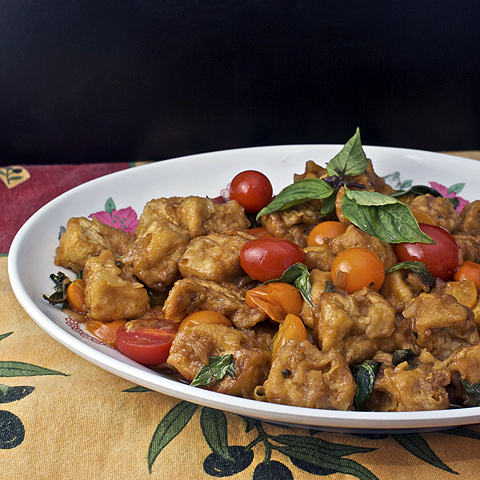
Tofu with Tomatoes and Thai Basil


With several eyes of round curing for some bresaola and some freshly sliced coppa sitting in my refrigerator, I can hardly be confused for a vegan.  I am a creature of the flesh and enjoy eating meat on a fairly regular basis.  At the same time, I enjoy tofu and tempe.  While the bresaola is curing in the fridge, I have a batch of tempe coming together in the oven (off, with the oven light on).  I'm complicated.

Actually, I am a slave to taste.  If something tastes good, I'll eat it.  While I admire  vegetarians and  vegans for their adherence to a diet that does without meat or animal products, I savor the taste of grilled pork and a succulent piece of brie.  Although fish sauce was foreign to my childhood, my enjoyment of life would be lessened without it.  The same with tofu and tempe.  My first tastes of tofu were probably as a dish that would be good for me, and I was underwhelmed.  It wasn't until I experienced it in refugee camps in Malaysia and living in Indonesia that I came to appreciate tofu.  That my wife is from Tofu City (Kediri) in Indonesia may be another reason for my fondness for tofu.  Tempe is probably unfamiliar to most Americans, and that is a shame.  What's worse is that most will only taste the health food type of tempe that is commonly available in the United States.  Javanese tempe is simple and exquisite.  It is the protein of the masses in Indonesia, and a good piece of tempe is every bit as ambrosial as that buttery piece of brie.


I can understand vegetarians and vegans abhorrence for meat.  As much as I might enjoy a quivering steak fresh off the grill, they view it as a moral abomination; I get that.  It's not going to make me enjoy my steak any less, but I understand how disgusted they may be by my choice.  Perhaps there's a Hell where pigs will be grilling pieces of my flesh on a spit, flames rising and dancing from the dripping fat. Oh well.

What I can't understand is how animated some meat eaters get about vegetarians and vegans.  They refuse to eat vegan dishes on principle.  Indignant perhaps that vegans would have them sentenced to Hell, they denounce the trappings of veganism as righteously as fundamentalists of one religion decry another.  "I'll eat a salad as a side, perhaps, but forget that tofu."  Tofu is viewed as an inferior meat, a poseur, and vegetarians should accept some of the blame for this in that too often tofu is used as a meat substitute.  However, if you appreciate tofu for what it is, a velvety flavor sponge, you can enjoy it just as much as that grilled steak. 

For vegans, vegetarians, and gastronomic agnostics, this is a wonderful dish.  You could spice it up by adding some minced chilies, but even without the chilies it is full of flavor.  For a variation, you can use nuoc cham (fish sauce with lime, garlic, and chilies) in place of the soy and vinegar based sauce in this recipe, but then it would no longer be a vegetarian dish. 


Tofu with Tomatoes and Thai Basil

4 or 5 blocks of Chinese tofu (approx. 4" x 4" x 1")
2 cups of cherry tomatoes, larger ones slice in half, smaller ones left whole
1/2 cup of Thai basil leaves
1/4 cup minced shallots
3 cloves of garlic, minced
scant 1 cup of water
2 TBS soy sauce
1 TBS rice vinegar
2--3 tsp sugar

1/2 cup all-purpose flour
1/4 cup rice flour
2 TBS corn starch
1/2 tsp salt
water

oil for frying

Cut the tofu in 1/2-inch to 3/4-inch cubes.  Drain on paper towels.  Make a batter by mixing together the flours, corn starch, salt, and water in a bowl until the consistency of heavy cream.

Heat oil to the depth of 1 1/2 inches to 350º F in a wok or other vessel. Working in batches, dip the cubes of drained tofu in the batter and then gently fry in the hot oil, stirring to keep the pieces from sticking together.  Each batch should take about two minutes to produce golden brown cubes that retain custard-like centers.  Remove the fried cubes and drain on paper towels while frying the rest of the tofu.

Remove all but several tablespoons of oil from the wok.  Fry the shallots and garlic until just softened.  Add the cherry tomatoes and fry for a minute or two.  Mix together the water, soy sauce, vinegar and sugar.  Taste and adjust for a sweet/sour/salty tang.  Add this to the tomatoes and shallots and increase the heat so the mixture is boiling vigorously.  After the mixture has reduced some, stir in the tofu.  When the liquid is absorbed and the tofu is heated through, stir in the basil leaves.  Remove from heat and serve.


Tuesday, September 20, 2011

Cherry Tomato Clafoutis


I first encountered Patricia Wells while working in Sungei Besi refugee camp in Malaysia.  Having little else of interest to read, I would read every inch of the International Herald Tribune, including the financial news and coverage of test cricket, two subjects I remain woefully ignorant of.  Patricia Wells' articles came out once or twice a week as I recall. 


While almost all the writing in the paper was of a very high standard--even the cricket coverage could be compelling--I particularly enjoyed Wells' articles.  Mostly reviews of Parisian eateries, her writing was informative and informed.  When she praised a particular chef's handling of bouillabaisse, she placed it within the context of other chefs' treatment of the dish, not only pointing out the differences, but explaining why each chose the approach they did.  It was obvious when reading her that Wells had a great knowledge of and keen passion for the food she wrote about.  Living on a $500 a month salary, working in a rather bleak refugee camp on the outskirts of Kuala Lumpur, I found myself transported to the bistros and restaurants Wells assayed in her articles.


Although I tend to cook mostly Asian food and thus my collection of cookbooks skews towards recipes from those countries, I do have a handful of other cookbooks I enjoy.  For French and Italian food I am partial to Wells and Joyce Goldstein.  Both authors not only write clear, tasty recipes, but also include information on the background of the dishes and useful tips along with a clean prose style.  I have seldom been disappointed in any of the recipes I have tried from either of these authors.


Having stopped by the Mien strawberry stand down the street from my house, I discovered they had these brilliant jewels of cherry tomatoes little bigger than peas.  Once I saw them, I decided I'd have to find a way to use them.  This recipe for cherry tomato clafoutis is adapted from Wells' recipe for tomato clafoutis from Patricia Wells at Home in Provence.  Larger cherry tomatoes would work just as well--and be a lot less time consuming when halving and salting.  Wells recipe (which I halved) calls for baking the clafoutis in a 10 1/2-inch round baking dish. 


1 1/2 cups cherry tomatoes, halved
fine sea salt
1 large egg
1 large egg yolk
3 TBS heavy cream
1/4 cup freshly grated Parmesan cheese
1 tsp fresh thyme leaves

Preheat the oven to 375º F.

Place the halved tomatoes in a colander, cut side up.  Sprinkle them with the salt.  Set aside for 30 to 60 minutes to allow the salt to draw the liquid from the tomatoes.  Then place the tomatoes in a bowl lined with paper towels. 

In a small bowl, bet together the egg, yolk, cream, half the cheese, and half the thyme leaves.

Divide the tomatoes between two four-inch ramekins.  Pour the batter over the tomatoes.  Top with the remaining thyme and cheese. 

Bake in the oven until the batter is set and the clafoutis is golden.  Serve warm or at room temperature. 


Tuesday, August 23, 2011

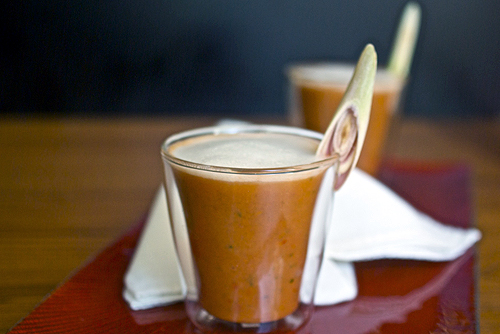
Gazpacho with Lemongrass Foam

Perhaps influenced by my stint in Kediri during Ramadan, I got to thinking about what would be a nice way to start off a summer meal, to break the fast if I were fasting.  Although I have what some would say is  a strange aversion to cucumbers, I do enjoy a good gazpacho.  And this is one soup that almost cries out for an Asian touch.  Lemongrass has a natural affinity for tomatoes, but getting the flavor without the fiber of the stalks is problematic.  One approach would be to infuse some oil with lemongrass.  I decided to take a different path.  Using some soy lecithin, I made a foam which I floated on the surface of the gazpacho.  This resulted in an ethereal touch of lemongrass that nicely complemented the gazpacho but did not overwhelm it.

 Summer is a great time to visit the farmers market in Sacramento.  Besides an abundance of stone fruits such as peaches, nectarines, and plums, there are also all the summer vegetables.  The variety of tomatoes now available is astounding, and I decided to use some of those in this gazpacho.  Happening upon some vibrant purple bell peppers, I chose to include those in the soup as well.  Unfortunately, they didn't add much to the appearance of the gazpacho, and I didn't think they tasted quite as good as regular bells.  The kaffir lime leaves which are from a tree we have growing in our back yard were a nice addition to the mix. Kalamansi limes spark the soup with a dash of zing.


(makes approximately 6  four to six ounce servings)

1 1/4 pounds of vine-ripened tomatoes (I used a mix of red and green zebras)
2 purple bell peppers, seeded and chopped
1 persian cucumber, seeded and peeled
2 shallots, peeled and chopped
1 to 2 cloves of garlic, peeled
1/3 to 1/2 cup olive oil
1--2 TBS rice vinegar
juice of 3 kalamansi limes
4 kaffir lime leaves, center vein removed, finely chopped
1 hot chile, seeded and chopped
salt and pepper to taste

3/4 cup water
two stalks of lemongrass, pale whitish bulb only, chopped
1 TBS lecithin

To make the gazpacho, quarter the tomatoes and press the seeds into a coarse mesh strainer set over a bowl.  Put all the ingredients into a blender.  Add the liquid collected from the drained seed pulp.  Puree the mixture and chill in the refrigerator.  

To make the lemongrass foam, puree the lemongrass and water in a blender.  Allow to sit for at least several hours before straining the lemongrass from the liquid.  Chill the liquid and add the lecithin.  Using a stick blender mix the liquid until a light froth forms on the surface.

To serve, pour the gazpacho into four to six ounce glasses and spoon on a layer of the lemongrass foam.


Sunday, August 29, 2010

Tomato and Olive Focaccia

After spending most of the summer in Indonesia, I have had  a longing for some good bread.  While Indonesia has great food, its bakeries are weak.  Indonesians tend to favor over-processed, Wonderbread-like fluffy baked goods.  Despite this, or perhaps because of it, toast (roti bakar) is a popular street snack, something I never could understand.


Focaccia is a good antidote to the tasteless loaves of Indonesia.  This particular recipe, from Saveur, produces a crisp bottom crust and a good crumb.  The combination of olives and tomatoes on the top is a wonderful use of local produce that captures the essence of a summer day in the central valley.  A slice of this along with a salad and you've got yourself a satisfying meal.


The recipe is from issue #120 of Saveur which I happened to pick up to read about Andrea Nguyen's account of her return to Saigon.  Saveur also has the recipe on its site. Click on Focaccia with Tomatoes and Olives to get the recipe.

Monday, January 4, 2010

Pea Shoot Soup

The last time I truly celebrated the western New Year in the manner traditionally associated with it--excessive drinking, wild partying, and lascivious lusting--was in a universe far, far away in both space and time. I was single then, with a liver that could rope-a-dope all night long. Living overseas, I didn't drive, and even better, 95% of the drivers didn't drink. Now, New Year's Eve is a night I almost dread. I fear the both the exuberance of young drunks rutting in clubs and their driving on the road. I find most of my friends are the same. We hunker in our homes now, share a nice dinner and perhaps some champagne with friends or family, and almost weep when we listen to Dick Clark trying to count down the last seconds of the receding year.

I do, however, celebrate Lunar New Year. For the last ten years I have invited family over to celebrate with a multi-course meal. It is kind of like Thanksgiving, but without the football, and with more food. It started out relatively small, with only eight or nine guests, but has grown as more relatives have moved to the area. I think there will be sixteen people this year, but that includes our godson, who is not yet one year old. In addition to the challenge of seating sixteen people in our dining area, there is the greater challenge of cooking for this many people. As I do all the cooking, I need to select a variety of dishes--with some that can be made ahead of time and served cold, others that can simmer on the stove, some that will be grilled, and still others that have to be fried at the last moment. Although there are several dishes that are always requested and reappear year after year, I try to vary the menu from one year to the next. One year I cooked only Vietnamese dishes, and other years I have done only Chinese. This year I will most likely do a few of each. (One of the benefits of being a Gwei Lo (Cantonese for ghost), Bule (Indonesian for albino--whitey), or Liên Xô (Vietnamese for Russian--that's what Vietnamese usually thought I was when I lived in Vietnam in 1994), is that I don't have to adhere to tradition. I can cook what I feel like, although my wife makes sure that the meal ends with fish.)

In the next couple of weeks running up to the New Year, which falls on February 14th this year, I will be posting some of the recipes I will be serving or am thinking of serving for the dinner. Because the cooking on the day itself is so hectic, I thought it makes more sense to present the dishes beforehand. Some of the dishes may not actually make it to the dinner menu, but most probably will. Any suggestions about dishes that I should include would be appreciated, but I don't know if they'll make it onto the menu either.

I usually don't serve soup, simply because of the logistics. I don't really have the tureens for serving that much soup. Also, we are sitting around rectangular tables rather than round ones, so serving is difficult. However, if the pea shoots are still available at the farmer's market, I may try to serve this soup this year. It's quite easy to prepare and can be finished just before serving.

Pea Shoot Soup

1 pound pea shoots, sorted and washed
4 to 6 ounces skinless, boneless chicken breast (shrimp or scallops could be substituted)
1 egg white
2 to 3 tsp cornflour
6 cups chicken stock
2 roma tomatoes, peeled, quartered, all seeds and pulp removed
salt and white pepper to taste
a few drops of sesame oil (optional)

Cut chicken into cubes and place in a food processor. Pulse until finely chopped. Add egg white, cornstarch, and a pinch of salt and process to a smooth paste.

Place teaspoons of the paste between leaves of the pea shoots. Bring stock to a full simmer. Add the pea shoots and cook for five minutes. Season to taste with salt and white pepper. Place the soup in a tureen. Arrange the quarters of tomatoes like flower petals on top of the soup. Sprinkle with a few drops of sesame oil if you wish. Serve.
Get the flash player here: http://www.adobe.com/flashplayer