Showing posts with label beef. Show all posts

Wednesday, December 5, 2012

Sop Buntut--Indonesian Oxtail Soup


Sop buntut is not my favorite Indonesian dish.  It is, however, extremely popular on Java.  It is a soup that is at once hearty and delicate, the oxtails being a rich, surprisingly fatty meat, yet the broth is light and fragrant with spice.  As with Vietnamese Pho Bo, it is the broth that is the mark of a good sop buntut.

The broth should be clear and fragrant, not muddied from simmering the ox tail.  The spices--cinnamon, nutmeg, cloves, pepper--should flavor the soup as the flute accents Sundanese gamelan.  Carrots and potatoes are included with the broth.  In most recipes the potatoes are simply added to the broth towards the end of the cooking.  I like James Oseland's method of frying the potatoes before adding them to the broth at the end.  It provides another note to the soup.

My wife, Tjing, is not much of a beef eater, but she does like sop buntut.  While oxtails are a cheaper cut in Indonesia, here in the US oxtails are relatively expensive.  I'm sure most Indonesians would consider it shocking that a kilogram of oxtails goes for around 95,000 Rp.  Considering the amount of bone and fat you get, they are definitely not a bargain.  Still, happy wife, happy life, so if Tjing wants some oxtail soup, that's fine with me.


Sop Buntut--Indonesian Oxtail Soup
(adapted from Cradle of Flavor)

2 1/2 pounds oxtails, cut into sections at the vertebrae
3 quarts water
1 2-inch piece of ginger, peeled and bruised
1 piece cinnamon stick
7 cloves
1 whole nutmeg, cracked into several pieces
1 tsp black pepper, freshly ground
1 TBS sugar
2 tsp salt
3--4 carrots, peeled and sliced on the diagonal about 1/4-inch thick
3--4 yukon gold potatoes, peeled and cut into 1-inch cubes
1--2 ripe tomatoes (I used cherry tomatoes), sliced into wedges
1 stalk of Chinese celery (seledri), finely chopped
2 green onions, white part only, thinly sliced
2 TBS fried shallots
2 TBS fried garlic slices
peanut or vegetable oil for frying the potatoes

In a large soup pot, bring the oxtails and water to a steady boil over high heat.  Use a spoon or a fine mesh skimmer to skim off any foam that rises to the surface.  After you have removed as much foam as possible, reduce the heat to medium-low and add the ginger.  Cover and simmer for about an hour.

Next, add the spices, including the sugar and salt, to the pot and continue to simmer, covered, for another 30--45 minutes.  The meat should be just beginning to come away from the bones.  Taste the broth and add salt to taste.

While the broth simmers, prepare the carrots and potatoes.  Bring a medium-sized saucepan of water to a boil.  Add the carrots and boil until just tender, two to three minutes.  Drain them in a colander and rinse with cold water.

Lightly fry the potatoes until they are light brown.  They should be just cooked through the center.  Drain on paper towels.

To serve, place some oxtail, carrots, and potatoes in a bowl.  Ladle in some hot broth.  Top with some wedges of ripe tomato.  Sprinkle with the fried shallots, fried slices of garlic, sliced green onion, and chopped Chinese celery.

Serve with rice and sambal.  Emping melinjo (melinjo crackers) are a nice accompaniment.


Friday, March 9, 2012

Sambal Goreng Printil


Sambal goreng printil is a nice dish to include when you are serving a variety of Indonesian dishes for a dinner, or to serve on its own with rice.  It can be made spicy or mild, a dish that can be adapted easily to different tastes.  In Indonesia it would include petai--a bean that resembles the fava bean, and is infamous for its effects when eaten--instead of snow peas, but finding petai in the United States is problematic.  The snow peas add a nice splash of color and your acquaintances won't be wondering if something has crawled inside you and died.

This is a relatively quick dish to prepare, taking about twenty minutes to make.  Once the meatballs are formed, it requires little more than ten minutes to cook the dish.  Slicing the shallots, garlic, and chilies instead of grinding them to a paste, as would normally be done in Indonesia, saves some time and provides a slightly different texture when eating this sambal.


Sambal Goreng Printil

1 pound ground beef
1 tsp salt
1/4 cup shallots, peeled and thinly sliced
2 cloves garlic, peeled and thinly sliced
1--2 red chilies, seeded and thinly sliced (or add sambal oelek to taste)
2 salam leaves
2 quarter-size slices of laos
1/2 tsp petis (shrimp paste)
1/2 cup coconut milk
1 tsp sugar
1--2 TBS tamarind water
2 cups snow peas, washed and trimmed
1/2 cup cherry tomatoes, sliced in half (or 2 ripe plum tomatoes, seeded and diced)
4 TBS oil, divided

Mix the ground beef with the salt.  Form into marble-sized meatballs.  Heat a wok or frying pan over medium high heat.  Add three tablespoons of the oil.  When oil is hot, brown the meatballs quickly; the interiors should still be rare.  Drain and set aside.

Pour off the fat from browning the meatballs.  Add the remaining tablespoon of oil to the pan and fry the shallots, garlic, and chilies until softened, about two minutes.  Add the salam leaves, laos, petis, coconut milk, sugar, and tamarind water together with the browned meatballs.  Cook for about five minutes, stirring to coat the meatballs with the liquid. 

Add the snow peas and tomatoes.  Cook another 3 to five minutes, stirring constantly just until snow peas are cooked.  Serve immediately.

Friday, October 7, 2011

Indonesian Red-Braised Beef Shanks


Red-cooked dishes are popular Chinese  dishes although they are not often found in restaurants in the US.  Most commonly featuring chicken or pork, the "red" stock they are cooked in is often a master stock that has been used and refreshed numerous times, becoming ever more flavorful and nuanced.  Unlike those dishes, this red-braised beef is a simpler affair, with its flavors similar to those of beef semur. 


Although Tjing doesn't much care for beef, her cousins are big meat eaters.  As their kitchen is currently undergoing a major renovation, I've been asked to cook some dinners for them.  With a recent cool down and light showers bringing an end to our summer, it seemed like a good time to make some stew.  This is a stew any meat and mushroom lover would appreciate.  The recipe is adapted from Terrific Pacific Cookbook, a cookbook with many delicious recipes influenced or inspired by Asian cuisines.


1/4 cup peanut oil
1 TBS roasted sesame oil
3 to 4 pounds meaty beef shanks
1/2 pound crimini mushrooms, sliced
2/3 cup shao hsing rice wine
6 TBS kecap manis
1 TBS dark soy sauce
3 slices ginger, crushed
10 dried shitake mushrooms, stems removed, rinsed to remove any grit
1/3 cup tamarind water (from 1 TBS tamarind pulp dissolved in boiling water, strained)
1 stick of cinnamon
4  1/2 cups beef stock or canned broth

2 tsp cornstarch mixed with 1 TBS cold water

Tie in a piece of cheesecloth or place in a spice bag:
2 star anise, crushed
1 tsp black peppercorns, lightly crushed
1 tsp coriander seeds, lightly crushed
5 cloves, lightly crushed
3 pieces tangerine peel

In a dutch oven or large pan heat the oils over medium-high heat until almost smoking.  In batches, brown the beef shanks.  Remove the beef from the pan and fry the mushrooms until browned.  Remove the mushrooms and place with the browned beef. 

Pour off the fat from the pan and add the rice wine, scraping the pan with a wooden spoon to get up all those good brown bits.  At this point I pour all of this liquid into a Chinese claypot and cook over medium heat until the liquid is reduced by about half, but you can simply continue cooking in the same pot if you like.  Add the soy sauces, tamarind water, ginger, shitakes, cinnamon, spices in the cheesecloth or spice bag, along with the stock, and bring this to a boil.  Add the beef and sliced mushrooms, cover the pot,  and simmer for 1 1/2 to two hours, until the beef is tender and falling from the bones. 

Uncover the pot and simmer on low until the liquid is reduced and thickened to your liking.  Stir in the cornstarch slurry and cook for several minutes.  You don't want a gravy-like sauce, but something approaching that of a good beef bourguignon. 


Tuesday, November 2, 2010

Soto Mie

Soto is found in numerous forms throughout Indonesia.  Soto ayam, chicken soto, which has numerous varieties itself, is my favorite soto.  The very best soto I've ever had comes, of course, from Rumah Makan Murni in Cepu.  In my two years of living in Cepu, I probably had soto ayam at RM Murni at least three times a week.  I've had good soto elsewhere in Indonesia, but none better than what is served in Cepu.

This past summer we visited my wife's brother's family in Jakarta.  While I am about as fond of Jakarta as I am of Los Angeles, one of Jakarta's attractions is its culinary mix from groups throughout the archipelago who come to the capital in search of livelihoods.  The massive influx of citizens from throughout Indonesia has created pockets of distinct cultures and hawkers selling their foods.  Unfortunately, traffic is so horrendous in Jakarta that this pockets are about as accessible as the interior of Kalimantan.


Like many folk living in Jakarta, my in-laws generally eat out at least once a day.  Cooking in a cramped kitchen over a two-burner propane stove is not just wearisome, it is hellish in a house without AC.  A quick stir-fry, boiled eggs, fried chicken,  or soups might be prepared early in the day to be enjoyed by the family later, but no meal is prepared to be eaten just after being cooked.  And when guests impose themselves on the family, there is little choice but to go out to eat.

As an air conditioner sales representative, installer, and service technician, my brother-in-law, Ming, knows Jakarta and the surrounding areas well.  He is without a doubt the best driver I've ever ridden with and seemingly knows all the back alleys and short cuts throughout Jakarta.  In the course of learning all the arteries of the city, Ming has also discovered remarkable warungs and restaurants.  One day he told us he had a job that he had to check on outside of the city, a new housing development on the ever expanding outskirts of the megalopolis.  If we wanted to come, he said, there was a rumah makan that sold excellent soto mie.  


Soto mie is an interesting soup.  Consisting of a spicy beef broth with noodles, cabbage, seledri (Asian celery), and sliced risoles that have been filled with rice vermicelli and fried, it's a dish anyone trying to stretch a rupiah might enjoy, the risoles being cheap yet flavorful while adding some additional body to the soup.  It's also a dish that suits the cooler clime of Bogor where it is said to have originated.  Although I still much prefer soto ayam, soto mie will definite get some play during the fall and winter months here in northern California.


The recipe is adapted from 668 Resep Masakan Khas Nusantara dari 33 Provinsi by Yullia T and Astuti Utomo.  (PT Agromedia Pustaka, 2008)


Soup base
150 grams shallots, roughly chopped
6 cloves garlic
1 tsp black pepper
6 kemiri (candlenuts)  dry roasted, unsalted macadamia nuts may be substituted
2 salam leaves
1 stalk of lemongrass, cut in half and lightly crushed
1 2-inch piece of ginger, crushed
2 quarts beef broth made from the beef ribs
salt to taste


11/2 lbs beef back ribs
12 oz fresh noodles, cooked and drained
1/4 head of cabbage, thick core removed, finely sliced
6 risols, sliced into 1 1/2 slices
3 stalks of seledri, finely sliced
1 green onion, finely sliced
emping goreng (fried melinjo crackers--these may be found, unfried, in Asian markets)
sambal

In a 4 to 6 quart pan, brown ribs on all sides.  Add 3 quarts water and bring to a boil.  Simmer for several hours until meat can be easily pulled from the bones.  Remove fat from the broth.  Cut meat into small, bite-sized pieces.

In food processor or blender, puree shallots, garlic, pepper and kemiri.  Fry this paste along with lemongrass, salam leaves and ginger until softened and fragrant.  Add beef both, bring to a boil and reduce to a low simmer while preparing risols.

Once risols have been filled and fried, assemble the soup.  Place some noodles, cabbage, beef, and tomato slices in individual bowls.  Add simmering broth, sliced risoles and a scattering of seledri and green onion.  Serve with emping and sambal.


Risole filling
80 grams rice vermicelli, softened in hot water, drained
2 cloves garlic, finely minced
1/4 tsp white pepper
1/2 tsp salt
1/4 tsp instant chicken broth (optional)
1/4 cup water
risol wrappers/eggroll skins
oil for shallow frying

Risole skins
1 cup flour
11/2 cups water
1 egg
1 TBS oil
1/2 tsp baking powder

Beat all the ingredients for the risole skins together.  You want a thin batter.  Add more water if necessary to thin the batter.  Fry like crepes in non-stick frying pan or crepe pan.  

To make the filling, briefly fry the garlic until softened and fragrant.  Add remaining ingredients and cook until the water has been absorbed/evaporated.
Place a couple tablespoons of filling into a risole skin. Roll like eggroll/burrito/cha gio and shallow fry filled rolls (several rolls can be fried at a time) until golden brown on all sides. 


Thursday, January 21, 2010

Semur Daging--Javanese Beef Stew (of a sort)


My mother makes a very good beef bourguignon, as well as a killer beef stroganoff. They were dishes I always looked forward to while I was growing up (and anytime she makes them now when I am fortunate enough to be there for dinner). But my wife doesn't care for beef much, so I don't cook it too often. When I do, I usually cook rendang, empal, rawon, or some other Indonesian dish. Semur is one of those Indonesian beef dishes that my wife enjoys.

Although commonly perceived as being spicy, a lot of Indonesian food is not particularly hot. Very often heat is introduced in the form of sambal, a chile based sauce. A typical serving of nasi rames might have a meat dish, a vegetable dish, tempe or tofu, a boiled egg, rice and a selection of sambals. Semur is one of those Indonesian dishes that incorporates several indigenous spices but forgoes the heat of chilies. It is a relatively easy stew-like dish that can be served as a main course to a simple family meal, or be a part of a multi-dish ristaffel.

Likely a Dutch-influenced dish ("smoor" meaning to smother in Dutch), semur is a slow braised stew redolent with spices that made Indonesia such a colonial prize. There are countless variations to semur, and the spices used reflect the cook's cultural background. In as much as my wife is ethnic Chinese from Java, the recipe I use contains star anise as well as cloves and cinnamon, which may not be found in other recipes. My wife also insists semur needs to have cellophane noodles, though I haven't seen them listed in other recipes. In short, semur invites you to tailor the dish to your own personal tastes and preferences.

Semur Daging

2 1/2 to 3 pounds boneless beef chuck, cut into 1-inch cubes
3/4 cup minced shallots
2 TBS oil
2 TBS minced ginger
1 1/2 tsp minced laos
1/2 nutmeg, grated
2--4 star anise
1 3 to 4-inch piece of cinnamon
5 cloves, ground
2 tsp salt
2 salam leaves
4 cups water
4 TBS kecap manis
2 tsp vinegar
3 roma tomatoes, cut in 1/2-inch dice
2 to 3 yukon gold potatoes, sliced crosswise 1/2-inch thick
1 bundle cellophane noodles, softened in hot water
3--4 hard boiled eggs, peeled

Fry the shallots in the oil about a minute. Stir in the ginger, laos, nutmeg, star anise, cinnamon, cloves, and salt. Add the beef, stir and cook for another five minutes or so. Pour in the water, add the kecap manis and salam leaves, and bring to a boil. Cover and simmer on low for an hour to an hour and a half, until the beef is tender.

Some people add the potatoes raw and let them cook in the stew. I like to brown them by lightly frying them first and adding them the last fifteen minutes of cooking, along with the tomatoes and eggs. Add the cellophane noodles near the end of the cooking time.

Just before serving, stir in the vinegar. Add salt and pepper to taste.

Saturday, November 21, 2009

Rawon

In many countries, the best food comes from nondescript holes-in-the-wall that concentrate on one or two dishes. Instead of the Cheesecake Factory approach of creating a magazine-like menu offering something for everyone, these humble establishments focus on doing one thing right. In turn, the good ones become known far and wide for that one dish. Over time they may add one or two other dishes as a way to increase their appeal, but it's that one dish that draws people to them.

In any town you will find people with strong views on where to get the best soto ayam, rawon, gado gado, mie bakso, or rujak, dishes that are often eaten for lunch or a late breakfast. Warungs (food stalls) and rumah makans (the Indonesian equivalent of a diner) can make a name for themselves by doing one of these dishes right. It's not unusual to see businessmen who have pulled up in Mercedes eating at table with a family of four or five that has arrived on a scooter.

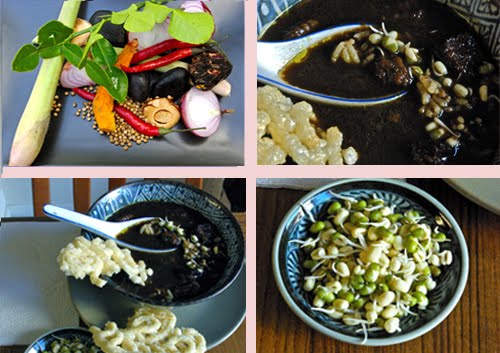
Rawon is one of those dishes that people will argue over. Essentially a beef soup, it is eaten with rice and garnished with young mung bean sprouts. It isn't commonly found on menus outside of Indonesia because its key ingredient, kluwek, is rarely found on market shelves. Besides being central to rawon, kluwek--a black, rounded seed that resembles a roughly triangular lump of tar or coal--is used in a some nonya dishes of the straits Chinese.

While my attempt at rawon tasted good, I don't think it compares with some of the rawon I've had in Java. Maybe when I go back next summer I'll find someone willing to share their secret to that perfect bowl. Until then, this was still very good, certainly worthy of a winter meal.

Rawon

2 lbs beef brisket
4 kluwek, soaked in water at least one hour to soften
4 long red chilis
1 tsp terasi
8 shallots, chopped
2 tsp coriander, ground
1 inch fresh turmeric, or 1 tsp ground
3 slices of laos (galingale)
2 stalks of lemongrass, bottom half only, pounded
8 kaffir lime leaves, bruised
2 TBS oil
a one inch slice of tamarind paste, grilled to char on all sides
salt, to taste

Boil the brisket in 2 quarts of water with a little salt for one hour. Remove beef from water, reserving water. Cut the beef into 1/2 inch cubes.

In blender or mortar, process the kluwek, chilis, terasi, shallots, coriander and turmeric, adding water as needed from what the kluwek soaked in to make a smooth paste.
Fry the paste with the laos, lemongrass and kaffir lime leaves in the oil for a minute or two. Add the diced beef, grilled tamarind paste and reserved water. Simmer for about an hour, until beef is tender. Remove the tamarind before serving. (I tie it up in a piece of cheese cloth to make this easier.)

Serve the rawon with hot rice, young mungbean sprouts, sambal terasi and krupuk ikan.

To make the mungbean sprouts, soak a cup of mungbeans in a bowl of water for ten minutes, then drain most of the water. Cover the bowl with a towel and place in a cabinet. Check in twelve hours to see if you need to add more water. Sprouts should be ready in a day or two.

Sunday, October 25, 2009

Rendang


 I had been planning to make some rendang for some time before I finally got around to it. As much as I hunger for it, I only make it four to six times a year. A quintessentially Indonesian dish--slow, incredibly rich yet unpretentious, spicy with a steady heat that sidles up to you--it's a dish that demands your time and attention. Essentially a stew that is simmered until almost all the liquid has been absorbed or cooked off, like many stews it seems even better the next day.

I first tasted rendang on a picnic in Java. I had only been in the country a few weeks when one of my students and her husband took me to Sarangan, a mountainous lake in Central Java. Vivi was originally from Solok, a small town near Padang in West Sumatra where rendang originated. The rendang that Vivi made was from beef and beef liver.

Liver is something I abhor. My gag reflex kicks in whenever I have to eat it. The first bite of rendang I had was simply beef. Then I got a piece of liver. Even rendang could not disguise that distinctive texture and taste of liver. However, the sauce was so luscious I didn't mind at all. Vivi had made a large batch (rendang is not a meal to cook for two) and I could have eaten all of it by myself. When they dropped me off at my room later that evening, Vivi and her husband gave me a pint or more of leftovers (half of which I ate as soon as I was alone). The rest I ate the next morning, cold, and it was still phenomenal.

Several years later, I got the chance to visit Padang, and even made it to Solok where I met Vivi's mother. Padang was a quiet, unassuming city, much quieter and more sparsely populated than cities in Java. It was a wonderful city to visit, one I hope to return to again some day.

The recent earthquake there apparently caused extensive damage. At least 3,000 people died as a direct result of the quake. People who had little were left with nothing. It is hard for us in the United States, especially those who have never been in developing countries, to appreciate how so many who have so little can face such devastation. The disasters attract our attention and sympathy for a minute but then we're distracted by the next bit of fluff, a shiny ballon drifting over a desert, or the pop star du jour's latest meltdown. We can't bring ourselves to acknowledge that but for the luck of being born where we were, we too could be facing such loss.

In the face of such disasters and poverty and children dying for want of clean water or mosquito netting, it seems almost obscene to be blogging about food. I don't know quite how to reconcile my feelings about this dichotomy. I have put in some time volunteering to help people less well off than I, but is that enough? What's the point of sharing recipes? Perhaps people tasting the food of a country will take a moment to think of the people in that country. Perhaps it's just a selfish act. I don't know. Any ideas or feedback is certainly welcome. In the meantime, here's Vivi's recipe for rendang.

A printable version of the recipe is available here.

Vivi’s Rendang

3 pounds chuck roast cut into 2 inch cubes
2 15 oz cans coconut milk
2 cups water

1/4 to 1/3 cup finely chopped or ground red chilies (can use sambal oelek if fresh hot red chilies aren’t available)
1 head of garlic (about 50 grams), coarsely chopped
6--8 shallots (about 150 grams), coarsely chopped
5 kemiri (candle nuts)
1 tsp coriander seeds, ground
1/2 a nut of nutmeg, ground
5 cloves, ground
1 two-inch finger of turmeric, peeled and chopped (2 tsp ground turmeric)
3 thumbs of ginger, peeled and coarsely chopped
1 thumb of laos (galingale) peeled and sliced
1 tsp kosher salt

3 daun salam
6 kaffir lime leaves
2 stalks of lemongrass, bruised with a pestle

Pulse the chilies, shallots, garlic, spices and salt in a food processor until you have a somewhat smooth paste.

In a dutch oven or similar pot, mix beef and spice paste. Add coconut milk, water, salam and kaffir lime leaves, and lemongrass and bring to a boil over medium heat. Lower the heat to maintain a steady simmer and stir every fifteen minutes or so. Open a beer, or the beverage of your choice, turn on some good music and relax. Like good barbecue, the secret to good rendang is cooking it low and slow. You can’t rush it.

James Oseland, in his excellent book Cradle of Flavor, recommends using a shallow, wide pan to cook rendang to speed up the evaporation process. I disagree for two reasons. One, I think you just need to give it the time it needs. Two, as you get near the end the oils tend to sputter and pop; with a shallow pan you will find your kitchen spattered with turmeric freckles.

As the liquid reduces you need to reduce the heat and stir more often. The rendang is done when the sauce has been reduced to a thick paste and is a chocolate brown.

Get the flash player here: http://www.adobe.com/flashplayer

Saturday, May 2, 2009

Silk Road Cumin Beef Sprouts


I'm submitting this recipe to Weekend Wokking, a world-wide food blogging event created by Wandering Chopsticks to celebrate the multiple ways we can cook one ingredient. The host this month is Kits Chow. If you would like to participate or to see the secret ingredient, check who's hosting next month.

My favorite sprout dishes are probably tahu telor or banh xeo. In both those the sprouts add texture and lighten the density of the dishes. They are counterpoints, foils, to the dishes rather than central to them. Each dish would be diminished without them, yet they are not the focal point of the dish. For my first Weekend Wokking event, I wanted to come up with a recipe that more fully featured the sprout.

One of the benefits of being an ESL teacher is the occasional potluck party. Having students from as many as fifteen different countries in one class, I get to taste dishes from all over the world. One of the drawbacks of being the teacher is that I can't pass up the Shuba (a herring and beet salad loaded with mayonnaise) for shrimp ceviche without hurting some student's feelings. In recent years the area has become to a large number of ethnic Russian immigrants from the "Stans"--Uzbekistan, Kazakhstan, and Kyrgyzstan. There are several dishes from these countries I always look forward to, my favorite being plov. Plov is a rice dish from Uzbekistan featuring beef or lamb, carrots, onions, and cumin. The cumin-carrot connection brings a wonderful freshness to this dish. As I am also fond of Xinjiang beef with cumin, I decided to try to incorporate the flavors of plov in a southwestern (China) stir fry. Xinjiang borders Kazakhstan and Kyrgyzstan and so it's natural their food would share an affinity. The robustness of soybean sprouts make them a better choice for this dish than the more common mung bean sprouts.

Silk Road Cumin Beef Sprouts

marinade:
1 TBS shaoxing wine
2 tsp dark soy sauce
1 TBS tapioca starch
1/2 tsp salt

3/4 lb flank steak, sliced thin
1/2 lb carrots, sliced thin
3/4 lb soybean sprouts, hairy roots pinched off
1 onion, sliced (I used a red onion because that's what I had in)
2 tsp slivered ginger
1 TBS chopped garlic
2 tsp ground chili flakes
4--6 dried red peppers
1 TBS cumin seed, ground
2 green onions, finely sliced
salt to taste
1 tsp sesame oil

Marinate the beef for half an hour or so. Drain and oil blanch the beef briefly in peanut oil heated to around 275ºF. Drain beef and pour off most of the oil, reserving perhaps 3 tablespoons.

Heat wok over a high flame. Add ginger, garlic, chilies and cumin. As soon as you can smell the spices, add carrots and chow briefly. Next add onions and cook for thirty seconds or so. Then add drained beef and sprouts. Stir and cook just until sprouts are fully incorporated. Add salt to taste and sprinkle in green onions. After removing from heat, stir in the sesame oil and serve.