Showing posts with label southeast asian. Show all posts

Tuesday, August 23, 2011

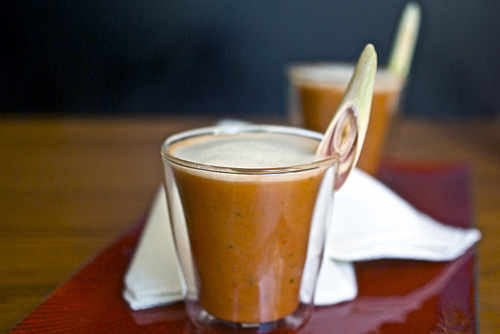
Gazpacho with Lemongrass Foam

Perhaps influenced by my stint in Kediri during Ramadan, I got to thinking about what would be a nice way to start off a summer meal, to break the fast if I were fasting.  Although I have what some would say is  a strange aversion to cucumbers, I do enjoy a good gazpacho.  And this is one soup that almost cries out for an Asian touch.  Lemongrass has a natural affinity for tomatoes, but getting the flavor without the fiber of the stalks is problematic.  One approach would be to infuse some oil with lemongrass.  I decided to take a different path.  Using some soy lecithin, I made a foam which I floated on the surface of the gazpacho.  This resulted in an ethereal touch of lemongrass that nicely complemented the gazpacho but did not overwhelm it.

 Summer is a great time to visit the farmers market in Sacramento.  Besides an abundance of stone fruits such as peaches, nectarines, and plums, there are also all the summer vegetables.  The variety of tomatoes now available is astounding, and I decided to use some of those in this gazpacho.  Happening upon some vibrant purple bell peppers, I chose to include those in the soup as well.  Unfortunately, they didn't add much to the appearance of the gazpacho, and I didn't think they tasted quite as good as regular bells.  The kaffir lime leaves which are from a tree we have growing in our back yard were a nice addition to the mix. Kalamansi limes spark the soup with a dash of zing.


(makes approximately 6  four to six ounce servings)

1 1/4 pounds of vine-ripened tomatoes (I used a mix of red and green zebras)
2 purple bell peppers, seeded and chopped
1 persian cucumber, seeded and peeled
2 shallots, peeled and chopped
1 to 2 cloves of garlic, peeled
1/3 to 1/2 cup olive oil
1--2 TBS rice vinegar
juice of 3 kalamansi limes
4 kaffir lime leaves, center vein removed, finely chopped
1 hot chile, seeded and chopped
salt and pepper to taste

3/4 cup water
two stalks of lemongrass, pale whitish bulb only, chopped
1 TBS lecithin

To make the gazpacho, quarter the tomatoes and press the seeds into a coarse mesh strainer set over a bowl.  Put all the ingredients into a blender.  Add the liquid collected from the drained seed pulp.  Puree the mixture and chill in the refrigerator.  

To make the lemongrass foam, puree the lemongrass and water in a blender.  Allow to sit for at least several hours before straining the lemongrass from the liquid.  Chill the liquid and add the lecithin.  Using a stick blender mix the liquid until a light froth forms on the surface.

To serve, pour the gazpacho into four to six ounce glasses and spoon on a layer of the lemongrass foam.


Wednesday, March 9, 2011

Calamari with a Sweet Hot Sauce--Cumi Goreng Pedas Manis


When I was working on Pulau Galang, the Indonesian refugee camp for refugees from Vietnam and Cambodia, I had to make regular trips to Singapore every three months to renew my visa.  All of the foreign workers in the camp had these special three-month visas rather than the typical one-year work visas so the government could easily prohibit us from returning to the camp if we caused any trouble.  As Singapore was just a couple of hours away by boat, and the process took three days, it was a nice break from the camp and a welcome change from the dining hall routine.


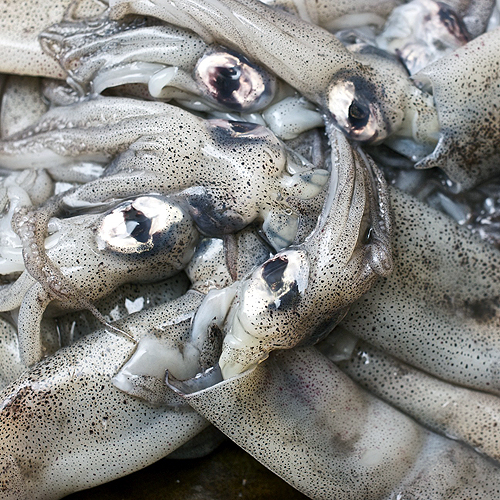
One of the dishes I have enjoyed on different visits to Singapore is the fried baby squid (although I think it's probably baby cuttlefish).  These are whole, baby cuttlefish that are first deep fried and then finished in a sweet sauce.  Done right, they are delicious.  Unfortunately, I've sometimes had them when the cook didn't do right by them and I was faced with a pile of cloyingly sweet, rubbery aliens from the sea.  Squid is one of those dishes that either is cooked right or is a disaster.  If the first time someone tries squid, the cook fucks it up, that person will probably never try squid again.

When I usually cook squid, which is not often, I use frozen squid, as this is what is most often available.  A few weeks back I noticed that Sunh Fish, where I buy most of my seafood, had some fresh squid in their case.  I didn't buy any at that time, but made note of it so that I might take advantage of some fresh squid next time they had some in when I was there.  That day came a few days ago and I bought a couple of pounds.


I had planned to make some grilled squid, cumi panggang, but when I got the squid home and cleaned them, I felt they were too delicate for such an approach.  Once cleaned, there were around thirty squid to a pound.  The bodies were extremely thin walled, about the thickness of a slice of skin from a careless moment with the mandoline.  Although I didn't think I could do them justice on the grill, I knew they would be great fried.


I intended to try the recipe from  The Food of Singapore, a book that I generally like.  After frying a few pieces of squid following its recipe, however, I decided to ditch that recipe and try my own approach.  The original recipe calls for a marinade in a batter of curry powder, cornstarch, soy sauce, and egg.  The fried squid tasted good, but didn't have the delicately crisp exterior that I prefer.  Discarding the wet ingredients, I kept the curry powder and cornstarch, and added some rice flour.  Dredging the squid in this mixture provided just the taste and texture I was looking for.

The sauce is even simpler.  To a half cup of Yeo's Sweet Chili Sauce, I stirred in about two tablespoons of kecap manis Cap Nonya. This was heated in a wok and then the fried squid were added and tossed with the sauce to coat.  The result was at least as good as any squid I've ever had in Singapore, or anywhere else.  If you like calamari, this is a dish I would definitely recommend.

Crispy  Fried Squid in a Sweet Hot Sauce

2 pounds small, fresh squid or 1 pound cleaned, frozen squid, thawed
1/2 cup cornstarch
1/2 cup rice flour
3 TBS curry powder
2 tsp sugar

oil for deep frying

1/2 cup Yeo's Sweet Chili Sauce  (I prefer Lingham's, but it wasn't at the market I went to on this day)
2 to 3 TBS kecap manis
water, as needed, to thin the sauce if necessary

Clean the squid and remove the eyes and beak from the tentacles.  Lightly score the inside of the bodies in a crosshatch diagonal pattern and cut into strips.  Dredge the prepared squid in the cornstarch mixture.  Fry in batches in hot oil for about 30 seconds.  Drain on paper towels.

After all the squid has been fried, heat the chili sauce and kecap manis in a wok or pan that  can easily accommodate the squid.  Toss the squid briefly in the heated sauce, plate, and serve.
Monday, November 29, 2010

Tuna Tartare with Kaffir Lime Leaves


 The deliciousness of my recent ahi carpaccio prompted me to make this tuna tartare.  Like the carpaccio, this is a dish I've had in the past with beef.  While there is an understandable reticence on the part of most Americans to consume raw beef and raw eggs, steak tartare is a treat that I enjoy.  Using impeccably fresh tuna in place of the beef and yolks from quail eggs, this was every bit as tasty as the ahi carpaccio.


I used a tomato paste can to serve the tartare on a layer of diced avocado.  The raw yolk added another dimension of lusciousness to the tartare.  For those concerned about consuming raw yolk, it could be hard boiled and then grated, or left out altogether. 
We are lucky enough to have a kaffir lime tree that seems to be thriving in our back yard, so getting fresh kaffir lime leaves is not a problem.  Their presence can overtake a dish though, and with something like ahi tartare you want to make sure the lime leaves don't detract from the simple clean taste of the tuna.  I found three leaves for a half pound of fish to be plenty, imparting a tropical citrus taste but not overpowering the other ingredients.


Tuna Tartare with Kaffir Lime Leaves

1/2 pound sashimi grade ahi tuna, small dice
1-2 shallots, depending on size, finely minced
3 whole kaffir lime leaves, midrib removed, finely minced
salt, to taste
avocado, small dice
quail egg yolks (optional)
chili oil (optional)

fried wonton triangles

Lightly toss together the diced tuna, minced shallots, and minced lime leaves.  Using a small tomato paste can, biscuit cutter, or similar cylinder with approximately 1 1/2 inch diameter, place a half inch of lightly salted, diced avocado in the bottom of the cylinder.  Top with 3/4 to 1 inch of tuna mixture.  Press down and push onto a serving plate.  Repeat.  You should have enough to make about four separate tartare towers.  Top each tower with an egg yolk, if desired.  Chili oil may be drizzled around the base of each tower.  Serve with fried wonton triangles.

Saturday, October 16, 2010

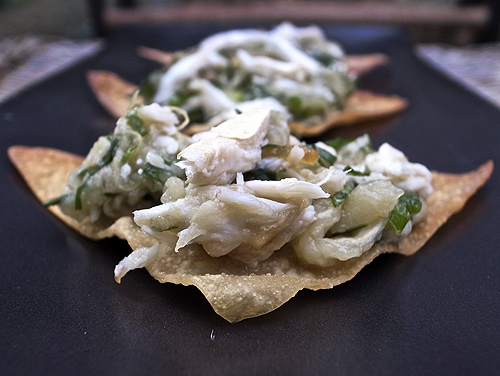
Roasted Eggplant and Crab Meat Salad on Won Ton Triangles


Our niece, the princess, recently returned to Indonesia after living with us for several years while she went to college here.  Although we would have liked it if she had stayed longer, we certainly understood her  desire to return home to her mother, grandmother, and miserable dogs.  At the same time, her departure has expanded the foods we're able to enjoy.  

Despite coming from an archipelago blessed with some tremendous seafood, the princess is allergic to all that the ocean produces.  She also claims to be allergic to eggplant.  She doesn't claim to be allergic to carrots, but has an aversion to them that borders on the phobic.  Since her return to Indonesia, I've reintroduced these items to our table.  


Eggplant is a vegetable that people generally love or hate.  Mishandled, it can be god-awful--greasy, salty, or bitter.  That is especially true for the larger, globe eggplant.  Asian eggplant tend not to be as bitter.  Roasted, they have a subtle sweetness and a silken texture.  Ca tim nuong, Vietnamese grilled eggplant, combines the eggplant with scallion oil and a salty-sweet dressing of fish sauce, lime juice, chilies and sugar.  Mix in some crab meat and serve on top of fried won ton triangles and you've got a wonderful appetizer, perfect for autumn when eggplants are at their best.


As much as I enjoyed it, this is not something I would have cooked for the princess's birthday this week had she still been here.  Still, I hope she had a wonderful time with family and friends in Surabaya.

Roasted Eggplant and Crab Meat Salad on Won Ton Triangles

Two slender, Japanese or Chinese, eggplant
1/2 cup crab meat (preferably fresh)
3 TBS mint, finely julienned
3 TBS Thai basil, finely julienned

2 scallions (green onions), green parts only, finely sliced into thin rounds
2 TBS vegetable oil

Juice of 1 lime
1 clove of garlic
2 TBS fish sauce
2--3 TBS sugar
1 red chili, seeded and minced (I didn't have any on hand, so I left it out)
1 TBS Thai sweet chili sauce

Prick the eggplants with a fork in 6 to 8 places.  Roast over a hot grill until softened.  When cool, peel, cut into 2 inch lengths and pull the pieces into shreds.  Heat the oil to smoking, then pour over the scallions.  Pour over the shredded eggplant. 

Mix the eggplant and scallions with the crab meat and herbs.  Lightly drizzle with the dressing.  Serve on top of won ton triangles for an appetizer.  This can also be served as an accompaniment to other dishes with rice.


Saturday, December 5, 2009

Belgian Endive Crab Bites

Tis the season for cocktail parties. Which means it's also the season for overindulgence in rich, buttery, cheesy, creamy appetizers and dips, along with an array of buttery cookies and baked goods. And what's wrong with that? Nothing, really, 'cept sometimes you want something a little lighter.

But by lighter, I don't mean broccoli spears and carrot sticks in an insipid fat-free mayo dip. I mean something naturally light and refreshing and tasty. Because if I have to choose between something tasty that will cause my doctor to cry and something healthy that has no taste, doc, the kleenex are next to the puff pastry. Fortunately, it doesn't have to be an either or dilemma. You can graze the hors d'oeuvre table and eat light, satisfying bites that aren't loaded with butter or cream.

Belgian endive are the perfect vegetable for delivering refreshing bites. They can be filled with any number of toppings and assembled ahead of time. When your guests come, the leaves are still crisp, an advantage over crostini. Also, people feel good about themselves when they eat something in a leaf. Serve chocolate truffles topped with caramel in an endive leaf and people would gobble them up while feeling so good about themselves for getting a vegetable.

The dressing for the salad utilizes kaffir lime pepper jelly, but you could use Thai sweet chili sauce instead. However, I strongly recommend the use of fresh kaffir lime leaves in the salad. They add a very refreshing accent. If you can't find those, you might try finely grated lime zest.


Belgian Endive Crab Bites


Belgian endive (Trader Joe's sells them in packs of three--two green, one red)

crab meat, preferably fresh, picked over to remove any cartilage or shell
red pepper, finely diced
Fuji apple, finely diced (fresh waterchestnuts or jicama could be substituted)
kaffir lime leaves, center vein removed, finely minced

1 TBS kaffir lime pepper jelly (or Thai sweet chili sauce)
1 TBS fish sauce
2 TBS water
lime juice, to taste

Mix crab, red pepper, apple and lime leaves together. Squeeze some lime over salad to keep apple from browning.

Heat jelly (if using) in microwave to liquify. Stir in fish sauce, water and lime juice. Taste and adjust seasonings as necessary to have a tart, slightly sweet dressing. Lightly dress the crab salad.

Spoon salad into washed, dried endive leaves. Plate and serve.


Get the flash player here: http://www.adobe.com/flashplayer

Wednesday, August 12, 2009

Lemongrass-Kaffir Lime Leaf-Pepper Jelly


Thai-style sweet chili sauce is a pleasing accompaniment to fried foods such as stuffed chicken wings and spring rolls. The combination of heat and sweetness along with the sharp twang of vinegar in the background really sparks the taste buds. I wanted to come up with a jelly that would make someone think of Southeast Asia when tasting it. I didn't want something that was merely incendiary hot; I wanted something more nuanced.

The method and ingredients for making pepper jelly differ little from those for making a Thai-style sweet chili sauce. The basic ingredients are chilies, vinegar, and sugar. Puree, boil, and steep. For the jelly I strained the solids and added pectin to make the liquid jell.

The jelly can be served on a cracker with cream cheese or brie. It could also be used as a glaze to grilled pork or chicken. Heated, it liquefies and could be used as a dip for stuffed chicken wings, or crab rangoons that Wandering Chopsticks posted about recently.

Lemongrass-Kaffir Lime Leaf-Pepper Jelly
2 or 3 stalks of lemongrass, pale whitish part only, bruised and sliced
6 to 8 kaffir lime leaves, julienned
1/2 cup red jalapenos, or other chilies of your choice (I chose jalapenos because they provide a nice amount of heat but aren't overwhelming), chopped
3/4 cup vinegar
3 cups white sugar
1 3 ounce package of liquid pectin


Mix lemongrass slices, lime leaves, chilies, vinegar and sugar in a saucepan. Heat and stir. Bring to a boil, then remove from heat. Using a blender or immersion blender, puree cooled mixture. Let sit for half an hour or so. Strain solids out using a sieve. Bring liquid to a boil and simmer five minutes. Remove from heat and stir in liquid pectin. Pour warm liquid into warm sterilized jars. Process in boiling water for five minutes. Makes 3 half-pint jars.
Get the flash player here: http://www.adobe.com/flashplayer