Showing posts with label snacks. Show all posts

Thursday, February 7, 2013

Lumpia Basah Khas Bandung--Fresh Lumpia Bandung Style


In the United States, most people think of Filipino-style fried lumpia when they hear of lumpia. Long, thin spring rolls packed with pork and shrimp and fried until crisp, Filipino spring rolls are delicious, but they are a totally different animal than these fresh lumpia from Bandung in West Java.  Lumpia basah are more akin to the popiah you can find in Malaysia and Singapore.  Essentially a crepe with a sweet/savory filling of jicama, beansprouts, and eggs, these are a cheap, satisfying snack hawkers sell in Bandung.

As they are not fried, lumpia basah could be considered a healthful snack.  With bean sprouts and jicama both being low in calories and relatively high in fiber, these lumpia can be enjoyed without feeling guilty.  The various components of the lumpia can be prepared ahead of time, but they should not be assembled until shortly before you eat them.  If they are assembled and rolled hours ahead of time, the wrappers are prone to split and come apart. 


Although you could purchase the lumpia wrappers from an Asian market (look for "pastry wrappers" made in the Philippines in the frozen section) making your own is not difficult.  The frozen ones are very thin, but they also are more brittle, without the flexibility of fresh wrappers.  The recipe I use for the skins does not produce as thin a wrapper as the commercial ones, but Tjing prefers it to the frozen ones.


Lumpia Basah Khas Bandung--Fresh Lumpia, Bandung Style

For the wrappers
1 1/3 cups (200 grams) all-purpose flour
3/4 cup + 2 TBS (200 ml) water
2/3 cup egg whites (5 to 6)
1 tsp salt

In a medium bowl, mix together the flour and salt.  With a whisk, stir in the egg whites. Then add half the water, stirring until fairly smooth.  Whisk in the remaining water and continue stirring for about five minutes.  Set the mixture aside and allow to rest for at least 40 minutes.

Heat a non-stick frying pan over medium-low heat.  Lightly brush with oil.  Ladle enough batter in to form an 8-inch crepe, using the bottom of the ladle to spread the mixture as needed.  As soon as the edges begin to lift from the pan, flip the crepe and cook briefly on the other side.  Each crepe should take about 25 to 30 seconds total.  Continue until all the batter is used.  This should make around 10 wrappers.

For the filling
1 jicama (about 1 pound/ 450 grams) peeled and cut into matchsticks
2 cups beansprouts
2 eggs, lightly beaten
3 1/2 ounces (100 grams) palm sugar (gula jawa), grated
1/3 cup water
1 tsp +/- salt
2 TBS tapioca starch
7 cloves of garlic, pounded to a paste
1 tsp ground white pepper
2 TBS oil

In a large pan that will hold the jicama easily, dissolve the palm sugar in the water and bring to a boil. Remove two tablespoons of this syrup and mix with the tapioca starch in a small bowl.  Add the jicama to the remaining sugar mixture and stir to coat well.  Cook over medium heat until the liquid is absorbed, and the jicama has softened and browned.

Heat a wok or large frying pan.  Add the oil and stir-fry the garlic and white pepper until fragrant.  Stir in the beaten eggs and scramble them.  After eggs are lightly scrambled, stir in the cooked jicama.  Cook for a minute or two before adding the beansprouts and salt.  Taste and adjust the seasonings if necessary.  As soon as the beansprouts begin to become limp, transfer the mixture to a bowl.

To assemble the lumpia, spread the bottom half of a wrapper with a spoonful of the tapioca starch thickened syrup.  Place a generous amount of the filling atop the wrapper.  Fold and roll like a burrito, folding in the two sides and then rolling until enclosed.  If you like, you can cut them into three or four pieces, but I think they're best enjoyed by scarfing the lumpia whole, bite by bite.


Friday, December 21, 2012

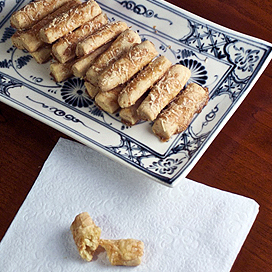
Kastengel--Savory Cheese Sticks


Santa don't want no cookies this Christmas Eve.  All that milk and sugar brings him down with a blood sugar crash, a Christmas day funk that lasts through New Year's.  So this year we're leaving him some kastengel and a glass of thick red wine, or maybe some scotch.

The Dutch didn't leave Indonesia much from 350 years of colonialism.  They were more interested in what they could take from the archipelago than in what they could contribute to it.  One thing they did leave was an appetite for kastengel.  Look at the ingredients and you immediately recognize they did not spring from the Indonesian islands.  Yet, kastengel are a favorite treat to celebrate Lebaran and other major holidays.  Cheesy, buttery, and utterly lacking in nutritional merit, kastengel make tremendous sense as a way to celebrate the end of a month of fasting. 


Kastengel are also a nice change from the overabundance of sweets following Ramadan and during the holiday season in the US.  Cookies are everywhere at this time of year.  Snickerdoodles, ginger snaps, candy cane meringues, almond crescents, and Russian tea cakes abound.  That Santa doesn't slip into a diabetic coma is a Christmas miracle in itself.  Leave a few kastengel in place of the usual cookies and Santa will be pleased.  He may even be extra good to you.


I had never heard of Nyonya Liem or Ibu Liem until Tjing asked me to make some kastengel, but a google search for kastengel resulted in her name appearing again and again.  So I adapted her recipe, simplifying its directions, and translating it into English.  I'm sure the cheddar cheese her recipe calls for is the Kraft processed cheddar that one can find fairly easily in Indonesia.  It makes a more decorative topping of the kastengel as it could probably be baked in a potter's kiln without melting.  A grated parmesan or other relatively dry cheese will produce similar results.  I used a mix of parmesan and a good English cheddar.


Kastengel ala Ny. Liem

I am giving the measurements most Americans are comfortable with; however,  I use a scale when making these as it just makes it easier.  The original recipe calls for equal parts butter and margarine, 150 grams each.

2 cubes butter (8 oz/227 gr), room temperature
6 TBS margarine, room temperature
2 egg yolks
1 tsp salt
3 1/3 TBS (50 ml) half and half
4 oz parmesan cheese, grated
4 oz cheddar/edam/gouda, grated

3 TBS (25 gr)corn starch
5 TBS (25 gr)powdered milk (the original recipe calls for full cream powdered milk, but I used non-fat as that is what is readily available in the US and it worked fine)
3 1/2 to 3 3/4 cups (500 gr) all purpose flour, sifted
1 tsp baking powder

Egg wash of egg yolks mixed with a little oil and water
Finely grated cheddar/parmesan cheese

In a large bowl, cream together the butter, margarine, and egg yolks.  Using a mixer, beat the ingredients for 3 to 5 minutes until light and fluffy.  Beat in the cream to further lighten the mixture.  Add in the cheese and continue to beat until thoroughly mixed in.

In another bowl mix together the dry ingredients.  Slowly add the dry ingredients to the butter/cheese mixture until all the flour has been incorporated.  You will have what looks like a bowlful of crumbly particles.  The dough will not come together until you press it together with your hands.

To make the logs, press together a handful of the mixture and roll it into a rope, like making a playdough snake.  You want the rope to be not quite as thick as an AA battery.  Using an AA battery as a guide, cut the rope of dough into pieces the length of a battery.  Place the cut pieces about 1 inch apart from each other on a baking sheet lined with parchment paper.

Once you have filled a baking sheet with the cut pieces, brush them with the egg yolk wash.  I make a wash with one egg yolk at a time and have found that will usually be enough for one baking sheet (about 50 kastengel).  Sprinkle the finely grated cheese atop the pieces.

Bake in a pre-heated 300º oven for about 20 minutes.  Lower the heat to 200º and bake for another 15 to 20 minutes until the kastengel are cooked through, but not really browned.

This makes a lot.  10 to 12 dozen.  The dough can be frozen.  Bring it to room temperature before attempting to roll it out and make the kastengel.


Saturday, November 17, 2012

Roti Jala


I gather from my nieces that in recent years Malaysia has tried to claim credit from Java for the development of batik.  While I'll definitely side with Indonesia on this issue, I believe Malaysia gets the nod for roti jala.

A crepe-like bread to accompany curries, roti jala is not something I have actually come across in Malaysia or Indonesia.  I first became aware of it several years ago when I bought a copy of Authentic Recipes from Malaysia, which calls them lacy Indian pancakes.  Named for its fishnet resemblance, roti jala is traditionally made with a special funnel with four or five spouts to form the net-like pattern.  I was at a Sundanese restaurant last summer that had several varieties of the funnels as decoration on its walls, suggesting that, at least in the past,  roti jala was enjoyed in Java.  The funnel I use is an inexpensive plastic one that I picked up in Singapore.  One could get much the same effect with more effort using a plastic squeeze bottle.

The recipe here is adapted from Resep Klasik Jajanan Pasar (Classic Market Snack Recipes), which contains 270 recipes for snacks that are often sold in Indonesian markets.  As supermarkets supplant the traditional markets, some of these snacks will undoubtedly disappear. One of the interesting things about the book is that one of the co-authors is a Japanese woman, Tomomi Kimura, who was studying at UGM in Yogya.  She collaborated with a catering company in compiling the recipes.


Roti Jala

1/4 cup thick coconut milk
1 3/4 cup water
2 cups all-purpose flour
1 tsp salt
1 egg, beaten
pinch of turmeric (optional)
vegetable oil to grease the pan

In a bowl, whisk together the coconut milk, water, salt, turmeric (if using), and egg.  Gradually whisk in the flour until you have a smooth batter, about the consistency of whipping cream.  Strain the batter through a fine sieve to remove any possible lumps.  This is important if using a roti jala funnel because even the smallest lumps can clog the spouts.

Heat a large non-stick skillet over medium heat.  Pour in a splash of vegetable oil and rub it into the surface with a paper towel.  Ladle some batter into the funnel (if using), holding the funnel about a half-inch to an inch over the skillet.  Move the funnel in circular pattern to form a lacy, fishnet-like crepe.  Cook until the crepe is set and the edges begin to lift and curl from the pan.  Slide onto a clean plate.  Roll or fold into eighths.  Continue until all the batter is finished. 

This makes about 16-20 crepes.  Serve it with curries or other saucy dishes.  I served it here with an excellent Burmese shrimp curry from Naomi Duguid's Burma: Rivers of Flavor.  I'll be posting my take on this dish soon.


Monday, October 8, 2012

Rengginang--Fried Rice Crackers


When I made some sambal serai--lemongrass sambal--a few weeks back, I thought it needed something other than some grilled food to accompany it.  The sambal is great with a meal, but I wanted to be able to enjoy it as a snack.  Rengginang--which are a kind of rice cracker made from sticky rice--make a perfect accompaniment.  They are light and savory, easy to make, and store well.


Rengginang are nothing like the tasteless puffed rice crackers that were popular with dieters many years ago.  Who knows, maybe they are still popular.  Nutritionally, they were equivalent to eating styrofoam. Unfortunately, styrofoam probably tastes better.  Rengginang taste like toasted rice with a hint of garlic and shrimp.  In Indonesia you can also get a sweetened version, but I've always been partial to the savory ones.  While they are usually about 3 inches in diameter, you can find platter-sized ones that are 10 inches or more across. 

Making these is a multi-step process, but it is not difficult.  Soak, steam, mix, steam, dry, and fry.  There's also a little grinding of garlic, but those are the basic steps.  While I like a little sambal with mine, you could really use them with almost any dip, especially salsas.  The dried disks can be stored until you are ready to fry them.  The fried rengginang will keep for at least a week in an airtight container. 


Rengginang--Fried Rice Crackers

1 kilo glutinous rice (approximately 5 cups)
6--8 cloves of garlic, peeled, and pounded to a paste
2 tsp salt
1 tsp terasi (optional)
2 TBS ebi (dried shrimp) soaked in hot water for 10 minutes, drained, and pounded to a paste (optional)
400 ml (1 3/4 cups) water

Soak the rice in water for two to four hours.  Drain, then steam the rice for 15 minutes.  Remove the rice to a large bowl.

In a mortar, pound the garlic, salt, terasi, and ebi (if using) into a smooth paste. Stir this paste into the 400 ml of water.  Pour this into the partially steamed rice and mix well.  Allow the rice to absorb the seasoned water.

After 15 to 20 minutes, when the rice has absorbed the added liquid, return the rice to the steamer and steam for another 30 minutes.  Remove the rice from the steamer and form into disks about 1/4 inch to 1/2 inch thick (.5 cm to 1 cm). 

If you live in a warm, sunny climate, place the disks in a single layer on some sort of rack or porous surface and allow them to dry.  This may take several days.  I hurried the process by putting them into an oven which I turned on to the lowest possible setting.  I meant to turn the oven off after five minutes, but forgot, so I dried them a little faster and at a higher temperature than was ideal.  Still, they fried up fine.  If you have a dehydrator, I would think that would be ideal for drying these.

Once dried, they are ready to be fried.  Heat oil in a wok or other pan to around 385º, maybe a little hotter.  Slide a disk into the hot oil.  It will sink to the bottom, but should rise almost immediately.  Cook in small batches.  Each only takes twenty seconds or less to cook.  The important thing is to have the oil hot enough so that the disks will rise to the surface almost immediately.  If the oil is too cool, the disks will remain on the bottom and you will have a hard, unpleasant cracker.


Sunday, February 19, 2012

Sambal Goreng Kering--Crispy Potato Sambal


When most Americans hear the word sambal, they immediately think of a chile sauce such as sambal ulek or sambal bajak.  In Indonesia there are several hundred varieties of sambal, and many of them are not sauces at all.  Instead, they are dishes which complement the "main" dish and rice.  A plate of nasi rames, for example, might contain rice, a piece of chicken, and several sambals, some with coconut milk, others dry like this one.  The result is a meal that is a balance of flavors and textures--sweet and savory, saucy and crispy. 

This particular sambal is very similar to tempeh kering.  The final steps are the same, the only difference is the ingredients.  While tempe is almost as cheap as potatoes in Indonesia, unless you make your own tempe in the US, you'll find this version is much cheaper with potatoes than with tempe.  You could also make this with kettle style potato chips; I'd suggest using the unsalted variety.  If you don't like your food looking back at you, you can eliminate the ikan teri (anchovies).  They provide an interesting crunch and flavor, but your sambal will be no less authentic without them.

Wandering Chopsticks, whose blog was one of the first to make me aware of food blogs and inspired me to start this blog, recently posted about enjoying this sambal at a food court in Southern California. In her post she mentioned she wanted to learn how to make it, so here it is as a small token of my appreciation for her assistance over the years.  While most Indonesians might enjoy this with rice, it is an excellent accompaniment to beer or cocktails.


Sambal Goreng Kering
printable recipe

6--8 potatoes (about 2 lbs.), peeled, julienned or thinly sliced with a mandoline
14 oz peanuts (if raw, fry in oil for five to six minutes until cooked)
60 -- 120 grams ikan teri, dried anchovies
oil for frying

2 TBS  oil
3--4 shallots, about 60 grams, peeled and minced
2 cloves garlic, peeled and minced
3 fresh red chilies, stemmed, seeded, and chopped
6--9 TBS gula jawa (palm sugar)
2 TBS tamarind pulp dissolved in 3/4 cup water
3 daun salam (if you can't find them, leave them out)
4 slices fresh (or frozen) galangal
1 tsp salt

In batches, first fry the potatoes several minutes in oil around 300º F.  Drain and let cool.  Heat the oil to 375º and fry the potatoes a second time until crisp, about two minutes more.  It's important that the potatoes be very crisp before you put them in the sauce.  Drain on paper towels.

You also have to fry the ikan teri in oil.  Once you have done so, you will not want to use this oil for anything else.  So, you may want to pour off and reserve some of the oil used to fry the potatoes before frying the anchovies.  These should be fried around 350º F for just a minute or two.  Drain on paper towels.

With a food processor or mortar and pestle, process or grind the shallots, garlic, and chilies to a paste.  Stir fry the paste in the 2 TBS of oil until softened and fragrant.  Add 6 TBS of palm sugar and stir until melted.  Add in the tamarind water, daun salam, galangal, and salt.  Stir and cook over medium heat until this becomes the consistency of a thick syrup.  Taste and adjust sweetness to your preference.  Fold in the potatoes, peanuts and ikan teri until all are covered with and have absorbed the sauce.  If your potatoes were crisp, the sambal should remain crisp in an airtight container for several days. 


Monday, November 28, 2011

Javanese Nuts and Bolts


Nuts and bolts (AKA Party Mix) is a seasonal snack in my family, something that pops up around this time every year.  Although the recipe makes a generous amount, it disappears as fast as it is put out.  The combination of toasted cereals, pretzels, and nuts with butter and worcestershire sauce produces an incredibly addictive, not too salty snack (although I've always found the packaged versions to be overly salty and nowhere nearly as tasty).  As much as I love the original version (or at least the version that my mother makes), I decided to try giving it a little Javanese flavor.

Instead of butter, I substituted fresh pressed whole kernel virgin coconut oil.  To be honest, I was worried that the coconut oil would overpower the mix.  Fortunately, it proved to be a fairly subtle back note to the mix, not at all overwhelming or cloying.  In addition to the coconut oil, I added some crisp tempe, some fried kaffir lime leaves, and some fried, finely chopped lemongrass.  Instead of using worcestershire sauce, I used kecap manis, some fish sauce, and some panang curry paste.  Although not my mother's party mix, this proved to be just as addictive.  If you're looking to give a different twist on an old standby, I'd certainly recommend giving this a try.


Javanese Nuts and Bolts

2 stalks of lemongrass, inner lower third only, very finely chopped (easiest to do in a food processor)
14 kaffir lime leaves

2 cups bite-size wheat square cereal (such as Wheat Chex®)
2 cups bite-size corn square cereal (such as Corn Chex®)
2 cups bite-size rice square cereal (such as Rice Chex®)
2 cups toasted oat cereal rings (such as Cheerios®)
2 cups pretzels
1 1/2 cups lightly salted dry roasted cashews
1 1/2 cups tempe sliced into pieces 2" x 3/4" x 1/3" and deep fried until crisp

1 cup fresh pressed virgin coconut oil
1/4 cup kecap manis
1 TBS fish sauce
2 tsp panang curry paste

Preheat your oven to 225º F.

In a pan over medium low heat, fry the lemongrass in several tablespoons of the coconut oil until browned and crisp, like when making tofu with lemongrass.

Fry the kaffir limes in hot oil until crisp.  Alternatively, crisp in a microwave.  You want to be able to crumble them easily.

Heat the remaining coconut oil in a small saucepan.  Stir in the curry paste until it is dissolved in the oil, and then stir in the kecap manis and fish sauce.

In a large bowl mix the cereals, pretzels, cashews, and fried tempe.  Pour in the coconut oil mixture. Mix well, tossing and stirring the cereals so all get coated.  Stir in the browned lemongrass and the crumbled kaffir lime leaves.  Mix well and pour into a large roasting pan.

Bake in the preheated oven for about an hour, stirring every fifteen minutes or so.  Cool before serving.

I've found the kaffir lime flavor to become more pronounced the longer the mix sits.  This is a flavor I think can be overbearing--as I find it is in Trader Joe's Thai-spiced cashew nuts.  You can taste the kaffir lime leaves in this mix, but they don't dominate it. 

Saturday, July 30, 2011

Opak Gambir--Rolled Wafer Production in Wlingi


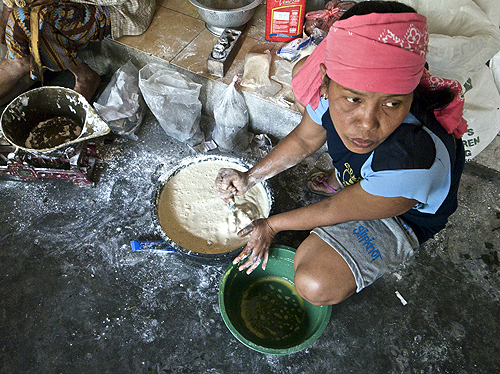
Tjing’s favorite aunt in Kediri, an excellent cook who taught me how to make botok jagung last year, arranged an outing to her hometown to visit some homes where opak gambir is produced.  These are thin, crisp wafers made from a variety of flours, coconut milk, eggs, and sugar that are cooked between two plates of iron stamped with various designs. Rolled or folded while still hot, opak gambir may be plain, with sesame seeds, or flavored with banana, pandan, ginger, or durian.  In Vietnam,  banh kep ngo are a variation of opak gambir with cilantro leaves and a sweetened peanut filling. 


Wlingi, the town where  Ching’s aunt, Yi Tjim, was born and grew up, is not quite half way between Kediri and Malang.  Although not a big town, it has grown since Yi Tjim moved to Kediri and she couldn’t quite place her old haunts.  Many of the people living there have been there for generations, so when Yi Tjim (who is in her 70s) would meet an older person she would introduce herself by saying she was so and so’s daughter.


Bu Liu has been making and selling opak gambir since 1968.  It is a small operation, with only two cooks, each managing 5 or 6 irons at a time.  On the day of our visit, the more experienced cook, whose hands have toughened to the point where she can fold and roll the still hot wafers, was absent.  The young woman working that day could only make the rolled version of the wafers.

Given the opportunity to try our own hands at rolling the wafers, Tjing and I had mixed success.  Tjing was unable to do more than pick up the wafer briefly before dropping it back onto the hot iron.  I managed to roll one, but it was a grosser, cloddish effort compared to the tight rolls the young woman produced. 

My effort at producing a roll.
From there we drove maybe a quarter mile down the street to visit another maker of opak gambir.  This was a larger operation than Bu Liu’s.  From the street we descended a steep alley to an area bordering rice paddy.  Housed in a shed with wire-meshed windows and a corrugated zinc roof, this “factory” employed seven cooks and two packers.  It seemed to be primarily a wholesaler, packaging the opak gambir in massive bags containing several thousand wafers.  As with Bu Liu’s, each cook handled 5 or 6 irons, constantly opening, filling, closing, flipping, and lifting one iron or another, always remembering which held a wafer ready to be rolled or folded.  Each cook produced about 6 1/2 kilograms (a little over 14 pounds) of wafers a day.  A kilogram of wafers sells for a little less than $3. 

Laundry drying outside the factory.
Don't worry, the girl is the owner's daughter.  She doesn't work there.
Mixing the batter.
Pandan flavored cone shaped opak gambir.
A scant teaspoon of batter is used for each wafer.
The hot wafer is folded, then rolled to form a layered cone.
The heat from the bank of coals is quite intense.
One of the packers.
Should you happen to find yourself in Java sometime, opak gambir are great with coffee or tea.  They’d also be nice with a dish of ice cream.  We picked up a couple of the irons in a shop in Kediri, so I’ll be attempting to produce my own opak gambir after returning to Sacramento.  Stay tuned for that post.

Saturday, July 16, 2011

Street Food

Treats abound on the streets of Java.  Go anywhere and there is someone selling something good to eat or drink.  Vendors sell from stalls set beside the road, from pushcarts, from baskets slung from cloths across their shoulders onto their hips, from trays poised on their heads, and from wooden boxes suspended from poles they balance on their shoulders.

Walking to the supermarket to buy some shampoo, I pass a man carrying some grilled cakes with the aroma of coconut.  I stop and ask what he is selling.  Kue rangin, he says, a savory snack made from fresh coconut and flour that is cooked in half-moon molds.  Like waffles dense with fresh coconut meat, the salty cakes are served with sugar.  The contrast between the saltiness of the kue and the sweetness of the sugar spark the tongue. 

He tramps the streets balancing the stove on one end of his joist, some finished cakes in a display box on the other end.  There is a rhythm to the walk of these vendors carrying their wares upon their shoulders, an easy, rolling gait.  Like acrobats balanced on a wire, they stride with apparent weightlessness, moving easily among the traffic of motorcycles, bicycles, trucks,  and automobiles.

Lowering his two boxes to the dusty street, the vendor plucks a batch of the kue from the molds, and wraps them in a piece of paper which he sprinkles with sugar before placing the wrapped cakes in a plastic bag and handing them to me.  Lightly greasing the molds, he pours in the next batch of batter, arranges his goods, arises and is on his way.


Tuesday, April 12, 2011

Oatmeal Streusel Ginger Berry Bars


Although my father was always a National League fan when it came to baseball, my mother adheres to Ted Williams' philosophy when it comes to freezing food.  Nothing can be frozen too long.  Roasts that were calves when Ted Williams still walked this earth reside in the back recesses of my mother's freezer, bargains that proved irresistible when the family still gathered for Sunday roasts. A bargain at today's prices will seem even more so when discovered a few years hence, shadowed with freezer burn perhaps, but still "perfectly edible."


Like my father, I am a fan of National League ball, the World Champion San Francisco Giants to be precise.  But like my mother, I tend to use the freezer like a time capsule.  There are some items that have been there for well over a year.  I believe we have some blocks of sauce for gado gado that we picked up when we were in Indonesia a half dozen years ago.  It's not that I am stocking up on bargains, but I sometimes don't get around to cooking something right away, so I shift it to the freezer.  Fortunately, we don't have a stand-alone freezer, so I am limited to what I can entomb.


I had had a bag of mixed berries from Trader Joe's in the freezer for some time.  I don't think they were as old as the bumbu gado gado, but I wouldn't testify to that under oath.  The berries seemed to have passed through several partial warming ages also, and the bag was half ice crystals when finally opened.  Still, they were perfectly edible, and featured prominently in these berry bars I made for Tjing's most recent knitting session.  

Oatmeal Streusel Ginger Berry Bars 

1 1/2 cups old fashioned rolled oats
1 1/2 cups all purpose flour
1 cup brown sugar
3/4 cup butter, softened and cut into small pieces
1/2 tsp baking soda
1/2 tsp salt 

1  16 oz. bag of frozen mixed berries, thawed
juice and zest from half a lemon
1 TBS fresh ginger, finely grated
2 TBS corn starch 

Preheat the oven to 350º F.

Mix the oats, flour, sugar, baking soda, and salt together.  Cut the butter into this mixture.  Reserve a third of this mixture.

Line a 9" x13" pan with baking parchment, leaving several inches on each side to enable you to lift it out later.  Press the bulk of the oatmeal mixture into the parchment lined pan.  Bake in the pre-heated oven for ten minutes.  Remove and allow to cool.


While the base is baking, prepare the berry filling.  In a saucepan simmer the berries,  lemon juice, zest, sugar and ginger for about eight to ten minutes.  Mix the corn starch with a little water to form a slurry.  Stir this into the berry mixture and simmer for another couple of minutes, until the mixture thickens.  Remove from heat and allow to cool slightly.

Pour and spread the berry filling over the cooled base.  Sprinkle the reserved oatmeal streusel mixture atop the filling.  Return the pan to the oven and bake for 20 to 25 minutes until golden brown.

Lift the parchment paper out of the pan and allow to cool completely on a wire rack before cutting. 

Thursday, May 27, 2010

Tofu and Sweet Potato Fritters--Bakwan Tahu dgn Ubi

After the porkapalooza over the weekend, I felt a need to step away from the meat.  So I thought I'd try a couple of dishes with tofu.

When I first tasted tofu many years ago, I hated it.  At that time, early to mid 70s, there was a push to convert meat eaters to vegetarians by making ersatz meat dishes with tofu.  You can still find remnants of this misguided effort in supermarkets that sell tofu dogs and such.  If you like a good hot dog, or even one that you might find at a bowling alley or an airport bar, rotating for god-only-knows-how-long on the bars of the wienermatic hot dog rotisserie, you will not like a tofu dog.  Moreover, if you like tofu, silken, firm, steamed, fried, or simmered, you will not like a tofu dog.  If suffering does indeed ennoble, a steady diet of tofu dogs should guarantee sainthood.

Bakwan tahu, on the other hand, are sinfully good.  In Indonesia, you would find these being sold from carts on street corners, one of a selection of fritters and chips fried to order.  Made with bean sprouts and finely julienned sweet potatoes, they are similar to Vietnamese banh tom.  You could easily add shrimp to these, and bakwan often do have shrimp, but I left them out since our niece is allergic.


They are good with cocktails, but then, isn't everything?  I served these without any sauce, but they would be good with some nuoc cham. They may be served with lettuce to hold and wrap them, or naked, as they are usually served in Indonesia.


The recipe can be easily adjusted to incorporate other ingredients.  The batter can be made slightly thinner or thicker by increasing or decreasing the water.  The bakwan can be deep fried or shallow fried.  If making ahead of time, keep warm in a very low oven until ready to serve.  They should not be made more than an hour ahead of time.

Bakwan Tahu dengan Ubi

1 egg, beaten
1/2 cup all purpose flour
1/2 cup rice flour
1/2 tsp baking powder
2/3 cup water
1/2 tsp salt
2 cloves of garlic, pounded to a paste
4 to 5 shallots, minced, then pounded to a paste


1 block of tofu, about 250 grams, cut into 1/2 inch cubes
2/3 cup finely julienned sweet potatoes
2/3 cup bean sprouts

oil for frying

Make a batter of the first eight ingredients.  Stir in the tofu, sweet potatoes, and bean sprouts.  Drop by large tablespoonfuls in hot oil.  Cook on both sides for two to three minutes.  Drain on paper towels.  Serve warm.

Thursday, November 26, 2009

Perkedel Jagung--Indonesian Corn Fritters

I was thinking the other day that I should have posted about perkedel jagung this summer, when corn was in season. Although it can be made with frozen corn, it's at its best when the kernels are shaved from the cob. I was very pleased then when I went to the local farmers market and found one grower still had corn. I was skeptical that corn this late in the season would be any good, but at four ears for $1.50 I figured I'd give it a try. It was the sweetest corn I have ever tasted, a little too sweet for my taste, but certainly more flavorful than any frozen corn could ever hope to be.

Perkedel jagung are a common side when fixing nasi tumpeng, a celebratory meal featuring a cone of nasi kuning and a variety of dishes to accompany it. Relatively easy to make, good perkedel jagung are all about the corn. There's a little flour added to the spices and egg to bind the fritters, but mostly they're just corn. I prefer to include shrimp, but they taste fine without. Although in Indonesia they are a part of a larger meal, they are perfect cocktail fare. If you wish to have these with drinks, you could serve with Thai sweet chili sauce, some nuoc cham, or a mixture of sriracha and mayonnaise. I prefer them plain, still warm from the pan. When making a batch of these, keep the fried perkedel warm in a low oven while frying the rest.


Perkedel Jagung

3 cups of corn kernels, preferably shaved from fresh ears of corn
3--4 TBS flour
1 tsp coriander, ground
salt, to taste
1 to 2 eggs, lightly beaten
2 red chilies, thinly sliced
2 kaffir lime leaves, finely sliced
6 ounces peeled, deveined shrimp, coarsely chopped (optional, but recommended)

oil for frying

Mix corn, flour, eggs, and spices together. Stir in shrimp if using. Mixture should just hold together.

Heat large frying pan and add 1/3 cup of oil. Drop corn mixture by large tablespoon and fry on both sides until brown and cooked. Alternately, you can deep fry. Drain on paper towels and serve warm.


Get the flash player here: http://www.adobe.com/flashplayer

Saturday, November 14, 2009

Char Siu So Bang--Char Siu Pastry

Finding good char siu is becoming a challenge. While char siu is becoming increasingly available in American supermarkets, it's tailored to American tastes, lean, sweet, with no nuances. Good char siu should have streaks of fat which keep the meat moist and have hints of hoisin and soy. The best place to find good char siu is in neighborhood Chinese markets where the customers want the fat and the seasoning that they associate with the meat.

Char siu so bang is a simple pastry to make, one that can be prepared up to the baking stage and frozen until you are ready to bake. Employing the two stage Chinese short pastry dough, it requires some advance planning when making the dough to allow for chilling between stages, but is not difficult to make at all. Once the dough is ready to roll out and cut, the final assembly and baking is quick and easy.

The richness of these pastries make them more suitable for a light snack than an appetizer before a meal. They are great with cocktails and would be perfect as an offering at a holiday cocktail party.

The recipe is adapted from Ellen Leong Blonder's Dim Sum, a little jewel of a book with a number of accessible, delicious recipes wonderfully illustrated with the author's own watercolors.

Flaky Pastry Dough

Water Dough
1 cup all-purpose flour, plus extra for dusting when rolling out
1 tsp sugar
1/4 cup vegetable shortening or lard
approximately 1/4 cup ice water

Combine flour with sugar. Cut in shortening until mixture resembles bread crumbs. Stir in ice water until the dough is moistened and just holds together when pressed. This may require a little more or a little less than 1/4 cup. Turn the dough out on a floured surface and knead just until the dough holds together as a ball. Wrap the dough in plastic wrap and then form the dough into a 5 x 8 1/2-inch rectangle. Refrigerate for at least an hour.

Short Dough
1/2 cup all-purpose flour
1/3 cup vegetable shortening or lard

Cut the shortening into the flour unit mixture resembles coarse meal. Wrap the dough in plastic wrap and then shape the dough into a 3 x 4-inch rectangle. Refrigerate for at least 1 hour.

After both doughs have been refrigerated at least an hour, unwrap the the water dough and place it on a floured surface with a long edge toward you. Unwrap the short dough and center it on top of the water dough, with a short edge toward you. Fold the sides of the water dough over the short dough, with the edges overlapping slightly. Press the overlapping edges and both ends to seal in the short dough completely. Roll out in the direction of the folds to make a rectangle about 6 x 18 inches. Fold the dough in thirds to form a 6-inch square. Wrap in plastic an refrigerate for at least 30 minutes.

Unwrap the chilled dough and roll it out again in the same direction to make a 6 x 18-inch rectangle as before. Fold, wrap and refrigerate another 30 minutes. Repeat the process one more time and refrigerate at least another 30 minutes and up to 1 day before the final rolling and shaping.

Roll the chilled dough into about a 13-inch square. With a knife trim the dough to a 12-inch square. Divide the dough into twelve 3 x 4-inch rectangles.

Char Siu Filling

2 tsp peanut oil
2 shallots, finely chopped
1 tsp sugar
1/2 tsp soy sauce
1 tsp oyster sauce
2 TBS water
1 TBS hoisin sauce
1/2 tsp sesame oil
1 tsp cornstarch dissolved in 1 TBS water
4 ounces char siu, finely chopped

In a small bowl stir together the sugar, soy sauce, oyster sauce, water, hoisin sauce and sesame oil.

Heat a skillet over medium heat, then add the oil. When it's almost smoking, add the shallots. Stir and cook for about three minutes until limp. Stir in the sauce mixture and heat until bubbling. Add the cornstarch slurry and cook for 30 seconds. Remove the pan from the heat and stir in the char siu. Set aside to cool.

Place about 2 teaspoons of the filling across the center of each pastry rectangle in the 3-inch direction. Fold the dough over the filling like enclosing a photo in a letter. Press down to seal in the filling on all sides. Crimp the ends with tines of a fork for a decorative seal.

Beat an egg yolk with 1 teaspoon of water. Brush this over the top of the pastries. Sprinkle with sesame seeds (I used black sesame because that's what I had in).

Bake on an ungreased cookie sheet in a 400º oven for 25 to 30 minutes until golden brown. Cool on a wire rack. Although best served warm, they're still delicious at room temperature.
Get the flash player here: http://www.adobe.com/flashplayer

Sunday, July 26, 2009

Rempeyek--Fried Crisps

Rempeyek, often simply called peyek in Java, are rice flour based crisps that are wonderful with beer or other adult beverages. The most common is rempeyek kacang--peanut rempeyek. Peanuts are added to a batter of rice flour, garlic, salt and other spices, and then the batter is ladled onto the side of a wok and after a minute the lacy crisp is nudged into hot oil and fried. Rempeyek are also popular in Malaysia, but they are more likely to contain cumin and to be cooked slightly thicker in a saucer-like mold. Small fish--ikan teri or ikan bilis--are often added to the batter. In Java they also make rempeyek bayam, dipping bayam (Indonesian spinach) in the batter and frying it--kind of like tempura. In Cepu, Central Java, where I lived for several years, they would make rempeyek with flying ants on nights when there was an abundance of those insects--I believe it was during nights of unusually high humidity and the insects would swarm around street lights.
The key to producing light, lacy rempeyek is to slowly ladle the batter on the side of the wok above the oil line. For this reason you want to use a gently sloping wok. For a demonstration of how to do this, watch this video, which also provides a slightly different recipe.

Rempeyek Kacang--Peanut Crisps
(recipe adapted from Indonesian Food and Cookery by Sri Owen)

250 grams (8 oz) peanuts
2 kemiri (candlenuts)
2 tsp ground coriander
1 clove garlic
1 tsp salt
1 cup water
120 grams (4 oz) rice flour
vegetable oil for frying

Pound the kemiri, coriander, garlic, and salt in a mortar until you have a fairly smooth paste. Mix the paste with the rice flour and then slowly stir in the water. You should have a fairly thick, cream-like batter.

Lightly pound or chop the peanuts. Some people like bigger pieces; my wife insists they should be coarsely ground.

Heat the oil in a wok to about 350º. Sprinkle several teaspoons of peanuts into a ladle of batter. Draw the ladle around the side of the wok above the oil. You are aiming to form a thin skin of batter just above the oil. After about thirty seconds, nudge the peyek off the wok into the hot oil. Cook for a minute or so, and then carefully lift the finished crisp out of the oil and drain on paper towels.

As long as you don't live where there's high humidity, the crisps should last several days stored in a cannister--if you can keep yourself from devouring them.


An even lighter crisp can be made with bayam. Simply dip the leaves in the batter and fry.

If you use ikan teri (ikan bilis), cut back on the amount of salt in the batter.

Get the flash player here: http://www.adobe.com/flashplayer