Tjing’s favorite aunt in Kediri, an excellent cook who
taught me how to make
botok jagung last year, arranged an outing to her
hometown to visit some homes where opak gambir is produced. These are thin,
crisp wafers made from a variety of flours, coconut milk, eggs, and sugar that
are cooked between two plates of iron stamped with various designs. Rolled or
folded while still hot, opak gambir may be plain, with sesame seeds, or
flavored with banana, pandan, ginger, or durian. In Vietnam,
banh kep ngo are a variation of opak gambir with cilantro leaves and a
sweetened peanut filling.

Wlingi, the town where
Ching’s aunt, Yi Tjim, was born and grew up, is not quite half way
between Kediri and Malang.
Although not a big town, it has grown since Yi Tjim moved to Kediri and
she couldn’t quite place her old haunts.
Many of the people living there have been there for generations, so when
Yi Tjim (who is in her 70s) would meet an older person she would introduce
herself by saying she was so and so’s daughter.
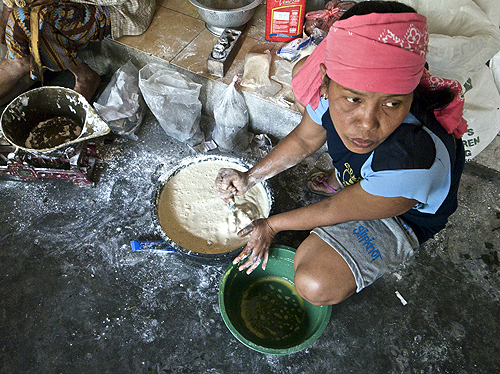
Bu Liu has been making and selling opak gambir since
1968. It is a small operation,
with only two cooks, each managing 5 or 6 irons at a time. On the day of our visit, the more
experienced cook, whose hands have toughened to the point where she can fold
and roll the still hot wafers, was absent. The young woman working that day could only make the rolled
version of the wafers.
Given the opportunity to try our own hands at rolling the
wafers, Tjing and I had mixed success.
Tjing was unable to do more than pick up the wafer briefly before
dropping it back onto the hot iron.
I managed to roll one, but it was a grosser, cloddish effort compared to
the tight rolls the young woman produced.
 |
| My effort at producing a roll. |
From there we drove maybe a quarter mile down the street to
visit another maker of opak gambir.
This was a larger operation than Bu Liu’s. From the street we descended a steep alley to an area
bordering rice paddy. Housed in a
shed with wire-meshed windows and a corrugated zinc roof, this “factory”
employed seven cooks and two packers.
It seemed to be primarily a wholesaler, packaging the opak gambir in
massive bags containing several thousand wafers. As with Bu Liu’s, each cook handled 5 or 6 irons, constantly
opening, filling, closing, flipping, and lifting one iron or another, always
remembering which held a wafer ready to be rolled or folded. Each cook produced about 6 1/2
kilograms (a little over 14 pounds) of wafers a day. A kilogram of wafers sells for a little less than $3.
 |
| Laundry drying outside the factory. |