Showing posts with label travel. Show all posts

Saturday, August 11, 2012

What Did Me This Summer


Night Stall

I took a break from posting while visiting friends and family in Indonesia this summer.  I had originally planned to post more on warungs and rumah makans I visited, but I didn't visit as many as I had planned.  Instead, I ate mostly at home--my sister-in-law's house.  Lili is an excellent cook and manages to produce simple, delicious meals on a two-burner stove in the open-air kitchen at the back of her house.  Spending time with her, her husband and two daughters was all Tjing needed, and it did me fine.

We ate tempe and/or tofu (along with other dishes) almost every day, and I was fine with that.  Indeed, I could eat Javanese tempe every day without complaint.  The difference between tempe you get in Java and the stuff that is sold (at about ten times the price) in the States is like the difference between a crusty French baguette and a loaf of Wonder Bread.  Being that Kediri is Kota Tahu (Tofu City), the tofu was of top quality also.

We did eat out at times, of course.  We enjoyed some Chinese food at Sari Agung (also known as Canton) on Jalan Doho.  We had sate ayam at Pak Siboen's down the street.  Rujak cingur from the Madurese woman.  Martabak telor from Jalan Panglima.  Mie pangsit from several different places.  Tahu telor from the warung on the corner.  But for the most part we simply ate at home.

Sometimes one doesn't need do much to be content.  Sometimes a simple dish is as satisfying as an extravagant feast.  To do more is excess.  I'll be posting recipes again soon, but for now here are some photos of what did me this summer.

 Preparing Soto Ayam Kediri

 Soto Ayam with Lontong


 Mie Pangsit

 Mie Pangsit

 Mie Pangsit


 Treats from a Muslim Neighbor Before the Start of Ramadan

 Soto Pekalongan in Bandung

Yammie Ayam in Bandung

Thursday, August 12, 2010

Roasted Coconut Juice--Kelapa Muda Bakar


Es kelapa muda is a drink found throughout Southeast Asia by one name or another.  At its best it is simply the juice and flesh from a young coconut with ice.  It is extremely refreshing with a natural sweetness.  Some places add syrups, such as rose syrup, which overpower the juice


Driving back to Surabaya after a brief visit in Yogyakarta, we passed these warungs selling baked young coconuts.  I had seen these on other visits to Java, but was never in a car that I could simply ask the driver to stop.  These never seem to be sold in cities, only in the countryside.  I asked the driver to stop and we got out and bought a few to taste.


I asked the woman, Bu Sari,  what the purpose was of roasting the coconuts.  She didn't answer directly, but claimed all sorts of health benefits from drinking the juice.  It was good for the kidneys, for the blood, would lower cholesterol, and treat gout, among others.  I just wanted to know how it tasted.


I don't know what effect the roasting of the coconuts has.  It appeared it may have somehow increased the liquid content of the coconuts.  Each seemed extremely juicy; there was about a liter of juice from each coconut. Bu Sari mixed the juice of the coconut with powdered ginger, gula jawa, and honey, producing a sweet, warming drink.  It was not as refreshing as simple es kelapa muda, but was better than a carbonated soft drink.  Our take-aways certainly made the drive more bearable.

Saturday, July 17, 2010

Serenity Now--Borobudur


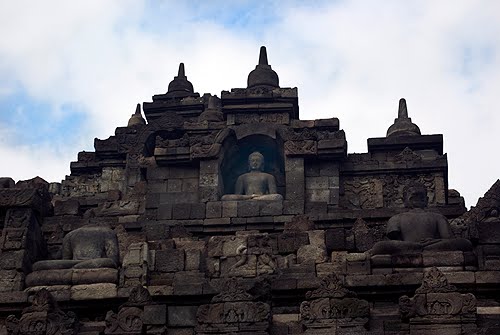
Borobudur is one of those places everyone should try to get to at least once in their lives.  It is magnificent.  I have been to it a half dozen times now and every time I am stunned by its beauty and sense of serenity.  Even with thousands of people assaulting it and hawkers selling t-shirts, soft drinks, post cards and trinkets, it maintains its integrity.


Built in the 9th century, Borobudur was constructed on a mound that apparently rose from a shallow lake plane, appearing like a lotus flower above surrounding water.  It’s an amazing technological achievement, a massive mandala structure that appears like a small mountain in the distance.  According to Wikipedia, it has 2,672 carved relief panels and 504 lifesize Buddha statues.  While the accomplishment of its construction is  amazing, the experience of visiting the site is awe inspiring.


Entering the grounds to Borobudur ($2 for Indonesians, $15 for all others), you approach the temple down a tree-lined path.  The first curve when the temple appears before you is incredible.  Despite the thousands of people surging towards and clamoring over the stones, you can’t help but be stirred by the sight of Borobudur itself.  A distant hill at first, as you get closer it appears to expand, becoming monumental.


The temple was intended as a shrine and as well as a didactic device, instructing visitors on Buddhists beliefs as well as the life of Buddha.  It has three levels, representing the world of desires, the world of forms, and the world of formlessness.  The Wikipedia article gives a good explanation of the design and significance of the different levels of the temple.


We arrived shortly after 9:00 a.m. under a cloudy sky.  By 9:30 the clouds were dispersing and the sun was coming on strong.  The last Saturday of school holidays, every family in Java and many from outlying islands decided to squeeze in a visit.  There were several thousand people there already and more kept coming.  The heat, from the sun, from the mass of bodies pushing up the narrow steps and around the walls of the different levels, was oppressive.  Buddha himself might have screamed “fuck this shit, give me some air.”


Rivulets of sweat ran down my nose.  At each level I discovered a new degree of crankiness.  By the time we climbed to the top level, the level of enlightenment, I was miserable.  I could hardly take a step without brushing against another person, the heat from their bodies, from the sun above and the stones of the temple exorcising all the moisture from my body.  Despite the beauty and peacefulness of the temple, all I wanted to do was get down and away from the throngs of people.


One thing caucasians should expect when visiting Borobudur is to have people request to have their photo taken with you.  On my first visit in 1983, I was amused when groups of teenagers approached and asked me to pose with them and sign their notebooks.  It has happened every time I have gone there.  This time a group of school girls from Surabaya stopped me to practice their English.  If you ever want to feel like a celebrity, Borobudur is the place to go.


Get the flash player here: http://www.adobe.com/flashplayer

Thursday, July 15, 2010

A Drive in the Country


In the US, I try to avoid traveling on major holiday weekends.  Memorial Day, the kickoff to summer vacation, and Labor Day, traditionally the last day of summer vacation for students, find the roadways packed with frantic families rushing to get away from or get back to their everyday lives.  Drivers stressed by the dual pressures of whining children and clogged freeways take unnecessary risks.  The news broadcasts keep a running account of traffic fatalities.  Every driver other than myself is an idiot who should be shot and dragged from their vehicles, their bodies ripped open so that feral cats might feed on their livers.  I am not one who travels those days.

This past weekend was the last weekend before the end of school holidays in Java.  Not thinking, I traveled.  My wife and I borrowed her cousin’s car, hired a driver, and embarked on a simple, excruciatingly hellish roadtrip.  Drivers and traffic in Indonesia do not bind themselves by the laws or the road.  On a two-lane highway traffic flows in six directions.  Buses, trucks, and cars think nothing of forcing motorcycles and pedestrians off the shoulder so that they might squeeze past a line of vehicles stupid enough to stay on the road.  Motorcyclists use the opposite shoulder to pass, driving into a stream of motorcycles flowing towards them.

Bus drivers in Java have neither souls nor mortal fears of death.  They play chicken and never lose, forcing vehicles and pedestrians to give way to their passage. When I first came to Indonesia in 1983, I bought a Vespa and planned to ride around Java.  Then I was on the bus to Surabaya one day and witnessed the conductor, who collects fares, lean out and push an older woman on a bicycle off the road, causing her to fall on the shoulder.  He and the driver had a good laugh.  I decided I’d just ride the Vespa around town.