Showing posts with label Java. Show all posts

Tuesday, October 30, 2012

Jamu


The iconographic image for Bali is a line of women on their way to temple balancing platters tiered with fruit, flowers, and woven offerings.  Even in the still photograph there is movement, a sense of the women’s rhythm, of their calm grace.  Their kebayas, fluorescent against the green of rice paddies and rain forests in the distance, shimmer in the stillness.  The first time you encounter such a procession of women in Bali, it catches your breath, the beauty of it, the recognition of the baseness of your own pitiful existence. 

One of the iconic images for me of Java is the jamu lady, resplendent in a vibrant, lacy kebaya, a length of batik wrapped as a sarong around her legs, a basket slung by a selendang from her shoulder, drifting along dusty streets, an apparent lightness to her step and being.  In heat that sucks the breath from you, these women move as if untethered to this earth.  They are their own best advertisement, a testimonial to the tonics they peddle.


Jamu is a traditional herbal tonic popular throughout Indonesia, but especially in Java.  Although it seems to be on the wane in the larger cities, jamu is still widely consumed in the rural areas.  Western medicine and pharmaceuticals seem to be supplanting the use of jamu among the younger population, but many Javanese still tout its virtues.  Long before the arrival of Viagra (knock-offs of which are widely distributed as "pil biru"--the blue pill), there was a jamu to treat limp dick.  There are also mixtures to keep women's juices flowing and preserve their youth, elixirs to keep their men from straying.

Tjing's childhood home, the house we still return to when we return to Java, was a jamu shop.  Customers would come in, say what ailed them, then sit on stools along a bar while Tjing's mother or aunt would prepare  tonics to remedy their complaints.  The mixtures were mostly prepackaged, a blend of various herbs that would then be made into drinks that also contained raw eggs and honey.  When I first visited the home in 1993, the bar was still set up and some customers still drifted in although it was no longer an active shop.  Until the last year or so, if you wanted to give a becak driver directions to the house all you had to do was to mention it was the cap Jago shop on Patimura (cap Jago being the brand of jamu that was sold there and featuring a sign with a rooster which still hangs outside the house).  


Too much of the world now seems familiar.  The uniqueness of place is vanishing as one small village becomes no different from another half a world away.  The Big Mac served in Kediri is not dissimilar to one you might have in New York, Moscow, or Lodi.  As smaller communities long to join the dominant world, they sacrifice pieces of themselves.  Regional foods disappear; newscasters all speak with the same generic accent.  That jamu ladies still tread this earth is something to give thanks for.  Seeing them, their baskets laden with bottles and packets of jamu, a pail for dirty glasses grasped in their hands, brings a recognition that this is Java, that it is a unique place graced by these women, that this land is unique, that here, in this everyday world, there is still that which we might recognize as sacred.

Thursday, September 13, 2012

Gokar Kencana--Ayam Goreng-Bakar--Surabaya


Bantam chickens are a breed of chicken that originated in West Java.  A smaller breed of chicken, they are, according to Wikipedia, a popular breed for suburban homes in large part due to their decreased need for space.  That such a chicken should originate in Java is fitting as it is one of the world's most densely populated islands.  Not quite one third the size of California, Java has almost 4 times the number of people as California, just over 136,000,000.  Good luck getting lost on Java; travel half a mile from any spot and it seems there is another cluster of homes.

While tempe is probably the most readily available source of protein on Java as it is cheap enough for everyone except perhaps the most abject poor, chicken is the most common meat of the Javanese diet.  Ayam goreng, sate ayam, soto ayam, and ayam panggang or ayam bakar can be found on just about any street.  Go hiking to get away from the masses and you'll probably find a hawker who has carried his grill and chicken up the mountainside to cater to hungry hikers.  A cold beer is a rare find, but a piece of freshly cooked chicken is never more than a few minutes from wherever you might be.

In Surabaya this summer, Tjing and I enjoyed a lunch at Gokar Kencana, a family restaurant specializing in fried and grilled  chicken. Anyone familiar with Indonesians fondness for acronyms might suss out the restaurant's focus (ayam GOreng) and (ayam baKAR).  In addition to chicken, the restaurant also serves fried and grilled gurame.


The restaurant is located in a suburb near several of Surabaya's universities, Universitas Airlangga, ITS (Institute Technology Surabaya), and Universitas Muhammadiyah Surabaya.  A spacious patio covered by an arching roof, the restaurant would seem to be a great place to grab a meal before or after classes.  It's much more upscale than the typical warung or rumah makan, but the prices seemed very reasonable at around 1500 rp for a serving of a quarter of a chicken with rice.

The fried chicken is not the KFC style with a crisp crust that absorbs grease, but the Indonesian style of chicken that is first simmered in coconut water with a mix of spices before being fried.  This results in a flavorful piece of chicken that is moist but thoroughly cooked without being greasy.  The grilled chicken includes some honey in the mixture that it is basted with while being grilled.  It is grilled on a custom made grill that uses briquettes rather than the lump charcoal that is more commonly used in Indonesia.  Both the fried chicken and the grilled were extremely tasty, as was the fried gurame.  Although I enjoyed all the dishes, I preferred the grilled chicken and its accompanying sambal.


Monday, July 18, 2011

Apel Hutan--Forest Apple

 The variety of fruit available in Java is astounding.  With a temperature that varies only slightly from month to month, and an even parsing of day and night throughout the year--sunrise and sunset forever between five and six--Java is not an island one would expect to find seasonal differences in what fruit is available.  Although certain fruit is available throughout the year, papaya, for example, others such as klengkeng (longan, a fruit similar to lychee) and rambutan (another fruit related to lychees) are only available for a month or two. 

It is my misfortune that my favorite variety of mango, and the one that is generally most prized in Indonesia, harum manis (sweet smelling), is not really in season in Java during the months Tjing and I are able to visit.  After tasting the mangoes that are available in Indonesia (and there are tens of different varieties), I am always disappointed by those I get in California. 


Yesterday my sister-in-law Lili brought home a new fruit for me to try.  Apel hutan (forest apple) are about the size of softballs.  The light green exterior is of a cork-like consistency, firm yet yielding, about a quarter inch thick.  The ivory flesh is the texture of honeydew melon that has just passed the peak of ripeness. The taste is reminiscent of honeydew as well, but without the aggressive sweetness. 

Sliced in half, each half serves as its own bowl.  The flesh is spooned from the shell like a creamy pudding.  I can find no mention of this fruit elsewhere and Tjing and others in her family had never had it before either.  Perhaps it is known by a different name elsewhere?  If you have any information on this, I’d love to hear it.

Saturday, July 16, 2011

Street Food

Treats abound on the streets of Java.  Go anywhere and there is someone selling something good to eat or drink.  Vendors sell from stalls set beside the road, from pushcarts, from baskets slung from cloths across their shoulders onto their hips, from trays poised on their heads, and from wooden boxes suspended from poles they balance on their shoulders.

Walking to the supermarket to buy some shampoo, I pass a man carrying some grilled cakes with the aroma of coconut.  I stop and ask what he is selling.  Kue rangin, he says, a savory snack made from fresh coconut and flour that is cooked in half-moon molds.  Like waffles dense with fresh coconut meat, the salty cakes are served with sugar.  The contrast between the saltiness of the kue and the sweetness of the sugar spark the tongue. 

He tramps the streets balancing the stove on one end of his joist, some finished cakes in a display box on the other end.  There is a rhythm to the walk of these vendors carrying their wares upon their shoulders, an easy, rolling gait.  Like acrobats balanced on a wire, they stride with apparent weightlessness, moving easily among the traffic of motorcycles, bicycles, trucks,  and automobiles.

Lowering his two boxes to the dusty street, the vendor plucks a batch of the kue from the molds, and wraps them in a piece of paper which he sprinkles with sugar before placing the wrapped cakes in a plastic bag and handing them to me.  Lightly greasing the molds, he pours in the next batch of batter, arranges his goods, arises and is on his way.


Thursday, July 14, 2011

Where I Am Writing From


My posting has become infrequent, sporadic.  Lack of discipline, entropy, inertia, a failing appetite, a reluctant acknowledgement that my wife and I are newly unemployed teachers, a dying father-in-law, witness to the dismantling of two ESL programs that served several generations of adult immigrants in Sacramento and helped it become recognized as the most diverse city in the United States--any and all of these may be behind the scarcity of recent posts.  I try to be generally upbeat in my posts, but it has been hard to be upbeat recently.  Yet, in the end, what choice do we have?  Stew in our funk, or try to enjoy life. 

Currently we are in Indonesia, visiting my dying father-in-law.  While the death of any parent is difficult, it is more so when they are not near.  Tjing’s mother died while Tjing was getting her Master’s in Australia.  She also had cancer, but her death was swift, happening just days after being diagnosed.  Although Tjing was home within 72 hours of hearing the diagnosis, it was too late.  That loss, that failure to connect with her mother one last time, is a hurt that haunts Tjing to this day. 

Despite­ the advances of science, cancer remains an unpleasant killer.  My father-in-law’s cancer of the tongue is particularly insidious, not only making it nearly impossible to eat or drink, but also robbing him of his voice.  He speaks as if muffled, choking on the tumor that mushrooms on his tongue and down his throat. Still unbent in spine, he stands about 5’9’’ but now barely weighs 90 pounds.  A once vibrant, social man who enjoyed morning walks and conversations with all manner of people, he now spends most of his days in his room, wanting only, he says, to die.

So yes, I’m in Indonesia, a country I feel at home in and enjoy as much as any.  Yet, it’s not exactly a vacation.  Still, it’s hard to stay in a funk in Java, to not appreciate the magic of its people, food, and culture.  Soon there will be more postings on some of that magic.  This I promise.

Saturday, July 17, 2010

Serenity Now--Borobudur


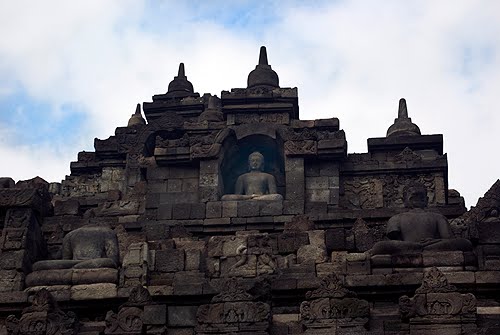
Borobudur is one of those places everyone should try to get to at least once in their lives.  It is magnificent.  I have been to it a half dozen times now and every time I am stunned by its beauty and sense of serenity.  Even with thousands of people assaulting it and hawkers selling t-shirts, soft drinks, post cards and trinkets, it maintains its integrity.


Built in the 9th century, Borobudur was constructed on a mound that apparently rose from a shallow lake plane, appearing like a lotus flower above surrounding water.  It’s an amazing technological achievement, a massive mandala structure that appears like a small mountain in the distance.  According to Wikipedia, it has 2,672 carved relief panels and 504 lifesize Buddha statues.  While the accomplishment of its construction is  amazing, the experience of visiting the site is awe inspiring.


Entering the grounds to Borobudur ($2 for Indonesians, $15 for all others), you approach the temple down a tree-lined path.  The first curve when the temple appears before you is incredible.  Despite the thousands of people surging towards and clamoring over the stones, you can’t help but be stirred by the sight of Borobudur itself.  A distant hill at first, as you get closer it appears to expand, becoming monumental.


The temple was intended as a shrine and as well as a didactic device, instructing visitors on Buddhists beliefs as well as the life of Buddha.  It has three levels, representing the world of desires, the world of forms, and the world of formlessness.  The Wikipedia article gives a good explanation of the design and significance of the different levels of the temple.


We arrived shortly after 9:00 a.m. under a cloudy sky.  By 9:30 the clouds were dispersing and the sun was coming on strong.  The last Saturday of school holidays, every family in Java and many from outlying islands decided to squeeze in a visit.  There were several thousand people there already and more kept coming.  The heat, from the sun, from the mass of bodies pushing up the narrow steps and around the walls of the different levels, was oppressive.  Buddha himself might have screamed “fuck this shit, give me some air.”


Rivulets of sweat ran down my nose.  At each level I discovered a new degree of crankiness.  By the time we climbed to the top level, the level of enlightenment, I was miserable.  I could hardly take a step without brushing against another person, the heat from their bodies, from the sun above and the stones of the temple exorcising all the moisture from my body.  Despite the beauty and peacefulness of the temple, all I wanted to do was get down and away from the throngs of people.


One thing caucasians should expect when visiting Borobudur is to have people request to have their photo taken with you.  On my first visit in 1983, I was amused when groups of teenagers approached and asked me to pose with them and sign their notebooks.  It has happened every time I have gone there.  This time a group of school girls from Surabaya stopped me to practice their English.  If you ever want to feel like a celebrity, Borobudur is the place to go.


Get the flash player here: http://www.adobe.com/flashplayer