Showing posts with label seafood. Show all posts

Tuesday, November 27, 2012

Burmese Shrimp Curry


I have very limited familiarity with Burmese cuisine.  It's a country I have wanted to visit, but I never felt comfortable contributing to a government that was so unabashedly oppressive to its people.  For years the military dictatorship used any and all means to crush the slightest dissent.  Recent reforms suggest that the country may be transitioning towards a more democratic government.  Aung San Suu Kyi, a Nobel Peace Prize winner and daughter of the man who negotiated Burma's independence from Britain in 1947, was released from prison in 2010 (she had been sentenced to 3 years hard labor because an American had swum across a lake to her house where she had been under house arrest for almost ten years; her sentence was commuted from hard labor to an additional 18 months of house arrest).  In May of this year, Suu Kyi was sworn in as a member of parliament.

While this apparent willingness to allow their people a voice is undoubtedly good news for the people of Burma, I fear Starbucks, McDonald's, and Pizza Huts may also be on their way to the country.  With the end of isolation, regional and cultural differences may also be threatened.  Traditional foods and customs come to be seen as quaint, out of touch with the modern world, kampungan, and are abandoned in favor of mass processed and marketed food that connects to the world outside.  One of the worst things I have eaten in Indonesia was a slice of Pizza Hut pizza that my nieces (whose mother is an excellent cook) pleaded for.  I still remember years ago when I was traveling in Padang (a city renowned throughout Indonesia for its food) and asked some teenagers where I could find the best food in town.  They thought about it and discussed it amongst themselves for a few minutes before telling me, triumphantly, "California Fried Chicken."  What will happen in Burma in 20 years?


Fortunately, Naomi Duguid has been visiting Burma and actively exploring its foods and markets for much of the last four years.  Burma: Rivers of Flavor, is her most recent cookbook exploring an Asian cuisine.  Having first gone to the country in 1980, Duguid's interest in and affection for the people and cultures of Burma are clearly apparent in the photographs and writing.  Like her previous books which she co-authored with Jeffrey Alford, Burma is as much an exploration and celebration of the culture and people of the country as it is of the cuisine.

Duguid's books are visually rich with photographs of the lands and people of her focus.  They are not traditional cookbooks that simply present a collection of recipes.  Cooks looking for elaborately staged photographs of finished dishes or step-by-step photos of how to prepare the included recipes may be disappointed by Duguid's Burma.  However, those who are interested in getting a glimpse of this long isolated nation will likely enjoy her anecdotal, informative approach.

The recipes presented in Duguid's book are straight forward, unfussy dishes.  Most of the ingredients can easily be found in any Asian supermarket.  Shallots, tomatoes, and various herbs (cilantro, lemongrass, Vietnamese cilantro (rau ram--daun laksa) are featured in many of the recipes. I have only tried a few of the recipes so far, but the book contains many that I look forward to trying.


I first served this shrimp curry with roti jala.  I have also served it with rice.  It is similar to sambal udang, but it is milder than most and contains no coconut milk.   For anyone put off by incendiary curries, consider giving this one a try.  

Shrimp Curry,  adapted from Burma: Rivers of Flavor

Generous 1 pound shrimp, peeled and deveined
1/4 cup minced shallots 
1 small clove of garlic, peeled and minced
3 TBS peanut oil
1/8 tsp turmeric
1 1/2 cups chopped ripe tomatoes or canned crushed tomatoes
3/4 cup water
2 tsp fish sauce
2 green cayenne chiles, seeded and minced, or to taste
1/2 tsp salt, or to taste
About 1/4 cup cilantro leaves (optional)
1 lime, cut into wedges (optional)

Rinse the shrimp and set aside.  (I boil the shells in water, strain and reserve the water and use this in place of the water called for in the recipe.) With a mortar, pound the minced shallots and garlic to a paste.

Heat the oil in a wok or a wide heavy skillet over medium-high heat.  Add the turmeric and stir, then toss in the shallot and garlic paste.  Lower the heat to medium, and cook, stirring frequently, about two minutes until softened but not browned.  Add the tomatoes and cook for several minutes at a medium boil, stirring occasionally, until the tomatoes are well softened and the oil has risen to the surface.

Add the water and fish sauce, bring back to a medium boil, and add the shrimp.  Cook just until the shrimp start to turn pink, then toss in the minced chiles, stir briefly, and remove from the heat. Taste and adjust the seasoning if necessary.  

Turn out into a bowl, top with the cilantro leaves, if using (and they certainly add to the dish), and put out lime wedges if you wish. Serve hot or at room temperature.


Thursday, March 1, 2012

Mini Alaskan Crab Tacos

 
A more correct title for this post might be Vietnamese crab salad mini tacos, for that is essentially what these are.  The filling is slightly adapted from goi buoi--Vietnamese pomelo and crab salad--with some avocado crema, red cabbage and sliced red onions.  The shells are fried sui gow skins, an idea I got from Andrea Nguyen, who writes that she borrowed it from Trader Vic's.  Check out her recipe for duck tacos, which includes a helpful video on frying the shells.  This is the sort of appetizer that looks elegant and tastes delicious, but can be prepared ahead of time and assembled at the last minute.  An even simpler presentation would be not to fold the skins and serve these as mini crab tostadas. However, since I'm submitting this in conjunction with a promotion of Alaskan fish tacos, I went with the taco version.

While I tend to focus more on Southeast Asian food, when the folks behind the Alaska fish taco promotion asked if I would be interested in doing some related posts, I agreed.  I don't know why they contacted me.  Perhaps it's because I submitted a pepes ikan taco recipe for the contest they had last year.  Maybe they've done their research and know there's a photo of me holding a 12 pound Coho salmon that I caught on the Tsiu River in Alaska in the original Rumah Makan Murni in Cepu, Central Java.  In any case, I like fish tacos and would love to go back to Alaska to do some fishing, so I agreed.  I should point out that the folks behind the promotion also gave me some gift cards to buy some Alaskan fish and fish tacos in exchange for me doing some posts.


 Mini Crab Tacos with Avocado Crema

Crab Pomelo Salad
1 cup cooked Alaskan crab meat
1 carrot, grated
1 pomelo, peeled, segmented, and crumbled (I wouldn't recommend substituting grapefruit. Although pomelo and grapefruit are similar, the taste is different enough that I don't think this would work with grapefruit.)
2 TBS minced rau ram (daun laksa) or mint (optional)
2 TBS minced cilantro

thinly sliced red onion
thinly sliced red cabbage
Nuoc Cham
juice of 1 lime
2 TBS water
2 TBS fish sauce
2 TBS sugar
1 to 2 cloves of garlic, finely minced
1 red chili, seeded and finely minced (or a splash of sriracha)

Avocado Crema
1 ripe avocado
juice from half a lime
2 TBS Mexican crema (can substitute sour cream)
2 cloves garlic, peeled and finely minced
2 TBS cilantro, minced
salt, to taste

Pot sticker or sui gow skins
oil for frying

In a large bowl, combine the  crab, carrot, pomelo, rau ram, and cilantro.  Make the nuoc cham by mixing together the ingredients in a jar and shaking well to dissolve the sugar.  Dress the salad lightly with several tablespoons of the nuoc cham.

Remove the flesh from the avocado.  Mash it up with the lime juice, crema, garlic, and cilantro.  Add salt to taste.

Fry the sui gow skins in hot oil about 1/3 inch deep.  Use tongs to hold the shells open while frying.  You need to keep them open enough so you can put the filling in.  The shells will remain crisp for at least one day if kept in an air tight container.  Andrea Nguyen has a helpful video showing how to fry the skins

When you have fried all the shells, you can assemble the tacos.  Rinse the sliced red onion in cold water.  Place some cabbage (if using) in each shell.  Then spoon in some of the crab salad.  Add a little avocado crema and top with several slices of the red onion. 


Friday, September 23, 2011

Ahi Poke


If you look towards the right side of the island, you'll notice the landing strip for Bandaneira, the main island in Central Maluku.  Landing on the strip in a twin engine prop is a exhilarating experience.  As you approach the island you notice how the strip bisects the island where it narrows.  It seems impossible that the plane will stop before the strip ends and you find yourself in the sea, but it does.  At least it did when I flew there in the late 80s.

Bandaneira is an island that doesn't attract too many foreign visitors although some of the best snorkeling in Indonesia can be found there and at other nearby islands.  It was here that the Dutch East Indies Company shifted from being simply a commercial force to a colonizing power.  Nutmeg is indigenous to the Banda islands, and the Dutch so wanted to maintain absolute control over the production of the spice that they traded Manhattan to the British for one of the islands.

I traveled there by myself, staying in a guesthouse for a few dollars a day.  The only other tourists at the time were a handful of young Germans who had the charming habit of dipping tobacco and were intent on getting some good underwater pictures of sharks.  The apparent leader of the group seemed to be the heaviest user of the dip, and as he spoke he would intermittently pause and dribble some dark saliva into a cup he carried.

They had a great wealth of underwater cameras, lights, and gear for filming their snorkeling excursions.  We all hiked up the adjacent volcano one day before snorkeling in a beautiful cove.  Because he wanted to get some good close-ups of sharks if possible, the dipper thought it would be a good idea to tie a mesh bag filled with fish heads around his waist while he snorkeled.  I swam away from the group.

It was during this trip I first had raw ahi.  A sport fishing boat that was connected to the hotel in town had caught some yellowfin.  I happened to be at the hotel when they arrived and proceeded to fillet the fish and serve up some pieces with some wasabi and soy sauce.  That began my appreciation for raw ahi.

Poke is a Hawaiian dish of ahi and onion with a simple dressing of soy sauce, sesame oil and a few other ingredients.  As with any recipe for raw ahi, the most important thing is to make sure you use only the best, freshest sashimi grade ahi.  The recipe is adapted from HAWAI'I Magazine.


1/2 lb. fresh ahi cubed into 1/4 inch pieces
1 TBS Ponzu sauce
1 TBS soy sauce
2 green onions, chopped, including green tops
2 TBS chopped Maui onion (or sweet yellow onion)
1 tsp sesame oil
1 tsp grated fresh ginger
1 tsp Lingham's Hot Sauce with Garlic
Sea salt, to taste
1 tsp toasted sesame seeds
1 tsp roasted kemiri (candlenut) ground with 1/2 tsp sea salt

Mix all ingredients together in a bowl.  Refrigerate for two hours before serving.

Tjing and I make a meal of this with rice and wakame (a kind of seaweed), but it also makes a nice appetizer served with fried won ton skins.

Tuesday, May 24, 2011

Grilled Asparagus and Smoked Salmon Salad Rolls


I'm not one for mash-ups of cuisines or dishes that have no natural affinity.  While Korean and Mexican food may share certain characteristics that make the Korean taco seem a natural permutation, some fusion dishes seem forced, the culinary equivalent to bestiality.  Foie gras con molé rojo y carnitas de conejillo de Indias might be interesting and fun.  Bestiality, after all, has its adherents.  Still, there are times when it's best just to walk away.  

Not wanting to sin against nature, I'm always hesitant to mess with a good thing.  Goi cuon, Vietnamese salad rolls, are a very good thing.  Most often filled with shrimp, bean sprouts, rice vermicelli, lettuce, and herbs, they almost make one feel virtuous simply for eating them. 

One of the meals Tjing used to fix us when we lived in Vietnam was roast pork with banh hoi and fresh vegetables.  Living on the 3rd floor in a Saigon townhouse without air-conditioning, we frequently had this during the hot, dry months before the rainy season.  Composed of sheets of banh hoi brushed with scallion oil, thit heo quay (roast pork purchased from a nearby shop), beansprouts, pineapple and young banana wrapped in lettuce, the rolls required no cooking.  Dipped in nuoc cham, they were lighter than a sandwich and we could easily doctor them to our individual tastes.


Spring in Northern California brings us asparagus and dill.  Grilled asparagus with a squeeze of lemon is one of those heavenly combinations. Cha ca, the classic Vietnamese dish from Hanoi, pairs dill and fish.  Gravlax, salmon cured with dill, is a classic combination from Europe.  Add in asparagus with mustard dill sauce and we have a party.  Making a non-traditional salad roll using cold-smoked salmon and grilled asparagus with a mustard dill sauce, therefore, didn't seem as though I was bedding the beast.  A peck on the cheek, perhaps, maybe a whispering of "who do ewe love?", but certainly no walk of shame.

The rolls turned out as good as, or better, than I had hoped.  Had we had these in Saigon, they would have been perfect on those stifling nights before the rains.  Here, I would recommend one or two pieces as a starter, but we enjoyed a plate of them for a delightful supper. 

Wednesday, March 9, 2011

Calamari with a Sweet Hot Sauce--Cumi Goreng Pedas Manis


When I was working on Pulau Galang, the Indonesian refugee camp for refugees from Vietnam and Cambodia, I had to make regular trips to Singapore every three months to renew my visa.  All of the foreign workers in the camp had these special three-month visas rather than the typical one-year work visas so the government could easily prohibit us from returning to the camp if we caused any trouble.  As Singapore was just a couple of hours away by boat, and the process took three days, it was a nice break from the camp and a welcome change from the dining hall routine.


One of the dishes I have enjoyed on different visits to Singapore is the fried baby squid (although I think it's probably baby cuttlefish).  These are whole, baby cuttlefish that are first deep fried and then finished in a sweet sauce.  Done right, they are delicious.  Unfortunately, I've sometimes had them when the cook didn't do right by them and I was faced with a pile of cloyingly sweet, rubbery aliens from the sea.  Squid is one of those dishes that either is cooked right or is a disaster.  If the first time someone tries squid, the cook fucks it up, that person will probably never try squid again.

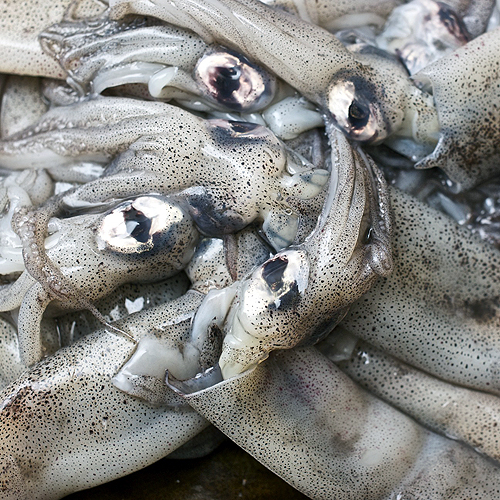
When I usually cook squid, which is not often, I use frozen squid, as this is what is most often available.  A few weeks back I noticed that Sunh Fish, where I buy most of my seafood, had some fresh squid in their case.  I didn't buy any at that time, but made note of it so that I might take advantage of some fresh squid next time they had some in when I was there.  That day came a few days ago and I bought a couple of pounds.


I had planned to make some grilled squid, cumi panggang, but when I got the squid home and cleaned them, I felt they were too delicate for such an approach.  Once cleaned, there were around thirty squid to a pound.  The bodies were extremely thin walled, about the thickness of a slice of skin from a careless moment with the mandoline.  Although I didn't think I could do them justice on the grill, I knew they would be great fried.


I intended to try the recipe from  The Food of Singapore, a book that I generally like.  After frying a few pieces of squid following its recipe, however, I decided to ditch that recipe and try my own approach.  The original recipe calls for a marinade in a batter of curry powder, cornstarch, soy sauce, and egg.  The fried squid tasted good, but didn't have the delicately crisp exterior that I prefer.  Discarding the wet ingredients, I kept the curry powder and cornstarch, and added some rice flour.  Dredging the squid in this mixture provided just the taste and texture I was looking for.

The sauce is even simpler.  To a half cup of Yeo's Sweet Chili Sauce, I stirred in about two tablespoons of kecap manis Cap Nonya. This was heated in a wok and then the fried squid were added and tossed with the sauce to coat.  The result was at least as good as any squid I've ever had in Singapore, or anywhere else.  If you like calamari, this is a dish I would definitely recommend.

Crispy  Fried Squid in a Sweet Hot Sauce

2 pounds small, fresh squid or 1 pound cleaned, frozen squid, thawed
1/2 cup cornstarch
1/2 cup rice flour
3 TBS curry powder
2 tsp sugar

oil for deep frying

1/2 cup Yeo's Sweet Chili Sauce  (I prefer Lingham's, but it wasn't at the market I went to on this day)
2 to 3 TBS kecap manis
water, as needed, to thin the sauce if necessary

Clean the squid and remove the eyes and beak from the tentacles.  Lightly score the inside of the bodies in a crosshatch diagonal pattern and cut into strips.  Dredge the prepared squid in the cornstarch mixture.  Fry in batches in hot oil for about 30 seconds.  Drain on paper towels.

After all the squid has been fried, heat the chili sauce and kecap manis in a wok or pan that  can easily accommodate the squid.  Toss the squid briefly in the heated sauce, plate, and serve.

Sunday, January 30, 2011

Indonesian Pepes Ikan Tacos with Mango Salsa

Ikan pepes is a traditional method of preparing fish throughout Indonesia.  The fish may be whole or  filleted, covered with a spice paste, wrapped in banana leaf and then steamed or grilled.  The paste keeps the fish moist and gives it a wonderful flavor.  Although banana leaves are used to wrap the fish in Indonesia, foil can be used if you don't have a Hispanic or Asian market from which to purchase frozen banana leaves in the US.


I decided to adapt a pepes ikan recipe for a twist on fish tacos.  The spice and heat of the pepes ikan makes perfect sense in a fish taco, and the mango salsa with jicama and daun laksa is one that could easily be made in Indonesia.  A drizzle of sambal kecap might have been an interesting addition; I'll try it with that next time I make these.


Unfortunately, today was a cold, rainy day more suited to a bowl of pozole than fish tacos.  They tasted good, but I was cold and wet from the grill, dreaming of white sand beaches while my feet were as cold as the coldest beer in Bali.  Fitting, perhaps, for a recipe entered in the Alaska fish taco contest.


1 12 oz package of Alaskan cod
6 shallots
3 cloves of garlic
2 slices of laos (galingal) about the size of quarters, peeled and chopped
2 slices of ginger, peeled and chopped
2 stalks of lemongrass, chopped, using only lower third, tough outer layers removed
2 tsp sambal oelek (Indonesian chili paste)
4 kemiri (candle nuts)
1 tsp ground turmeric
2 tsp light brown sugar
1/2 tsp salt
2 tsp lemon juice
2 tsp vegetable oil
6 cherry tomatoes, sliced
banana leaves (or aluminum foil) for wrapping the fish

mango salsa
1 cup of mango, preferably fresh, diced
1 shallot,  small dice
1 to 2 red chilies, seeded and cut in small dice
1/2 small jicama, diced
1/4 cup of laksa leaves (Vietnamese rau ram) finely chopped
juice of 1/2 lime

red cabbage, finely sliced
avocado, sliced

tortillas


Add the shallots, garlic, laos, ginger and lemongrass to a food processor with a metal blade and chop fine.  Add sambal, kemiri, turmeric, brown sugar, salt and lemon juice, blending to a fine paste.  Heat oil in a frying pan and fry the spice paste for several minutes until fragrant, but take care not to brown it. Remove the paste to a bowl and allow to cool.

On an 8 x 12 inch banana leaf (or aluminum foil) lay one fillet of cod.  Spread the fish with some of the cooled spice paste.  Turn it over and spread the other side.  Top the fillet with some of the sliced tomatoes.  Fold the banana leaf into a packet, using toothpicks to seal the folds. (If using banana leaves, it may be necessary to use two leaves to ensure your packet doesn't leak.) Follow the same procedure for the remaining fillets.

Grill on a medium-hot grill for 20 to 25 minutes, flipping the packet over  halfway through the cooking time. 

While the packets are being grilled, prepare the other elements.  Make the salsa by mixing together the ingredients in a bowl.  Add more lime juice if necessary.

To serve, slice open the grilled packets.  Slice off some fish from a packet and add it along with some slices of cherry tomatoes to a warmed tortilla.  Add some of the red cabbage and slices of avocado.  Top with some of the mango salsa.  Enjoy with Bir Bintang or a crisp lager.

Monday, November 29, 2010

Tuna Tartare with Kaffir Lime Leaves


 The deliciousness of my recent ahi carpaccio prompted me to make this tuna tartare.  Like the carpaccio, this is a dish I've had in the past with beef.  While there is an understandable reticence on the part of most Americans to consume raw beef and raw eggs, steak tartare is a treat that I enjoy.  Using impeccably fresh tuna in place of the beef and yolks from quail eggs, this was every bit as tasty as the ahi carpaccio.


I used a tomato paste can to serve the tartare on a layer of diced avocado.  The raw yolk added another dimension of lusciousness to the tartare.  For those concerned about consuming raw yolk, it could be hard boiled and then grated, or left out altogether. 
We are lucky enough to have a kaffir lime tree that seems to be thriving in our back yard, so getting fresh kaffir lime leaves is not a problem.  Their presence can overtake a dish though, and with something like ahi tartare you want to make sure the lime leaves don't detract from the simple clean taste of the tuna.  I found three leaves for a half pound of fish to be plenty, imparting a tropical citrus taste but not overpowering the other ingredients.


Tuna Tartare with Kaffir Lime Leaves

1/2 pound sashimi grade ahi tuna, small dice
1-2 shallots, depending on size, finely minced
3 whole kaffir lime leaves, midrib removed, finely minced
salt, to taste
avocado, small dice
quail egg yolks (optional)
chili oil (optional)

fried wonton triangles

Lightly toss together the diced tuna, minced shallots, and minced lime leaves.  Using a small tomato paste can, biscuit cutter, or similar cylinder with approximately 1 1/2 inch diameter, place a half inch of lightly salted, diced avocado in the bottom of the cylinder.  Top with 3/4 to 1 inch of tuna mixture.  Press down and push onto a serving plate.  Repeat.  You should have enough to make about four separate tartare towers.  Top each tower with an egg yolk, if desired.  Chili oil may be drizzled around the base of each tower.  Serve with fried wonton triangles.

Thursday, November 18, 2010

Soft-Shell Crab--Cua Lot Chien Bot


As a child, I had heard of soft-shell crabs from my parents, who were both originally from the East Coast.  Although I don't remember being fond of any kind of seafood before our family lived in Malaysia for a year in 1966, the concept of a soft-shell crab always fascinated me.  It seemed so brutal and perverse to wait until the animal was at its most vulnerable stage to harvest and devour it.  That there was this small window of time when the crab's exoskeleton was defenseless against a predator's appetite always held some allure for me.  This was not an everyday dish.  This was special.


Still, for all their appeal, I didn't get the chance to try soft-shell crab until 1994 while living in Saigon.  By the time the Gastronomer discovered the crab shack in 2008, prices had risen considerably from what they were in 1994, but the food there is still worth every dong.  I believe the cha gio were 5,000 dong (about 35 cents) when we first ate there and the soft-shell crabs were similarly priced.  I know the beer bill was always higher than the food bill when it came time to pay. And beer was cheap.

When I was picking up some ahi from Sunh Fish on Broadway, I noticed they had some boxes of soft-shelled crabs in their freezer.  The crabs come five to the box,  have already been cleaned,  and are ready to cook once they thaw.  Although they couldn't really compare to the ones in Saigon, at a little under $2 a piece they were worth a try.

I was tempted to make a sort of soft-shell crab po' boy sandwich, or with a tamarind sauce, but in the end decided to go with a crispy fried version served on top of a meatless yum woon sen containing several types of mushrooms.   Although I was pleased with how the crabs tasted, I think fried food never tastes as good when you are the one doing the frying.  More importantly, they were a hit with Tjing, who has a particularly unpleasant memory associated with Quan 94 in Saigon.


The recipe is adapted from Authentic Recipes from Vietnam.  The use of soy sauce results in a dark batter; replacing the soy sauce with a tablespoon of fish sauce would probably produce a lighter, more attractive batter.


Crispy Soft-shell Crab


1 tsp sesame oil
2 cloves garlic, crushed
1 tsp grated ginger
2 tsp gound white pepper
1 tsp salt

1 cup all-purpose wheat flour
1 cup rice flour
1 cup water
1 TBS rice vinegar
2 TBS soy sauce (see note above)
1 tsp oil
1 tsp sugar

soft-shell crabs
flour for dusting the crabs
oil for frying

Mix the first five ingredients together and marinate the crabs in this mixture for 30--45 minutes.

Mix the ingredients for the batter, aiming for a thin, pancake-like batter.  

Dust the marinated crabs in flour, then dip in batter before frying in oil at 360º--375º.  The crabs will have a lot of moisture and may spatter while frying, so be careful.  I found I could comfortably fry two crabs at a time in a wok.  

Serve with Thai sweet chili sauce, nuoc cham, or tamarind-ginger dipping sauce.

Friday, November 5, 2010

Vietnamese Ahi Carpaccio--Ca Tai Chanh

While I am a fan of traditional carpaccio made with raw beef, and I also enjoyed bo tai chanh on several occasions while living in Saigon, Tjing doesn't like cooked beef and raw beef makes her shudder.  So I decided to eliminate the beef and use ahi for this dish.  The combination of the ahi with the herbs is delicious and makes an impressive starter.

The one requirement for this dish is sashimi grade ahi.  Sunh Fish in the Asian Food Market is where many of the local sushi restaurants in Sacramento get their fish.  The quality of the fish is excellent and they are just as responsive to individual customers as they are to their restaurant buyers.  They are also one of the few places I know of in Sacramento that you can find fresh squid.


The key to this dish is pristine ingredients.  Assemble the components and let diners appreciate the simple clean tastes of the herbs with the raw ahi.  


I served this with sesame cracker (banh trang me), but I could also see serving it with banh hoi brushed with scallion oil.  I had to take the pictures at night, so they are less than ideal.


Vietnamese Ahi Carpaccio--Ca Tai Chanh

1/2 pound sashimi grade ahi tuna

2 TBS lime juice
2 tsp fish sauce
scant teaspoon of sugar

1 shallot, sliced lengthwise with a mandoline to get paper thin slices
1/4 cup mixed herbs, finely sliced or chopped,
1 TBS young ginger, finely minced and briefly fried

Slice tuna into pieces 1/4 inch thick.  Place one slice between two pieces of plastic wrap.  Gently pound with a meat pounder (or rolling pin, wine bottle, or sauce pan) to about an 1/8 inch of thickness.  You don't want these to be paper thin.
Place fish in saucer with lime juice mixture for just a few minutes.  With good quality ahi there's no need for the lime juice to "cook" the fish.  

Place the slices on a plate,  and top with sliced shallots, herbs, and minced young ginger.  Serve with sesame crackers, banh hoi, or whatever you like.


I am submitting this to Delicious Vietnam #7, a monthly blogging event celebrating Vietnamese food.  Founded by Anh of A Food Lover's Journey, and Kim and Hong of Ravenous Couple, Delicious Vietnam welcomes submissions from bloggers around the world.  To learn how you might participate, click here.  The roundup for Delicious Vietnam #7 will be hosted by Nina, of the blog MissAdventureAtHome.  The submission deadline is November 14, 2010.  For full details on how to participate, please go to the Delicious Vietnam page at Ravenous Couple's blog.  Check out the roundup to find the details on who will be hosting Delicious Vietnam #8.

Thursday, June 17, 2010

Mango-Langostino Skewers


Trader Joe's is a chain of markets owned by a German company.  Perhaps most famous for its Two Buck Chuck--$2 bottles of wine with the Charles Shaw label--Trader Joe's has good prices on cheese, wine, and certain other foodstuffs.  And you know Germans make good stuff.


While TJ's offers some good deals and has some items you can't easily find elsewhere, I prefer to shop local.  Living in California, I'm fortunate to have access to a vast array of fresh, seasonal produce and seafood.  The local farmer's market offers pastured chickens, grass fed beef, oysters from Point Reyes, and live fish in addition to a tremendous selection of fruits and vegetables.  Still, I wondered if I could make an appealing appetizer using ingredients purchased at Trader Joe's, ingredients that would be available year-round, anywhere there is a TJ's.


This is a simple recipe that can be assembled in minutes.  Although a summery dish, using the frozen ingredients from TJ's this could just as easily be served in Manitoba in January.

Mango Langostino Skewers (printable recipe)

2 mangoes--I used 3 mango halves from a TJ's Sweet Mango Halves package (4 halves to a package for $1.99) cut in cubes about the same size as the langostino pieces
approximately 1/2 package of peeled, cooked, frozen langostino tails ($8.95)
4 inch skewers
1 package micro greens ($2.19)

2 TBS Thai sweet chili sauce
2 TBS sriracha sauce
2 tsp olive oil
1 tsp sesame oil
2 TBS sugar
2 TBS water
1 TBS lime juice
1/4 tsp vanilla extract
2 tsp minced fresh mint

Alternate pieces of mango with pieces of langostino on the skewers, allowing two pieces of each on each skewer. You should get around 14 to 18 skewers.

Mix the dressing ingredients together.  Place the micro greens on a serving platter or individual plates.  Lay skewers upon the greens.  Drizzle dressing over skewers and greens.  Enjoy.


Thursday, December 31, 2009

Pan-fried prawns with pea shoots

Since our niece (who is allergic to seafood) was out of the house for the night, I decided to make hay while the sun shone. That is, I decided to fry up some prawns. So I went down to the Asian Market on Broadway, picked up some meaty prawns and some pea shoots. With good fresh ingredients, I think preparation should be simple, letting the ingredients stand out.

The pea shoots aren't usually available; according to Bruce Cost they have a short shelf life, turning tough and bitter if consumed too long after they've been picked. In his marvelous Asian Ingredients, Cost recommends cooking the pea shoots with a little sugar, salt and rice wine. I added two, small, thinly sliced cloves of garlic. Like other leafy greens, the shoots wilt considerably when fried, losing about half to two-thirds of their volume.

I decided to cook the prawns in their shell. A recipe I have enjoyed time and again is Blonder and Low's Pan-Fried Prawns in Ketchup Sauce from their Every Grain of Rice. This cookbook is every bit as enjoyable as Blonder's very fine Dim Sum, which I've mentioned in previous posts. Americans tend to avoid getting down and dirty when eating, preferring their prawns shelled. But the shells not only help the prawns retain their moisture, they also provide flavor. By cutting through the shell and deveining the prawn, but not removing the shell, you have a colorful, flavorful dish that is still ridiculously easy to eat.

Pan-Fried Prawns in Ketchup Sauce


1 pound prawns in the shell
2 TBS ketchup
1 TBS oyster sauce
1/8 tsp white pepper
1/2 tsp sesame oil
1 TBS vegetable oil
2 green onions, cut into 1-inch pieces

With a sharp knife, cut each prawn through the shell just far enough to expose the sand vein down the back. Remove the sand vein. Rinse the prawns and pat them dry. (This step is important, otherwise the prawns will not brown properly.) Cut off the sharp point from the tails, but leave the rest of the shell intact.

In a small bowl, combine the ketchup, oyster sauce, white pepper, and sesame oil and set aside.

Place a large skillet or wok over high heat. Add the tablespoon of vegetable oil. Place the prawns in the pan in a single layer. Brown on one side, then turn and brown on the other. Lower the heat to medium, add the ketchup mixture, and stir to coat the prawns well. Add the green onions and continue to cook just long enough to bring out the color of the onions, about 30 seconds. Serve immediately.

Saturday, November 14, 2009

Daring Cooks Sushi

The November 2009 Daring Cooks challenge was brought to you by Audax of Audax Artifex and Rose of The Bite Me Kitchen. They chose sushi as the challenge.

As fond as I am of sushi, and seafood in general, it's not something I would normally make at home as one of the members of the household is allergic to seafood. It's a pain to have to prepare separate meals for the different diets, so I generally choose to cook something that everyone can eat. And I don't care how accommodating you may try to be, sushi without seafood ain't sushi.

The biggest challenge in making the sushi was finding a time when I was well enough and had enough time to get the ingredients and prepare them on the same day. I think I may have had a touch of the H1N1 a few weeks ago, and then I was at the Foodbuzz Festival in San Francisco last week. During the week I don't have enough time to run to the store between classes and then prepare the sushi. And you don't want to make sushi with yesterday's fish.

So I had to put it off to the last moment. I actually made the nigiri sushi and the spiral sushi roll a few days ago when we had a holiday (although I still had a night class to teach). The dragon roll I only got to today.

For the sushi rice, I used Kagayaki Haiga brown rice, which is 100% khoshihikari rice. Although a brown rice with considerably more nutritional value than regular milled rice (more than twice the dietary fiber, three times the magnesium and B6, and ten times the Vitamin E), it appears almost as white as regular short grain rice. The taste was very good.

The recipes are too detailed to include with the post. They are surely available somewhere on the web, or breakdown and buy a book. The nigiri sushi is topped with salmon and ahi tuna. To accommodate my allergic niece, I made the spiral sushi with char siu, grilled green onions, avocado, and roasted red peppers. For the dragon rolls I pan fried salmon and ahi fillets that had been marinated in a teriyaki style sauce.

All of recipes were tasty. Thanks to Audax and Rose for an interesting challenge.
Get the flash player here: http://www.adobe.com/flashplayer