Showing posts with label tofu. Show all posts

Thursday, June 20, 2013

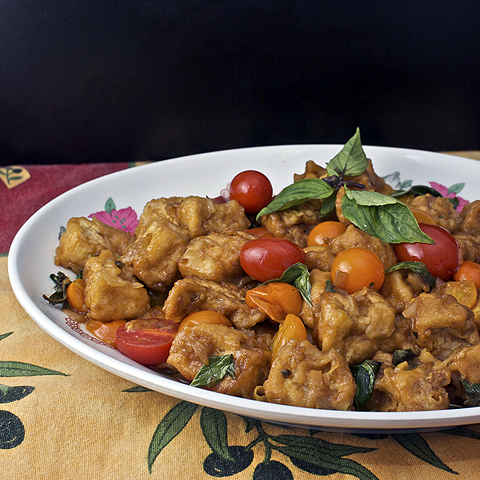
Tofu with Tomatoes and Thai Basil


With several eyes of round curing for some bresaola and some freshly sliced coppa sitting in my refrigerator, I can hardly be confused for a vegan.  I am a creature of the flesh and enjoy eating meat on a fairly regular basis.  At the same time, I enjoy tofu and tempe.  While the bresaola is curing in the fridge, I have a batch of tempe coming together in the oven (off, with the oven light on).  I'm complicated.

Actually, I am a slave to taste.  If something tastes good, I'll eat it.  While I admire  vegetarians and  vegans for their adherence to a diet that does without meat or animal products, I savor the taste of grilled pork and a succulent piece of brie.  Although fish sauce was foreign to my childhood, my enjoyment of life would be lessened without it.  The same with tofu and tempe.  My first tastes of tofu were probably as a dish that would be good for me, and I was underwhelmed.  It wasn't until I experienced it in refugee camps in Malaysia and living in Indonesia that I came to appreciate tofu.  That my wife is from Tofu City (Kediri) in Indonesia may be another reason for my fondness for tofu.  Tempe is probably unfamiliar to most Americans, and that is a shame.  What's worse is that most will only taste the health food type of tempe that is commonly available in the United States.  Javanese tempe is simple and exquisite.  It is the protein of the masses in Indonesia, and a good piece of tempe is every bit as ambrosial as that buttery piece of brie.


I can understand vegetarians and vegans abhorrence for meat.  As much as I might enjoy a quivering steak fresh off the grill, they view it as a moral abomination; I get that.  It's not going to make me enjoy my steak any less, but I understand how disgusted they may be by my choice.  Perhaps there's a Hell where pigs will be grilling pieces of my flesh on a spit, flames rising and dancing from the dripping fat. Oh well.

What I can't understand is how animated some meat eaters get about vegetarians and vegans.  They refuse to eat vegan dishes on principle.  Indignant perhaps that vegans would have them sentenced to Hell, they denounce the trappings of veganism as righteously as fundamentalists of one religion decry another.  "I'll eat a salad as a side, perhaps, but forget that tofu."  Tofu is viewed as an inferior meat, a poseur, and vegetarians should accept some of the blame for this in that too often tofu is used as a meat substitute.  However, if you appreciate tofu for what it is, a velvety flavor sponge, you can enjoy it just as much as that grilled steak. 

For vegans, vegetarians, and gastronomic agnostics, this is a wonderful dish.  You could spice it up by adding some minced chilies, but even without the chilies it is full of flavor.  For a variation, you can use nuoc cham (fish sauce with lime, garlic, and chilies) in place of the soy and vinegar based sauce in this recipe, but then it would no longer be a vegetarian dish. 


Tofu with Tomatoes and Thai Basil

4 or 5 blocks of Chinese tofu (approx. 4" x 4" x 1")
2 cups of cherry tomatoes, larger ones slice in half, smaller ones left whole
1/2 cup of Thai basil leaves
1/4 cup minced shallots
3 cloves of garlic, minced
scant 1 cup of water
2 TBS soy sauce
1 TBS rice vinegar
2--3 tsp sugar

1/2 cup all-purpose flour
1/4 cup rice flour
2 TBS corn starch
1/2 tsp salt
water

oil for frying

Cut the tofu in 1/2-inch to 3/4-inch cubes.  Drain on paper towels.  Make a batter by mixing together the flours, corn starch, salt, and water in a bowl until the consistency of heavy cream.

Heat oil to the depth of 1 1/2 inches to 350º F in a wok or other vessel. Working in batches, dip the cubes of drained tofu in the batter and then gently fry in the hot oil, stirring to keep the pieces from sticking together.  Each batch should take about two minutes to produce golden brown cubes that retain custard-like centers.  Remove the fried cubes and drain on paper towels while frying the rest of the tofu.

Remove all but several tablespoons of oil from the wok.  Fry the shallots and garlic until just softened.  Add the cherry tomatoes and fry for a minute or two.  Mix together the water, soy sauce, vinegar and sugar.  Taste and adjust for a sweet/sour/salty tang.  Add this to the tomatoes and shallots and increase the heat so the mixture is boiling vigorously.  After the mixture has reduced some, stir in the tofu.  When the liquid is absorbed and the tofu is heated through, stir in the basil leaves.  Remove from heat and serve.


Friday, August 17, 2012

Steamed Silken Tofu with Ginger, Green Onions, and Cilantro


It might seem odd that after spending much of the summer in Kediri, self proclaimed Kota Tahu (Tofu City) in Indonesia, that one of the first things I cooked upon returning to the States was this silken tofu dish, but this is not something you generally find in Indonesia.  I first tasted something like this dish some years ago in Kuala Terengganu in Malaysia. Tjing and I were at a rather unassuming Chinese restaurant and decided to give it a try.  It was a surprising burst of flavor against the backdrop of the silken tofu.  I have never come across the dish at any other restaurant.  Web searches have been fruitless as well.

When Andrea Nguyen's Asian Tofu came out, I eagerly purchased it hoping to find a recipe for the dish in it.  Alas, although her book has many delicious recipes (and the silken tofu I used in this recipe is made following her directions), it doesn't have this recipe in it.  She has several recipes using silken tofu cold, but nothing like that dish we had in KT. 

Actually, this is similar to the Chinese way of steaming fish.  The tofu is steamed and then sprinkled with finely julienned ginger and green onions, sprinkled with a vinegar-laced soy sauce dressing and chopped cilantro, and then drizzled with smoking hot peanut oil.  The oil flash cooks the herbs and adds a richness to the tofu.  This is one of those dishes meat eaters and vegans can both enjoy.  Indeed, this is one of those dishes that could actually get meat eaters to concede that a vegan diet might be possible, were all vegan dishes this tasty.


Silken Tofu with Ginger, Green Onions, and Cilantro

1 block of silken tofu, sliced into 1-inch thick rectangles
4 tsp kecap manis
4 tsp black vinegar
3 tsp soy sauce
1 inch piece of young ginger, peeled and finely julienned
2 green onions, cut into 2-inch lengths, finely julienned
1/2 cup cilantro, roughly chopped
1 tsp sesame oil
2 TBS peanut oil

Place the tofu on a plate, place half the ginger and green onions on top and steam for 8 minutes.  

Drain accumulated liquid from the plate.  Mix together the kecap manis, vinegar, and soy sauce.  Pour this mixture over the steamed tofu.  Sprinkle the remaining ginger, green onion, and the chopped cilantro on top.  Heat the peanut oil in a small pan until it is smoking.  Add the sesame oil and then drizzle this over the tofu dish.  Serve with steamed rice.

Sunday, June 24, 2012

A Plate of Java

Java, for most Americans, is synonymous with coffee.  Countless coffee shops employ
names such as Java City, Java House, and Java Corner to identify themselves as hip and
true.  They want you to know they serve the authentic coffee, no corporate multinational
conglomerate brew for them.  Unfortunately, Java produces little coffee these days, and that
which it does produce is generally inferior to that grown  on other islands in Indonesia such
as Sumatra,  Sulawesi, Bali and Flores.  Food is another story.

Throughout the archipelago local ingredients and conditions have influenced the cooking. 
Some cuisines, such as that of the Minangkabau of West Sumatra, have spread throughout
the islands; you are as likely to find a Padang restaurant in Irian Jaya as you are in Padang. 
Likewise,  a single dish such as soto has innumerable variations, evolving to reflect local
tastes and ingredients. 

For this month’s Foodbuzz 24 x 24, I proposed a sampling of the foods offered on the streets of
Kediri, my wife’s hometown in East Java.  We arrived here Friday evening,  after traveling
for 36 hours from California to reach Java, 23 of those hours spent in the air.  While time generally
seems to slip by more quickly the older I get,  not so for those long flights.

A minivan shuttled us from my wife's cousin's house in Surabaya to Tjing's family home in Kediri.  A drive that normally takes around three hours took six.  With less legroom than is afforded in economy airline seats these days, the van ride seemed every bit as long as the flight from California.  Arriving in Kediri around 8:30, we quickly set out to a local pushcart serving fried rice (nasi goreng), fried noodles (mie goreng), noodle soup (mie kuah), and a mix of fried noodles and rice (nasi mawut).  In a small wok set over a burner of glowing coals, the cook prepared each serving cooked to order.  It was a nice start to our stay in Kediri.

I thought the task of sampling a variety of the dishes available in Kediri through the course of a day would be relatively simple.  I had forgotten how much variety there is in Java, how many possibilities and variations there are.  As much as I wanted to, it was impossible to include sup buntut (oxtail soup), rawon (a hearty beef soup), pecel lele (catfish grilled or fried and served with vegetables and sambal), belut (eel), swike (frog), martabak telor (a kind of crepe folded around beaten eggs and fried crisp) while also having those dishes that I did.  I chose to avoid gado-gado and sate (satay), as I figured they were familiar to anyone who has ever been to an Indonesian or Malaysian restaurant. 

Normally my breakfast here consists of coffee and a bowl of fruit, usually papaya with a squeeze of lime.  Tjing's family consider this odd, fruit not being adequate for breakfast.  Most often breakfast for the family  is rice with whatever was left from yesterday's meals.  When told of my need to blog about the food typically eaten in Kediri, Tjing's sister, Lili, and her husband, An Kok, both natives of Kediri, quickly suggested where to get the best nasi gurih, nasi kuning, and other dishes they thought were worthy to blog about. 


A little after 7:15 on Saturday morning, Lili, Tjing, and I set out to get the food.  The first place we stopped was at the bubur ayam truck on Jl. Doho.  Bubur ayam is a rice porridge (congee or jook) usually served with a sprinkling of fried peanuts, fried shallots, chopped scallions, and fried Chinese crullers (cakwe).  It's the very definition of a comfort food, simple yet satisfying.  Although it wasn't even 7:30 yet, there was only enough bubur left for one bowl.  We purchased that for 8,000 rupiah (90 cents) and continued on our way to get nasi kuning (yellow rice).


At the nasi kuning stall we discovered we were once again too late.  Sold out.  Some sort of school group had come earlier and bought all the yellow rice.  They had nasi gurih though, so we got a portion of that for 10,000 rupiah and three fried bananas (pisang goreng) for several thousand more.  Nasi gurih is rice that has been cooked with a little coconut milk and served with several sides.  Here it was served with chicken, tofu, vegetable in a spicy coconut broth, sambal kentang kering, and a sprinkling of fried shallots.

We then went to another stall and picked up some more nasi gurih, this with a spicier broth.  After this we stopped at another sidewalk vendor on Jl. Doho that still had some nasi kuning.  Nasi kuning is traditionally a celebratory dish, often served at weddings, birthdays and selamatans.  Rice is cooked in coconut milk colored with turmeric and scented with pandan leaves.  This produces a rich, fragrant rice, visually and aromatically appealing.  This was bundled together with noodles, sambal tempe kering, fried tofu, chicken, and vegetables in spicy broth.

In both the nasi gurih and the nasi kuning there is a balance between the savory and sweet, the spicy and mild, the crispness of the sambals and the pleasing suppleness of the vegetables in their broth. 


Finally, two doors down from Lili's house, we stopped and picked up an order of pecel tumpang.  Pecel is a kind of less elaborate version of gado-gado.  Consisting of some boiled greens (in this case cassava leaves) topped with some fried tofu and tempe and dressed in a peanut based sauce, this a what might be described as a vegan's wet dream.  Pecel tumpang is a specialty of East Java, the sauce using overly ripened tempe to give it it's complex funkiness.  My brother-in-law in Bandung, West Java, who has been known to travel 14 hours by bus to Kediri, visit for two hours or so before getting back on the bus to return to Bandung, never fails to get some pecel tumpang when he is in town. We also picked up some kolak ubi there, a sweet soup rich with coconut milk and palm sugar.


bubur ayam
the spread
nasi tumpang
nasi gurih and nasi kuning
another version of nasi gurih

 kolak ubi--a sweet potato sweet coconut milk soup
Having at last assembled all the elements for our breakfast, we headed home, just two doors down.  Lili and Tjing spread the bounty upon the dining table and we all helped ourselves to a little of this and that.  The nasi kuning was superb, expertly seasoned, and the sambal tempe kering that accompanied it was just as good.  For a total of 56,000 rupiah (about $6), we had more than enough food for four adults and two hungry girls.


For lunch we had one of my favorites, soto ayam.  Soto ayam can be found throughout Indonesia, but some of the best is undoubtedly in Central and East Java.  When I first came to Indonesia almost 30 years ago, soto ayam was what I had for a mid-morning snack or lunch at least four days a week. The best soto ayam I've had is still that I used to get in Cepu, but Kediri has several worthy contenders.  We chose to eat at the venerable Soto Pojok (Corner Soto), a small rumah makan located on Jl. Doho, Kediri's main street.  Soto Pojok has been in business since 1926 and is open every day of the year, including national holidays and during Ramadan.

soto ayam
tahu dan tempe goreng
enjoying lunch
A rumah makan (which literally translates as eating house) is a kind of scaled down restaurant.  Most rumah makans offer a very limited menu of a few dishes which are already cooked and are merely assembled when ordered.  Soto Pojok offers two items, soto ayam and tahu and tempe goreng (fried tempeh and tofu).  Their tempe goreng is heavenly, with a golden brown and crisp exterior and an almost creamy interior.  Although they use a light hand when adding chicken to the soto, and the rice they use is not the best, their broth is very good, which you would expect from a place that has been in business more than 75 years. Six bowls of soto, five krupuk, two portions of tahu dan tempe goreng plus drinks came to 75,000 rupiah (about $8).

Having purchased food from pedagang kaki lima (street vendors) and warungs for breakfast, and eaten lunch at a rumah makan, I thought for dinner we should go to a restaurant.  It's one An Kwok and Lili took us to several years ago, a seafood restaurant which I remembered having some excellent ikan bakar (grilled fish). 

Ikan Bakar 99 is an odd place that serves very good food.  The owner and main cook is a body builder who stands about 5'6" tall.  On the walls inside the dining room, which appears to be the living room of a house, are pictures of the owner oiled and flexing.  As sometimes happens in Indonesia, one of the servers was wearing a T-shirt that might not have been appropriate for a restaurant.  It read: Save Water, Pee While You Shower.  Not something you really want to think about while sitting down to eat.  The room has the capacity to seat 28, uncomfortably.  Being Saturday night, it was full when we arrived, but fortunately we were able to squeeze into a table in the back corner. 

All the food is prepared in front of the restaurant.  The owner/cook mans two gas fired burners, one dedicated to a wok for deep frying, and another for braises and stir fries.  An assistant oversees a grill of ruby coals over which whole fish are quickly grilled.

I ordered more food than we could possibly eat, more than I was comfortable ordering, but I wanted to try a range of dishes.  I was uncomfortable ordering so much in front of An Kok and Lili, not wanting them to think Tjing and I were gluttons or people who didn't know the value of money.  There is always this line one walks as a foreigner in Indonesia, knowing that what seems like little to you is not so little to those who live there.  A plate of noodles for less than two dollars would be nothing for many Americans, but for many Indonesians that would seem an extravagance.  Nevertheless, I ordered away, explaining it was Foodbuzz paying for the meal, not me.  We had ikan kakap bakar manis (snapper grilled with sweet soya sauce), gurame goreng (thin slices of filleted gurame dusted with flour and fried, served with a sweet and sour sauce, sawi cah udang (choy sum with shrimp), kweitiau seafood (broad rice noodles with seafood), udang crispy (crispy fried shrimp), mun tahu (tofu braised with vegetables and seafood), and steamed rice.  The total for the dinner, including tea and a glass of fresh orange juice, came to 199,000 rupiah (a little over $20). 

ikan kakap bakar manis

gurame goreng

digging in

mun tahu

sawi cah udang

 udang crispy

All in all, it was a wonderful day sampling some of the foods Kediri has to offer.  I'd like to thank Foodbuzz for the opportunity and hope to post more of the places  and recipes I try in my next few weeks here.

*When I originally posted this my laptop had less than 5% battery life, so I wasn't able to include any recipes other than the link to soto.  Here are a few others.

Pecel Sambal Kacang

500 grams peanuts, fried
1 red chile
5 red Thai chiles
5 cloves of garlic, peeled
1/2 inch of fresh kencur (almost impossible to find in the US) or 1/2 tsp ground kencur
2 kaffir lime leaves
1 tsp vinegar
200 grams sugar
salt, to taste
3 TBS vegetable oil

Long beans or green beans
Spinach
Bean sprouts

Heat the vegetable oil in a wok or skillet, add the chiles and garlic and stir fry until softened, being careful not to brown the garlic. When softened, remove from the pan and mix with the peanuts, kencur (if you have), lime leaves, sugar, and salt in a blender.  Process until you have a well mixed paste.  Add the vinegar and enough water to make a sauce that is thick, but can be poured atop the vegetables.

Boil the vegetables separately in a large pot of boiling water.  The beans will take two to three minutes, maybe a little less for the spinach, and a minute should be long enough for the bean sprouts.  As each vegetable is cooked, drain and plunge in cold water to stop the cooking.  Drain well.

Place the vegetables on a plate and top with the peanut sauce.  Serve with rempeyek and/or krupuk.

Pecel Sambal Tumpang

150 grams tempe, diced
50 grams tempe semangit (overripe tempe--if you make your own tempe, let some of it continue to ferment before wrapping it and putting it in the refrigerator or freezer)
1 salam leaf
2 kaffir lime leaves
1/2 inch of laos, pounded
3 red Thai chiles
200 ml water
500 ml coconut milk
3 TBS vegetable oil

4 shallots, peeled
3 cloves of garlic, peeled
1 red chile
1/2 tsp coriander seeds, finely ground
1/2 inch kencur
salt, to taste

Long beans or green beans
Cassava leaves (these are somewhat bitter, chard or kale would be a good substitute)
Bean sprouts

In a mortar or using a food processor or blender, grind together the shallots, garlic, chile, coriander, kencur and salt.  Heat the vegetable oil in a pan over medium heat and add the ground spice mixture.  Cook, stirring, until fragrant and softened.  Remove from the pan and cool.

In a medium saucepan boil the water with the two tempes, salam leaf, kaffir lime leaves, laos and Thai chiles until they are cooked.  Add the previously fried spice mixture, bring to a simmer, then remove from the heat.

Process the cooked tempe mixture to a paste and return to the saucepan.  Add the coconut milk and bring just to a simmer over low flame.  Remove from the heat and allow to cool.

Cook each of the vegetables separately in a large pot of boiling water. Put in cold water to stop the cooking and drain. 

Place a mix of the cooked vegetables on a plate and pour over the cooled tempe sauce.  Serve with rempeyek.

Mun Tahu

8 oz silken tofu, cut into 1/2-inch cubes
4 oz shrimp, peeled and coarsely chopped
4 oz chicken or pork, coarsely chopped
1 cup water
3 cloves of garlic, peeled and crushed
1 slice of ginger, crushed
1/4 tsp white pepper, finely ground
1 TBS light soy sauce
3 TBS vegetable oil
1 tsp cornstarch mixed with 2 TBS water
8 young scallions, thinly sliced
1 tsp sesame oil

Heat the vegetable oil in a wok.  Stir fry the garlic until golden and fragrant.  Add shrimp and chicken or pork, stirring.  As soon as this mixture colors, add the water and bring to a boil.

Lower the heat and add the tofu, ginger, white pepper and soil sauce.  Simmer five minutes to allow the flavors to develop.  Stir in cornstarch slurry and simmer several minutes until the sauce thickens slightly.  Stir in the thinly sliced scallions and sesame oil.  Remove from heat and serve.


Sunday, June 17, 2012

Tofu and Garlic Chive Turnovers


Garlic chives (kucai) appear in many dumpling recipes.  They are much more fragrant, some might say odorous, than regular chives although their flavor is not overpowering.  They are particularly nice when cooked with shrimp.  In this recipe from Andrea Nguyen's Asian Tofu, they are paired with tofu.  Nguyen's recipe actually calls for the use of seasoned pressed tofu, but I used some fresh tofu from a local tofu maker after first draining the tofu in a colander under weight and then wrapping the tofu in cheesecloth and wringing out every bit of moisture that I could. 

These are substantial, much larger than potstickers.  They are about the size of empanadas.  The dough is easy to make and work with, and it produces a chewy crust.  Although best served warm (and what fried food isn't?), they are not bad at room temperature. 

I am not someone who eats tofu as penitence.  While I would never choose to eat a tofu, lettuce and tomato sandwich instead of a BLT, I  certainly might opt for tahu lontong or tahu telor rather than a BLT.


Tofu and Garlic Chive Turnovers
printable recipe

2 cups unbleached all-purpose flour, plus extra for dusting
1/2 tsp salt
2/3 cup warm water
4 tsp vegetable oil

1 small bundle (they come eight to a package) cellophane noodles, soaked in hot water to soften, drained and chopped
2 blocks of fresh tofu, drained, squeezed in cheesecloth to drain all the moisture you can from it--or 4 to 5 ounces baked pressed tofu, finely chopped (about one cup)
1 1/2 cups garlic chives, chopped
3/4 tsp salt
1/2 tsp white pepper
1/2 tsp sugar
1 TBS cornstarch
1 TBS sesame oil
1 large egg

vegetable oil for panfrying

In a large bowl or  food processor, mix together the flour and salt.  Combine the water and oil and add to the flour mixture.  Process in the food processor until the dough forms a ball and continue for another 30 seconds or so.  If mixing by hand, stir in the liquid until the dough comes together.  You should have a fairly soft, supple dough.

Knead the dough until it is smooth and elastic, maybe about ten minutes if doing the entire process by hand, less time if starting with the food processor.  Once the dough is smooth, wrap well with plastic and let rest at room temperature for at least 15 minutes and up to 2 hours.

While the dough is resting, make the filling.  In a medium-sized bowl mix together the noodles, tofu, and garlic chives.  Mix together the salt, pepper, sugar, and cornstarch in a small bowl.  Stir in the egg and sesame oil into the seasoning mixture and mix well.  Pour this into the tofu mixture and stir until well combined.

Make the turnovers in 2 batches.  Cut the rested dough in half.  Wrap the half you are not using in plastic.  Cut the half you are using into 4 equal size pieces about the size of golf balls.  Flatten each ball into a 3-inch wide disk.  Dust both sides of each disk with flour.  Use a rolling pin to roll the disks out to approximately 6 1/2-inch diameters.

Place approximately 1/4-cup of filling just off center of a rolled out piece of dough.  Bring over half of the circle and press to seal.  Lightly wetting the bottom edge of the circle helps ensure a secure seal.  Make sure the filling is distributed evenly within the closed turnover.

Dust the bottom of each filled turnover with flour and place on a parchment lined baking sheet.  Cover the filled turnovers with a dishtowel while rolling out and filling the others. 

When all have been rolled and filled, heat about 1/4 cup of oil in a large nonstick frying pan over medium to medium-high heat.

When the oil is shimmering, panfry the turnovers for 3 to 4 minutes on each side, frying 2 to 3 turnovers at a time.  Fry until they are brown and crispy on both sides.  Nguyen suggests using tongs to hold the turnovers upright and brown the spines.


Wednesday, December 7, 2011

Pong Tauhu--Tofu with Meatball Soup


Although they share many cultural, linguistic, and culinary influences, Indonesia, Malaysia and Singapore also have distinct differences.  One of the reasons I am so fond of Indonesia is that there are so many distinct cultures throughout the archipelago.  Even within Java, the Sundanese of West Java are different from the Javanese of Central and East Java, with their own language and dietary preferences.

Nonya cuisine is essentially a blend of Straits Chinese and native Malay/Indonesian spices and ingredients.  As a result, you'll find a combination of tastes that you would not find in strictly Chinese or strictly Indonesian dishes.  For instance, coconut milk is rarely used in Chinese dishes, and pork would of course be taboo for Muslims.  This amalgamation of ingredients and flavors results in a vibrant and rich culinary tradition that stretches along the Straits of Malacca from Penang to Singapore and Riau in Indonesia. 

While Penang, Malacca, and Singapore are where the Peranakan culture and cuisine have been best preserved and promoted, in truth its influence remains strong along the east coast of Sumatra and along the north coast of Java wherever Chinese communities have been. This particular recipe is from a Singapore cookbook, Nyonya Specialties by Mrs. Leong Yee Soo, but it is something I could easily imagine finding on the table in my wife's home in Kediri.  It's a bright, robust soup that is hearty enough to serve as a meal on a chill winter evening. 

BTW, this soup, pong tauhu, should not be confused with the Indonesian tahu pong.  Although they are probably derived from the same root, tahu pong are fried tofu puffs.  Those in this recipe are  denser dumplings of tofu that are not fried.


 Tauhu Pong--Bean Curd with Meatball Soup
adapted from Nyonya Specialties

1 1/2 lb prawns, preferably with heads (for making the stock)
1 1/2 lb minced pork
3 TBS green onions, finely chopped
8 oz firm tofu

 Seasoning
1 TBS salt
1 egg, lightly beaten
1 tsp dark soy sauce
1/4 cup vegetable oil
4 cloves of garlic, peeled, minced and fried crisp
1 tsp white pepper, finely ground

2 TBS vegetable oil
2 cloves garlic, peeled and pounded to a paste
1 TBS yellow bean paste (tauco), pounded
1 tsp sugar
1 tsp salt or more, to taste

1 1/2 pound julienned bamboo shoots
12 oz fresh pork belly

Remove the shells (and heads) from the prawns.  Reserving the meat of the prawns, fry the shells in a stockpot until they change color and are charred in spots.  Pound the shells and add 6 1/2 cups water.  Strain and set this stock aside.

Boil the pork belly in 4 cups of water for about 45 minutes.  Cut the pork into thin strips.  Add the pork stock to the prawn stock.

Mix together the seasoning ingredients.  Mince the prawns and tofu and combine them with the minced pork, green onions, and seasoning.  Grease your hands and roll the tofu mixture into walnut-sized balls.  Place the meatballs on a tray.

Heat 2 TBS oil and fry the pounded garlic until it just begins to color.  Add tauco and sugar and stir-fry for a minute.  Add bamboo shoots and stir.  Stir in reserved pork and prawn stock.  Boil for 15 minutes, then taste and add salt. 

Add meatballs and pork strips to boiling soup.  Cook on a low boil until meatballs float to the surface.  Simmer for 5 to 7 minutes.

Serve hot. 


Friday, September 2, 2011

Fried Tofu with Flowering Chives


There are two places I like to go when I visit any city.  One is the bookstore, the other the supermarket.  Those two places give a good feel of the city and what the tastes of its population lean towards.  A city that only has a bookstore stocked almost entirely of popular generic fiction and spiritual/financial/home decorating self-help tomes is likely to have a supermarket that has preformed taco shells and rice in the "Ethnic" aisle.  A proper bookstore is a place one can lose oneself in, drifting from find to find, discovering books and authors scattered throughout the aisles, one discovery leading to the next.


While Indonesian bookstores (and really there is only one major chain that operates throughout the country--Gramedia) have limited offerings in the realm of fiction (the government having long suppressed critical voices--although it is now possible to buy copies of Pramoedya Ananta Toer's novels in Indonesia), the cookbook selection is fairly extensive.  A large number of the cookbooks have a slant towards home industry--collections of snacks and variations that can be sold for profit.  The rest of the cookbooks tend to be for the home cooks who wants to expand their familiarity with traditional Indonesian dishes.


As many Indonesian families employ maids to help with cooking and cleaning, a lot of Indonesians grow up not learning how to cook.  A maid from Central Java is going to cook soto ayam different from a maid from West Java.  My father-in-law (who is from East Java) is famous for complaining about the food when he stayed with his son in Bandung, West Java.  Nothing ever tasted right to him. The cookbooks with 30 variations on soto help the beleaguered housewife soothe her family's tastes.

One of the cookbooks I picked up during our stay in Indonesia this summer is 240 Resep Hindangan Sehari-Hari untuk 2 Bulan (240 Recipes of Dishes for Every Day for 2 Months).  The book presents four recipes for each day, one for breakfast and the other three for lunch/dinner, with photos.  It has a number of recipes that look promising and I'll be posting in the coming months.  The coconut milk used in this one gives the fried tofu a lushness that is not usually associated with tofu.  I served it with Lingham's Hot Sauce with Garlic, but a Thai sweet chili sauce would also work, and I think Vietnamese ginger-lime sauce (nuoc mam gung) would be really nice with this.


Fried Tofu with Flowering Chives
(Tahu Goreng Tepung)

1 large block of regular tofu cut into 1-inch cubes

3/4 cup all-purpose flour
1/4 cup rice flour (do not use glutinous rice flour)
1 tsp fine sea salt
1/2 tsp ground white pepper
1 1/4 cup coconut milk
1 large egg, beaten
10 flowering chives, cut into 1-inch lengths

oil for frying

In a large bowl mix the flours, salt, and pepper.  Whisk in the coconut milk and beaten egg until you have a fairly smooth batter.  Stir in the chives and about a third of the tofu cubes.

Heat the oil in a wok.  With a fork or slotted spoon remove pieces of tofu that have been covered in the coconut batter and carefully lower into the hot oil.  Gently fry until all the pieces are a golden brown.  Remove  and drain on paper towels.  Repeat until all of the tofu pieces have been battered and fried.  As with all fried foods, these are best served hot.


Wednesday, August 18, 2010

Fried Tofu with Shrimp Paste Sambal--Tahu Goreng Sambal Petis


I came across Kecap Manis Cap Nonya while staying at a small hotel just outside of my wife's hometown of Kediri.  We were there because her brothers and their families had come from Jakarta and Bandung to celebrate my father-in-law's 80th birthday.  Needing a place to sleep, we all headed up the hill towards Pohsarang, a place of pilgrimage for Catholics in Java.  On weekends buses from across Java fill the narrow roads and the hotel fills up, but it is quiet during the middle of the week.  In fact, there were no other guests the two nights we stayed there.


In the morning the hotel cooked up some delicious tahu goreng with sambal petis.  This is a simple dish that relies on good ingredients.  Cap Nonya provided a nice smoky sweetness to balance the funk of the petis (a fermented shrimp paste used in a number of East Javanese dishes). 


Tahu Goreng Sambal Petis

Five blocks of fresh tofu (sold in plastic bags with water in Asian markets)
Oil for deep frying the tofu

1 TBS petis, or more, to taste (don't substitute Vietnamese mam ruoc--which is more pungent)
1 clove of garlic, crushed to a paste in a mortar
chilies, stemmed, seeded, to taste, I recommend starting with one or two, ground to a paste with the garlic in the mortar
1 to 2 TBS kecap manis
2 TBS water
1 TBS natural, crunchy peanut butter (optional--make with and without to give your guests a choice)

Quarter the blocks of tofu into cubes or triangles.  Fry in hot oil until crisp and golden.

Mix all of the sambal ingredients in a mortar.  Serve with the warm tofu.

Vegetarians can omit the petis and substitute the juice of half a lime.  You might also experiment by substituting a teaspoon or so of fermented tofu. 

Monday, June 7, 2010

Tofu Fried with Basil


Now, my favorite way of having tofu is probably tahu telor.  I think that dish, which is similar to a Spanish tortilla with tofu rather than potatoes and then served with bean sprouts and a tangy peanut sauce, is impossible to top when it is cooked right.  That's not to say that I don't like stuffed tofu, or salt and pepper tofu, or ma po tofu, or countless other ways you can prepare tofu.  However, I don't generally like dishes in which tofu's role is an ersatz meat.  Spaghetti and tofu ragu would be better without the tofu; tofu is simply a distraction from the other ingredients rather than a complement.

Chicken fried with basil is a dish you'll find at every Thai restaurant outside of Thailand.  Gai paht kra prao, pad thai, and gai yang seem to be the holy trinity of dishes on Thai menus.  It's a dish that comes together quickly and is a flavor powerhouse.  Although I don't generally favor the substitution of tofu for meat, there are dishes where it works.  This is one.  That's because what really makes this dish is the combination of garlic, peppers and basil in a salty-sweet sauce.  It works with chicken, pork, shrimp, or tofu.  The tofu is not the star of the dish, but it doesn't detract from it.

Friday, June 4, 2010

How to Make Tofu


I like to make things from scratch.  Jam, krupuk, sambal, and tempe are some of the things I have attempted.  It's not so much that I think everything homemade is better than what you can buy in the store; I don't.  It's also not because I am worried about artificial flavors, preservatives,  or other chemical additives.  If one thing doesn't kill you, something else will, so I don't worry excessively about what I consume.  I make things from scratch because I like the challenge, and the learning process.  After I have successfully made something that I had hitherto only bought in a store, I have a much greater appreciation for it.  I think the process teaches me to be more discerning in appreciating what are the subtle differences between a good product and a great one.


Making tofu is simple, but complicated, time consuming, but quick.  It requires several different pots, a blender, several pieces of good quality cheesecloth, a form for pressing the tofu, and several spoons.  It requires hours of inactive time, but only minutes of active involvement.  The final product is tofu that is as good or better than the best you can find in any market, but it is still, in the end, only tofu. While I'll  continue to make it on an irregular basis, I won't stop buying tofu from my local tofu shop.

Thursday, May 27, 2010

Tofu and Sweet Potato Fritters--Bakwan Tahu dgn Ubi

After the porkapalooza over the weekend, I felt a need to step away from the meat.  So I thought I'd try a couple of dishes with tofu.

When I first tasted tofu many years ago, I hated it.  At that time, early to mid 70s, there was a push to convert meat eaters to vegetarians by making ersatz meat dishes with tofu.  You can still find remnants of this misguided effort in supermarkets that sell tofu dogs and such.  If you like a good hot dog, or even one that you might find at a bowling alley or an airport bar, rotating for god-only-knows-how-long on the bars of the wienermatic hot dog rotisserie, you will not like a tofu dog.  Moreover, if you like tofu, silken, firm, steamed, fried, or simmered, you will not like a tofu dog.  If suffering does indeed ennoble, a steady diet of tofu dogs should guarantee sainthood.

Bakwan tahu, on the other hand, are sinfully good.  In Indonesia, you would find these being sold from carts on street corners, one of a selection of fritters and chips fried to order.  Made with bean sprouts and finely julienned sweet potatoes, they are similar to Vietnamese banh tom.  You could easily add shrimp to these, and bakwan often do have shrimp, but I left them out since our niece is allergic.


They are good with cocktails, but then, isn't everything?  I served these without any sauce, but they would be good with some nuoc cham. They may be served with lettuce to hold and wrap them, or naked, as they are usually served in Indonesia.


The recipe can be easily adjusted to incorporate other ingredients.  The batter can be made slightly thinner or thicker by increasing or decreasing the water.  The bakwan can be deep fried or shallow fried.  If making ahead of time, keep warm in a very low oven until ready to serve.  They should not be made more than an hour ahead of time.

Bakwan Tahu dengan Ubi

1 egg, beaten
1/2 cup all purpose flour
1/2 cup rice flour
1/2 tsp baking powder
2/3 cup water
1/2 tsp salt
2 cloves of garlic, pounded to a paste
4 to 5 shallots, minced, then pounded to a paste


1 block of tofu, about 250 grams, cut into 1/2 inch cubes
2/3 cup finely julienned sweet potatoes
2/3 cup bean sprouts

oil for frying

Make a batter of the first eight ingredients.  Stir in the tofu, sweet potatoes, and bean sprouts.  Drop by large tablespoonfuls in hot oil.  Cook on both sides for two to three minutes.  Drain on paper towels.  Serve warm.