Showing posts sorted by relevance for query soto. Sort by date Show all posts

Saturday, January 15, 2011

Soto Madura

Outside of the Indonesian spiced coffee cake recipe that I posted last month, I realize I haven't posted many Indonesian recipes lately.  I could blame it on the season--winter in Northern California just doesn't put one in an Indonesian frame of mind--but it's more likely the result of laziness.  Cooking for just the two of us, I don't feel the urge to cook up a dish that I know I will be eating for several days in a row.  Winter is also the time Tjing finds her way to the kitchen, cooking up large quantities of noodles and pigs feet in soy sauce.  We cook one or two nights and eat leftovers for lunch and dinner the rest of the week.  However, this week I decided to try out a recipe for soto Madura.

Just as Indonesia has numerous versions of sate (satay), so too does it have countless variations of soto, a soup that can be found throughout the archipelago.  In fact, the cookbook that this recipe comes from--668 Indonesian Recipes from 33 Provinces  (668 Resep Masakan Khas Nusantara dari 33 Provinsi)--features 23 recipes for soto and only 11 for sate.  Soto is a perfect dish for rumah makans because the bowls can be assembled per order with the ingredients the customer requests and then filled with the hot broth.


I am particularly fond of Soto Ayam Ambengan (which may lay claim to being the most popular soto in Indonesia), but like other versions as well.  As with Vietnamese pho, the key to any good soto is the broth.  Although you could make a quick version using canned chicken broth, it will be a far cry from a soto made with homemade chicken stock. 


Madura, an island off Surabaya that is now connected to Java by an impressive bridge, is included in the province of East Java.  Javanese generally consider the Madurese to be coarse folk easily angered.  Then again, many Javanese describe almost all non-Javanese this way.  With a slightly drier climate and less fertile soil than Java has, Madura has developed a cuisine with some differences from Java.  Bull racing (kerapan sapi) draws adventurous tourists to the island, and the bulls also feature prominently in traditional dishes, most famously in rujak cingur and soto daging.  This soto ayam Madura may have evolved from the popularity of chicken soto in nearby Java.

As I mentioned, the recipe is adapted from 668 Resep Masakan Khas Nusantara dari 33 Provinis by Yulia T and Astuti Utomo; Agromedia Pustaka; 2008.  

Soto Ayam Madura

1 small chicken, preferably free range, about 3 pounds
1 TBS salt
3 quarts filtered water

12 shallots (smallish ones, shallots in Indonesia tend to be the size of large garlic cloves)
9 cloves of garlic
2 tsp black pepper, freshly ground
1/4 cup fresh ginger, peeled and coarsely chopped
1/4 cup fresh laos (galingal) peeled and coarsely chopped
7 kemiri (candlenuts) unsalted macadamia nuts may be substituted
1 1/2 tsp sugar

2 cups bean sprouts, blanched by pouring boiling water over and drained
1 pound potatoes, boiled, sliced and fried
4 to 6 eggs, hard boiled, peeled, and sliced in half (or as you like)
6 stalks seledri (a leafy celery that you can find in Asian supermarkets), finely sliced
6 TBS fried shallots
2 limes, sliced

In a sufficiently large pot, place the chicken with the water and salt.  Bring to a boil, then lower to a simmer and cook until done, skimming any foam from the surface.  Remove the chicken, allowing it to cool before shredding the meat with your fingers.  Skim or separate the fat from the broth.

In a food processor, puree the spices until you have a relatively smooth paste.  Add a little broth if needed to make the process easier.  Stir the paste into the pot with the broth.  Simmer for 20 minutes or so.

Prepare bowls by adding some shredded chicken, bean sprouts, sliced potatoes, half an egg, and sliced seledri.  Ladle in the simmering broth.  Top with fried shallots.  Serve with sambal, kecap manis, and sliced limes, allowing diners to adjust the seasonings to their taste.

Tuesday, November 2, 2010

Soto Mie

Soto is found in numerous forms throughout Indonesia.  Soto ayam, chicken soto, which has numerous varieties itself, is my favorite soto.  The very best soto I've ever had comes, of course, from Rumah Makan Murni in Cepu.  In my two years of living in Cepu, I probably had soto ayam at RM Murni at least three times a week.  I've had good soto elsewhere in Indonesia, but none better than what is served in Cepu.

This past summer we visited my wife's brother's family in Jakarta.  While I am about as fond of Jakarta as I am of Los Angeles, one of Jakarta's attractions is its culinary mix from groups throughout the archipelago who come to the capital in search of livelihoods.  The massive influx of citizens from throughout Indonesia has created pockets of distinct cultures and hawkers selling their foods.  Unfortunately, traffic is so horrendous in Jakarta that this pockets are about as accessible as the interior of Kalimantan.


Like many folk living in Jakarta, my in-laws generally eat out at least once a day.  Cooking in a cramped kitchen over a two-burner propane stove is not just wearisome, it is hellish in a house without AC.  A quick stir-fry, boiled eggs, fried chicken,  or soups might be prepared early in the day to be enjoyed by the family later, but no meal is prepared to be eaten just after being cooked.  And when guests impose themselves on the family, there is little choice but to go out to eat.

As an air conditioner sales representative, installer, and service technician, my brother-in-law, Ming, knows Jakarta and the surrounding areas well.  He is without a doubt the best driver I've ever ridden with and seemingly knows all the back alleys and short cuts throughout Jakarta.  In the course of learning all the arteries of the city, Ming has also discovered remarkable warungs and restaurants.  One day he told us he had a job that he had to check on outside of the city, a new housing development on the ever expanding outskirts of the megalopolis.  If we wanted to come, he said, there was a rumah makan that sold excellent soto mie.  


Soto mie is an interesting soup.  Consisting of a spicy beef broth with noodles, cabbage, seledri (Asian celery), and sliced risoles that have been filled with rice vermicelli and fried, it's a dish anyone trying to stretch a rupiah might enjoy, the risoles being cheap yet flavorful while adding some additional body to the soup.  It's also a dish that suits the cooler clime of Bogor where it is said to have originated.  Although I still much prefer soto ayam, soto mie will definite get some play during the fall and winter months here in northern California.


The recipe is adapted from 668 Resep Masakan Khas Nusantara dari 33 Provinsi by Yullia T and Astuti Utomo.  (PT Agromedia Pustaka, 2008)


Soup base
150 grams shallots, roughly chopped
6 cloves garlic
1 tsp black pepper
6 kemiri (candlenuts)  dry roasted, unsalted macadamia nuts may be substituted
2 salam leaves
1 stalk of lemongrass, cut in half and lightly crushed
1 2-inch piece of ginger, crushed
2 quarts beef broth made from the beef ribs
salt to taste


11/2 lbs beef back ribs
12 oz fresh noodles, cooked and drained
1/4 head of cabbage, thick core removed, finely sliced
6 risols, sliced into 1 1/2 slices
3 stalks of seledri, finely sliced
1 green onion, finely sliced
emping goreng (fried melinjo crackers--these may be found, unfried, in Asian markets)
sambal

In a 4 to 6 quart pan, brown ribs on all sides.  Add 3 quarts water and bring to a boil.  Simmer for several hours until meat can be easily pulled from the bones.  Remove fat from the broth.  Cut meat into small, bite-sized pieces.

In food processor or blender, puree shallots, garlic, pepper and kemiri.  Fry this paste along with lemongrass, salam leaves and ginger until softened and fragrant.  Add beef both, bring to a boil and reduce to a low simmer while preparing risols.

Once risols have been filled and fried, assemble the soup.  Place some noodles, cabbage, beef, and tomato slices in individual bowls.  Add simmering broth, sliced risoles and a scattering of seledri and green onion.  Serve with emping and sambal.


Risole filling
80 grams rice vermicelli, softened in hot water, drained
2 cloves garlic, finely minced
1/4 tsp white pepper
1/2 tsp salt
1/4 tsp instant chicken broth (optional)
1/4 cup water
risol wrappers/eggroll skins
oil for shallow frying

Risole skins
1 cup flour
11/2 cups water
1 egg
1 TBS oil
1/2 tsp baking powder

Beat all the ingredients for the risole skins together.  You want a thin batter.  Add more water if necessary to thin the batter.  Fry like crepes in non-stick frying pan or crepe pan.  

To make the filling, briefly fry the garlic until softened and fragrant.  Add remaining ingredients and cook until the water has been absorbed/evaporated.
Place a couple tablespoons of filling into a risole skin. Roll like eggroll/burrito/cha gio and shallow fry filled rolls (several rolls can be fried at a time) until golden brown on all sides. 


Friday, October 2, 2009

Soto Ayam

Soto Ayam, the flavorful chicken soup from Indonesia, is what I used to eat for lunch three to four times a week when I lived in a small town in Central Java for several years from 1983 to 1985. I would usually have a half portion of that or of gado-gado at Rumah Makan Murni on Jalan Diponegoro in Cepu. Occasionally I would have the Opor Ayam, but I was almost always torn between the gado-gado and the soto. To this day, I've never had gado-gado that approaches that made by Tien and her sister at Rumah Makan Murni. Their soto ayam was also the best I've ever had, but I've enjoyed many other versions that have been almost as good.

Soto Ayam is a dish that lends itself to regional variances. It is, after all, chicken soup, and each town seems to have its own idea of what to include in it. Some include cloves in the spices; others use cumin or even cinnamon. As long as your broth is decent, whatever version of soto you try is going to taste good.

Soto is personalized by how you choose to garnish it. Fried shallots are a must (and they should be relatively fresh, not those awful things in plastic containers you can buy in Asian markets here). I also like fried garlic in mine. A drizzle of kecap manis and a squeeze of lime are also standard. A dab of sambal is usually added with the kecap and lime. Chopped cabbage, bean sprouts, and Indonesian celery are other elements to add or omit according to personal preference and availability. Quartered, boiled eggs are usually included in the bowl. I always used to have soto with the lightest, perfectly fried krupuk ikan Palembang when I lived in Cepu. My wife loves it with potato chips. Serve it with rice or slices of lontong.

Soto Ayam (adapted from Cradle of Flavor by James Oseland)

Broth
1 chicken, quartered (free-range is preferred, but I used a fresh supermarket chicken)
2 1/2 quarts water
2 stalks fresh lemongrass, lightly pounded
6 to 8 fresh kaffir lime leaves
1 tsp kosher salt

Spice Paste
1 1/2 tsp white peppercorns
2 TBS coriander seeds
1 tsp cumin seeds
6 shallots, coarsely chopped
3 cloves garlic, chopped
5 kemiri (candlenuts)
1 "finger" turmeric, peeled and chopped (1 1/2 tsps ground turmeric)
4 slices of laos about the size of quarters (galangal)
1 thumb of ginger, peeled and chopped

3 TBS oil
2 oz bundle of soun (cellophane noodles), soaked in boiling water for ten minutes or so until softened. Drain and cut in half or thirds.
1 TBS lime juice

Recommended Garnishes
chopped cabbage
bean sprouts
boiled eggs
chopped Indonesian celery
limes
sambal
kecap manis
fried shallots
krupuk
potato chips

Prepare the broth by covering the quartered chicken with the water. Add the lemongrass and kaffir lime leaves. Bring to a boil, then lower to a moderate simmer and cook for about 45 minutes, skimming foam from the surface every ten minutes or so as needed to get a clear broth.
Remove chicken from broth and allow to cool. Tear into small shreds and reserve. (You may include the skin or not according to your preference.)

Grind the pepper and seeds in a coffee grinder or in a mortar with pestle until finely ground. Add other ingredients to the mortar and continue to grind until you have a smooth paste, or use a blender or small food processor. You want to have a fairly smooth paste without small pieces of garlic, shallot, turmeric, ginger or laos.

Heat the oil in a two quart saucepan and fry the spice paste over medium-low heat for about five minutes, until the paste begins to separate from the oil. Ladle a little of the broth into the pan with the spice paste. Stir and add this back to the pot of broth, along with the shredded chicken and lime juice.

To serve, put cellophane noodles into individual bowls. Ladle broth onto the noodles and allow diners to select which garnishes they prefer. In Indonesia this is usually served with a bowl of rice or lontong which diners then eat with the soto.
Get the flash player here: http://www.adobe.com/flashplayer

Sunday, June 24, 2012

A Plate of Java

Java, for most Americans, is synonymous with coffee.  Countless coffee shops employ
names such as Java City, Java House, and Java Corner to identify themselves as hip and
true.  They want you to know they serve the authentic coffee, no corporate multinational
conglomerate brew for them.  Unfortunately, Java produces little coffee these days, and that
which it does produce is generally inferior to that grown  on other islands in Indonesia such
as Sumatra,  Sulawesi, Bali and Flores.  Food is another story.

Throughout the archipelago local ingredients and conditions have influenced the cooking. 
Some cuisines, such as that of the Minangkabau of West Sumatra, have spread throughout
the islands; you are as likely to find a Padang restaurant in Irian Jaya as you are in Padang. 
Likewise,  a single dish such as soto has innumerable variations, evolving to reflect local
tastes and ingredients. 

For this month’s Foodbuzz 24 x 24, I proposed a sampling of the foods offered on the streets of
Kediri, my wife’s hometown in East Java.  We arrived here Friday evening,  after traveling
for 36 hours from California to reach Java, 23 of those hours spent in the air.  While time generally
seems to slip by more quickly the older I get,  not so for those long flights.

A minivan shuttled us from my wife's cousin's house in Surabaya to Tjing's family home in Kediri.  A drive that normally takes around three hours took six.  With less legroom than is afforded in economy airline seats these days, the van ride seemed every bit as long as the flight from California.  Arriving in Kediri around 8:30, we quickly set out to a local pushcart serving fried rice (nasi goreng), fried noodles (mie goreng), noodle soup (mie kuah), and a mix of fried noodles and rice (nasi mawut).  In a small wok set over a burner of glowing coals, the cook prepared each serving cooked to order.  It was a nice start to our stay in Kediri.

I thought the task of sampling a variety of the dishes available in Kediri through the course of a day would be relatively simple.  I had forgotten how much variety there is in Java, how many possibilities and variations there are.  As much as I wanted to, it was impossible to include sup buntut (oxtail soup), rawon (a hearty beef soup), pecel lele (catfish grilled or fried and served with vegetables and sambal), belut (eel), swike (frog), martabak telor (a kind of crepe folded around beaten eggs and fried crisp) while also having those dishes that I did.  I chose to avoid gado-gado and sate (satay), as I figured they were familiar to anyone who has ever been to an Indonesian or Malaysian restaurant. 

Normally my breakfast here consists of coffee and a bowl of fruit, usually papaya with a squeeze of lime.  Tjing's family consider this odd, fruit not being adequate for breakfast.  Most often breakfast for the family  is rice with whatever was left from yesterday's meals.  When told of my need to blog about the food typically eaten in Kediri, Tjing's sister, Lili, and her husband, An Kok, both natives of Kediri, quickly suggested where to get the best nasi gurih, nasi kuning, and other dishes they thought were worthy to blog about. 


A little after 7:15 on Saturday morning, Lili, Tjing, and I set out to get the food.  The first place we stopped was at the bubur ayam truck on Jl. Doho.  Bubur ayam is a rice porridge (congee or jook) usually served with a sprinkling of fried peanuts, fried shallots, chopped scallions, and fried Chinese crullers (cakwe).  It's the very definition of a comfort food, simple yet satisfying.  Although it wasn't even 7:30 yet, there was only enough bubur left for one bowl.  We purchased that for 8,000 rupiah (90 cents) and continued on our way to get nasi kuning (yellow rice).


At the nasi kuning stall we discovered we were once again too late.  Sold out.  Some sort of school group had come earlier and bought all the yellow rice.  They had nasi gurih though, so we got a portion of that for 10,000 rupiah and three fried bananas (pisang goreng) for several thousand more.  Nasi gurih is rice that has been cooked with a little coconut milk and served with several sides.  Here it was served with chicken, tofu, vegetable in a spicy coconut broth, sambal kentang kering, and a sprinkling of fried shallots.

We then went to another stall and picked up some more nasi gurih, this with a spicier broth.  After this we stopped at another sidewalk vendor on Jl. Doho that still had some nasi kuning.  Nasi kuning is traditionally a celebratory dish, often served at weddings, birthdays and selamatans.  Rice is cooked in coconut milk colored with turmeric and scented with pandan leaves.  This produces a rich, fragrant rice, visually and aromatically appealing.  This was bundled together with noodles, sambal tempe kering, fried tofu, chicken, and vegetables in spicy broth.

In both the nasi gurih and the nasi kuning there is a balance between the savory and sweet, the spicy and mild, the crispness of the sambals and the pleasing suppleness of the vegetables in their broth. 


Finally, two doors down from Lili's house, we stopped and picked up an order of pecel tumpang.  Pecel is a kind of less elaborate version of gado-gado.  Consisting of some boiled greens (in this case cassava leaves) topped with some fried tofu and tempe and dressed in a peanut based sauce, this a what might be described as a vegan's wet dream.  Pecel tumpang is a specialty of East Java, the sauce using overly ripened tempe to give it it's complex funkiness.  My brother-in-law in Bandung, West Java, who has been known to travel 14 hours by bus to Kediri, visit for two hours or so before getting back on the bus to return to Bandung, never fails to get some pecel tumpang when he is in town. We also picked up some kolak ubi there, a sweet soup rich with coconut milk and palm sugar.


bubur ayam
the spread
nasi tumpang
nasi gurih and nasi kuning
another version of nasi gurih

 kolak ubi--a sweet potato sweet coconut milk soup
Having at last assembled all the elements for our breakfast, we headed home, just two doors down.  Lili and Tjing spread the bounty upon the dining table and we all helped ourselves to a little of this and that.  The nasi kuning was superb, expertly seasoned, and the sambal tempe kering that accompanied it was just as good.  For a total of 56,000 rupiah (about $6), we had more than enough food for four adults and two hungry girls.


For lunch we had one of my favorites, soto ayam.  Soto ayam can be found throughout Indonesia, but some of the best is undoubtedly in Central and East Java.  When I first came to Indonesia almost 30 years ago, soto ayam was what I had for a mid-morning snack or lunch at least four days a week. The best soto ayam I've had is still that I used to get in Cepu, but Kediri has several worthy contenders.  We chose to eat at the venerable Soto Pojok (Corner Soto), a small rumah makan located on Jl. Doho, Kediri's main street.  Soto Pojok has been in business since 1926 and is open every day of the year, including national holidays and during Ramadan.

soto ayam
tahu dan tempe goreng
enjoying lunch
A rumah makan (which literally translates as eating house) is a kind of scaled down restaurant.  Most rumah makans offer a very limited menu of a few dishes which are already cooked and are merely assembled when ordered.  Soto Pojok offers two items, soto ayam and tahu and tempe goreng (fried tempeh and tofu).  Their tempe goreng is heavenly, with a golden brown and crisp exterior and an almost creamy interior.  Although they use a light hand when adding chicken to the soto, and the rice they use is not the best, their broth is very good, which you would expect from a place that has been in business more than 75 years. Six bowls of soto, five krupuk, two portions of tahu dan tempe goreng plus drinks came to 75,000 rupiah (about $8).

Having purchased food from pedagang kaki lima (street vendors) and warungs for breakfast, and eaten lunch at a rumah makan, I thought for dinner we should go to a restaurant.  It's one An Kwok and Lili took us to several years ago, a seafood restaurant which I remembered having some excellent ikan bakar (grilled fish). 

Ikan Bakar 99 is an odd place that serves very good food.  The owner and main cook is a body builder who stands about 5'6" tall.  On the walls inside the dining room, which appears to be the living room of a house, are pictures of the owner oiled and flexing.  As sometimes happens in Indonesia, one of the servers was wearing a T-shirt that might not have been appropriate for a restaurant.  It read: Save Water, Pee While You Shower.  Not something you really want to think about while sitting down to eat.  The room has the capacity to seat 28, uncomfortably.  Being Saturday night, it was full when we arrived, but fortunately we were able to squeeze into a table in the back corner. 

All the food is prepared in front of the restaurant.  The owner/cook mans two gas fired burners, one dedicated to a wok for deep frying, and another for braises and stir fries.  An assistant oversees a grill of ruby coals over which whole fish are quickly grilled.

I ordered more food than we could possibly eat, more than I was comfortable ordering, but I wanted to try a range of dishes.  I was uncomfortable ordering so much in front of An Kok and Lili, not wanting them to think Tjing and I were gluttons or people who didn't know the value of money.  There is always this line one walks as a foreigner in Indonesia, knowing that what seems like little to you is not so little to those who live there.  A plate of noodles for less than two dollars would be nothing for many Americans, but for many Indonesians that would seem an extravagance.  Nevertheless, I ordered away, explaining it was Foodbuzz paying for the meal, not me.  We had ikan kakap bakar manis (snapper grilled with sweet soya sauce), gurame goreng (thin slices of filleted gurame dusted with flour and fried, served with a sweet and sour sauce, sawi cah udang (choy sum with shrimp), kweitiau seafood (broad rice noodles with seafood), udang crispy (crispy fried shrimp), mun tahu (tofu braised with vegetables and seafood), and steamed rice.  The total for the dinner, including tea and a glass of fresh orange juice, came to 199,000 rupiah (a little over $20). 

ikan kakap bakar manis

gurame goreng

digging in

mun tahu

sawi cah udang

 udang crispy

All in all, it was a wonderful day sampling some of the foods Kediri has to offer.  I'd like to thank Foodbuzz for the opportunity and hope to post more of the places  and recipes I try in my next few weeks here.

*When I originally posted this my laptop had less than 5% battery life, so I wasn't able to include any recipes other than the link to soto.  Here are a few others.

Pecel Sambal Kacang

500 grams peanuts, fried
1 red chile
5 red Thai chiles
5 cloves of garlic, peeled
1/2 inch of fresh kencur (almost impossible to find in the US) or 1/2 tsp ground kencur
2 kaffir lime leaves
1 tsp vinegar
200 grams sugar
salt, to taste
3 TBS vegetable oil

Long beans or green beans
Spinach
Bean sprouts

Heat the vegetable oil in a wok or skillet, add the chiles and garlic and stir fry until softened, being careful not to brown the garlic. When softened, remove from the pan and mix with the peanuts, kencur (if you have), lime leaves, sugar, and salt in a blender.  Process until you have a well mixed paste.  Add the vinegar and enough water to make a sauce that is thick, but can be poured atop the vegetables.

Boil the vegetables separately in a large pot of boiling water.  The beans will take two to three minutes, maybe a little less for the spinach, and a minute should be long enough for the bean sprouts.  As each vegetable is cooked, drain and plunge in cold water to stop the cooking.  Drain well.

Place the vegetables on a plate and top with the peanut sauce.  Serve with rempeyek and/or krupuk.

Pecel Sambal Tumpang

150 grams tempe, diced
50 grams tempe semangit (overripe tempe--if you make your own tempe, let some of it continue to ferment before wrapping it and putting it in the refrigerator or freezer)
1 salam leaf
2 kaffir lime leaves
1/2 inch of laos, pounded
3 red Thai chiles
200 ml water
500 ml coconut milk
3 TBS vegetable oil

4 shallots, peeled
3 cloves of garlic, peeled
1 red chile
1/2 tsp coriander seeds, finely ground
1/2 inch kencur
salt, to taste

Long beans or green beans
Cassava leaves (these are somewhat bitter, chard or kale would be a good substitute)
Bean sprouts

In a mortar or using a food processor or blender, grind together the shallots, garlic, chile, coriander, kencur and salt.  Heat the vegetable oil in a pan over medium heat and add the ground spice mixture.  Cook, stirring, until fragrant and softened.  Remove from the pan and cool.

In a medium saucepan boil the water with the two tempes, salam leaf, kaffir lime leaves, laos and Thai chiles until they are cooked.  Add the previously fried spice mixture, bring to a simmer, then remove from the heat.

Process the cooked tempe mixture to a paste and return to the saucepan.  Add the coconut milk and bring just to a simmer over low flame.  Remove from the heat and allow to cool.

Cook each of the vegetables separately in a large pot of boiling water. Put in cold water to stop the cooking and drain. 

Place a mix of the cooked vegetables on a plate and pour over the cooled tempe sauce.  Serve with rempeyek.

Mun Tahu

8 oz silken tofu, cut into 1/2-inch cubes
4 oz shrimp, peeled and coarsely chopped
4 oz chicken or pork, coarsely chopped
1 cup water
3 cloves of garlic, peeled and crushed
1 slice of ginger, crushed
1/4 tsp white pepper, finely ground
1 TBS light soy sauce
3 TBS vegetable oil
1 tsp cornstarch mixed with 2 TBS water
8 young scallions, thinly sliced
1 tsp sesame oil

Heat the vegetable oil in a wok.  Stir fry the garlic until golden and fragrant.  Add shrimp and chicken or pork, stirring.  As soon as this mixture colors, add the water and bring to a boil.

Lower the heat and add the tofu, ginger, white pepper and soil sauce.  Simmer five minutes to allow the flavors to develop.  Stir in cornstarch slurry and simmer several minutes until the sauce thickens slightly.  Stir in the thinly sliced scallions and sesame oil.  Remove from heat and serve.


Sunday, August 21, 2011

Breaking the Fast--Buka Puasa


In Indonesia, where more than 90% of the population is Muslim, Ramadan is an important month. During this month Muslims are called upon to fast from sunrise to sunset.  But this is much more than just a fast in the sense that most non-Muslims probably consider the word.  For Muslims, the fast does not simply mean not eating during the daylight hours, but also not drinking (anything, including water), smoking, gossiping, looking at profane images or objects, or engaging in any activities that might enflame the passions.  It's a month of sacrifice and self-reflection, a time to think less about one's own appetites and focus more on the community.  The breaking of the fast is done at sunset and is a communal event including family, friends, and neighbors.


This was my first Ramadan in Kediri.  I recall that in Cepu during Ramadan the town was basically closed down, the rumah makans closed or appearing so, so as not to tempt, or taunt, any fasters.  I recall religious patrols in KL making sure restaurants had their front doors closed so that Muslims would not be affronted by the sight of people eating during the day.  I expected Kediri to also close down during daylight for the month.  Much to my surprise, this didn't happen.


While some warungs and rumah makans closed the first day or two of the month, by day three most of them appeared to reopen.  Doors were not kept closed, nor was there any attempt to disguise the fact that food and drinks were being served and that some people were eating.  At the Podjok Soto (Soto Corner), a rumah makan featuring chicken soto that has been in operation since 1926 and, like the now defunct Tower Records, is open every day of the year, including all holidays, a young Muslim woman wearing a jilbab (a headscarf) was serving customers soto and drinks.  All of this openness about eating during the day during Ramadan really took me by surprise, but I was glad to see it.


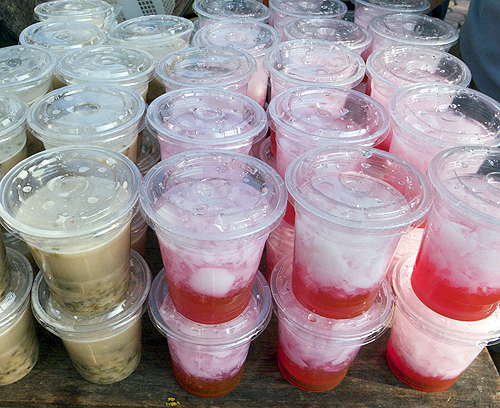
Another thing that surprised me about Ramadan in Kediri was the selling of drinks and foods to break the fast.  Perhaps because Cepu was such a relatively small town, or maybe because in the early 80s people did not have the disposable income to spend on prepared foods, but there was nothing like the array of prepared snacks offered in Kediri.  From after the afternoon call to prayer to the breaking of the fast at sunset, vendors set up tables on Jl. Hayam Wuruk, one of the main streets in Kediri.  Again, as the fast also means no liquids during the day, drinks, especially sweetened fruit drinks, are a popular treat to break the fast.  The demand for these snacks and drinks is such that a special police patrol makes sure that the vendors and their many customers don't entirely cut off traffic from the street. 


Saturday, August 11, 2012

What Did Me This Summer


Night Stall

I took a break from posting while visiting friends and family in Indonesia this summer.  I had originally planned to post more on warungs and rumah makans I visited, but I didn't visit as many as I had planned.  Instead, I ate mostly at home--my sister-in-law's house.  Lili is an excellent cook and manages to produce simple, delicious meals on a two-burner stove in the open-air kitchen at the back of her house.  Spending time with her, her husband and two daughters was all Tjing needed, and it did me fine.

We ate tempe and/or tofu (along with other dishes) almost every day, and I was fine with that.  Indeed, I could eat Javanese tempe every day without complaint.  The difference between tempe you get in Java and the stuff that is sold (at about ten times the price) in the States is like the difference between a crusty French baguette and a loaf of Wonder Bread.  Being that Kediri is Kota Tahu (Tofu City), the tofu was of top quality also.

We did eat out at times, of course.  We enjoyed some Chinese food at Sari Agung (also known as Canton) on Jalan Doho.  We had sate ayam at Pak Siboen's down the street.  Rujak cingur from the Madurese woman.  Martabak telor from Jalan Panglima.  Mie pangsit from several different places.  Tahu telor from the warung on the corner.  But for the most part we simply ate at home.

Sometimes one doesn't need do much to be content.  Sometimes a simple dish is as satisfying as an extravagant feast.  To do more is excess.  I'll be posting recipes again soon, but for now here are some photos of what did me this summer.

 Preparing Soto Ayam Kediri

 Soto Ayam with Lontong


 Mie Pangsit

 Mie Pangsit

 Mie Pangsit


 Treats from a Muslim Neighbor Before the Start of Ramadan

 Soto Pekalongan in Bandung

Yammie Ayam in Bandung

Thursday, July 15, 2010

A Drive in the Country


In the US, I try to avoid traveling on major holiday weekends.  Memorial Day, the kickoff to summer vacation, and Labor Day, traditionally the last day of summer vacation for students, find the roadways packed with frantic families rushing to get away from or get back to their everyday lives.  Drivers stressed by the dual pressures of whining children and clogged freeways take unnecessary risks.  The news broadcasts keep a running account of traffic fatalities.  Every driver other than myself is an idiot who should be shot and dragged from their vehicles, their bodies ripped open so that feral cats might feed on their livers.  I am not one who travels those days.

This past weekend was the last weekend before the end of school holidays in Java.  Not thinking, I traveled.  My wife and I borrowed her cousin’s car, hired a driver, and embarked on a simple, excruciatingly hellish roadtrip.  Drivers and traffic in Indonesia do not bind themselves by the laws or the road.  On a two-lane highway traffic flows in six directions.  Buses, trucks, and cars think nothing of forcing motorcycles and pedestrians off the shoulder so that they might squeeze past a line of vehicles stupid enough to stay on the road.  Motorcyclists use the opposite shoulder to pass, driving into a stream of motorcycles flowing towards them.

Bus drivers in Java have neither souls nor mortal fears of death.  They play chicken and never lose, forcing vehicles and pedestrians to give way to their passage. When I first came to Indonesia in 1983, I bought a Vespa and planned to ride around Java.  Then I was on the bus to Surabaya one day and witnessed the conductor, who collects fares, lean out and push an older woman on a bicycle off the road, causing her to fall on the shoulder.  He and the driver had a good laugh.  I decided I’d just ride the Vespa around town. 

Thursday, September 27, 2012

Sambal Serai--Lemongrass Sambal


Sambal is a part of just about every Indonesian meal.  Sambals can be cooked, raw, with vegetables or proteins, complex, or simple.  Some varieties can be found here.  Sambal ulek (usually seen in markets with the Dutch spelling, sambal oelek) is the most basic of sambals, simply freshly ground chilies and salt.  Sambals may be served alone as a snack, or as an accent to spark grilled fish or fried chicken.  You decide how much sambal your bowl of soto needs, but no soto is complete without it.


Sambal sereh is a cooked sambal that is a great accompaniment to grilled chicken, but also tastes great as a dip for rengginang or krupuk.  Although not for the faint-hearted, the level of heat can be adjusted by the types of chilies used.  Here in Sacramento, the Asian farmers market--a few blocks west of the official Sunday farmers market--finds the stalls overflowing with a variety of  chilies, some hot, others blistering.  Cabai rawit--bird chilies--are particularly hot and can be found throughout the year in local markets.  Cabai keriting--curly chilies--are hot, but not as hot as cabai rawit.  They are rarely found in local markets or at other farmers markets, but they do appear in late summer at the Asian farmers market. 


The Indonesian recipe that I adapted this from calls for 100 grams of cabai keriting.  I used about 80 grams and added a gypsy pepper, a mild red pepper.  This made for a very hot sambal, but one that I can still enjoy just eating with rengginang.  If you prefer a milder sambal, use fewer of the curly chilies and more of the gypsy chili or red bell pepper.  I suppose vegetarians could leave out the dried shrimp and terasi, but the sambal would be less complex.  Terasi (belacan) is an acquired taste, but once you've become accustomed to it, you will long for it.


80 grams (a good handful) chilies  (cabai keriting, but any hot red chili may be used), seeded
1 mild red pepper
3 cloves of garlic, peeled and minced
2 tsp ebi (dried shrimp), soaked in 2 TBS warm water for a few minutes and drained
1 tsp salt
1--2 TBS gula jawa (palm sugar)
1 TBS terasi (fermented shrimp paste)
3  tomatoes, roughly chopped
2 TBS vegetable oil
3/4 cup of water
2 stalks of lemongrass, outer leaves removed, crushed with a pestle and tied into a knot

In a blender or food processor, process the chilies and red pepper until you have a fairly smooth paste. Reserve.  Grind the garlic and salt to a smooth paste in a mortar.  Add the drained ebi, gula jawa, and terasi and grind with a pestle until smooth.  Add the tomatoes and continue to grind until all the ingredients are well mixed.
Heat a frying pan.  Add the oil and then the tomato and garlic mixture.  Fry until fragrant, then stir in water.  Add the chili paste and lemongrass. While stirring, cook over low heat until the mixture thickens.  Ideally, you want a sambal that is moist but not too liquid.  Scrape as much of the sambal as you can from the lemongrass.  Suck what remains on the stalks and count your blessings.

Serve the sambal with grilled/fried fish or chicken.  Or add to an omelet.  Or use as a dip for crackers, chips, krupuk, or rengginang.  Any way you serve it, you will enjoy.