The fourth Thursday in November is a day of celebration across the United States, a day for feasting, for celebrating traditions, family and community. In Sacramento, the fourth Thursday in November is when Hmong celebrate New Year . They celebrate four days, from Thursday through Sunday, at Cal Expo, site of California's State Fair.

The Hmong view the New year's celebration as a chance to renew their community ties and celebrate their culture. Recognizing its importance in preserving their cultural identity, the Hmong stagger the New Year's celebration to ensure that most of the community can participate. Thus, in California the first New Year's celebration is in Chico in September and the last one is in Fresno from December 26 to 30. Besides the Thanksgiving weekend celebration in Sacramento, there are also celebrations in other communities across California between September and December.

A people 5,000 years old that have preserved their unique cultural identity while living amongst more politically dominant cultures, the Hmong have long employed a flexible approach to celebrating New Year. Although their New Year is based on the lunar calendar just as the Chinese and Vietnamese New Years are, in China, where the largest number of Hmong still live, they celebrate their New Year in December to differentiate it from the Chinese New Year. In Laos, where most of the Hmong in the US came from, the celebrations are scheduled around harvests and staggered over a month to allow greater participation.

Covering the celebration in Sacramento as one of
Foodbuzz's November 24/24/24 participants, I spent several afternoons at the festival. My wife, another friend and I attended the New Year's celebrations Saturday and met several of our students. My wife and I then returned Sunday. We intended to just go Saturday, but my camera battery gave out and we decided we could get some more Hmong barbecue. On Saturday we watched some dancing and qeej (pronounced "keng," the Hmong bagpipe-like instrument) competitions. The dancing reflected the global influence on the generation of Hmong growing up in the United States. It ranged from hip hop, to Thai, to Bollywood inspired dances. The qeej are traditionally played at funerals, weddings, and other important community ceremonies. The players spin in circles, dip and thrust the instrument like the horns of a water buffalo, hop on one leg, hooking the leg with the qeej, twist it up and to the side, all the while playing a continuous melodic hum.

For most of the participants, the New Year celebration is an opportunity to wear their traditional clothes, visit friends and relatives, and eat Hmong barbecue. For young men and women it is a chance to see and be seen. Although both men and women wear traditional costumes, more men choose to wear western clothes, with some wearing conservative suits and others wearing hoodies and jeans. The traditional costumes identify the wearers as White Hmong or Green Hmong, from northern Laos or western Laos. Some younger women put together their own outfits based not on tribal identity but personal fashion preference. Besides offering Hmong dvds, cds, and medicine for sale, kiosks sell traditional jewelry, hats, and clothes.

The food was delicious. Chickens, Flintstone size pork chops, skewers of meatballs, fish wrapped in banana leaves and then in foil, as well as Hmong and American sausage are grilled over mesquite charcoal. The meats are served with sticky rice and Hmong sambal. Papaya salad was also sold at each of the barbecue stands. Each salad was made to order, resulting in long, slow lines. The Hmong version of papaya salad is much more robust than the Vietnamese version, and spicier and more fragrant than you'll find in most Thai restaurants. In addition to the barbecue and papaya salad, there were stalls selling curry noodles, pho, egg rolls, fried rice and other such fare. In as much as this is the capital of California, there were also churros and even one stand selling nachos of the variety you can find at gas stations. I can't explain this any more than I can explain the success of McDonald's in Singapore.

The final Hmong New Year celebration in California takes place next month in Fresno. According to my students, this is the biggest of all the celebrations. There were probably at least 20,000 people who attended the celebrations each day in Sacramento. For a peek into another culture and a chance to taste food that you can't easily find, I would recommend that anyone who is in the vicinity of Fresno from December 26 to 30 to take advantage of the opportunity and go to the New Year's celebration. If you can't do that, try one of the following recipes, or better yet, buy the book.

The recipes that follow are adapted from
Cooking from the Heart: The Hmong Kitchen in America by Sami Scripter and Sheng Yang. This is an interesting, at times very moving collection of recipes and stories of the Hmong experience in the United States. As an ESL teacher who has often enjoyed many of the dishes featured in the book at class potlucks, I especially enjoyed the cultural and personal stories included in the book.
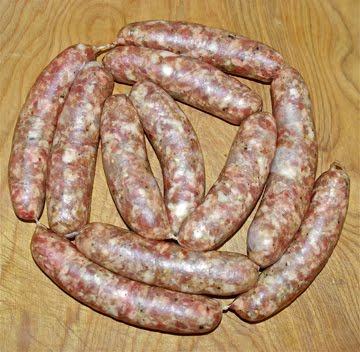
 Hmong SausageNyhuv Ntxwm Hmoob
(makes 8 servings)
3 pounds pork meat with some fat, finely minced or ground
1 cup finely chopped ginger
3 to 4 cloves garlic, minced
2 to 3 hot chili peppers, minced
2 teaspoons salt
1 teaspoon black pepper
sausage casing (I used 35/38 mm hog casing)
Preparation
Mix the meat and spices thoroughly. Take a small amount of the mixture and fry it in a nonstick skillet. Taste and adjust the seasonings. With a sausage-stuffing machine, fill the casing. Don't fill too tight or the sausages will burst. While the Hmong generally make longer links, I prefer 6 to 8 inch links.
After assembly, Hmong let the sausage rest for a day or two to let the flavors blend and allow the sausage to become firm. In Laos I saw people just hang sausage outside. Cook or freeze the sausages within two days of making them. Grill the sausages over hot coals, turning frequently to brown on all sides. As with all fresh sausage, you want to cook thoroughly but guard against bursting. Cook to 170º. Serve with sticky rice. (The sausage I bought at the New Year's celebration had a fairly high fat ratio as well as a lot of salt or salt and msg, but it was delicious.)

One of the interesting features of
Cooking from the Heart is that many of the recipes are super-sized, appropriate for Hmong family gatherings and celebrations. While this might seem strange, it makes sense when you consider the book's target audience is younger Hmong who have grown up in the United States who long for the food they grew up eating. Their parents and grandparents probably cooked without set recipes and it's hard to pass that knowledge to a generation used to formulas. You might be able to cook green beans for eight, but how about when you're having a celebration and need to cook for 25? This book tells you how.
Garlicky Green Bean Stir-FryTaum Kib Xyaw Qej(makes 25 servings)
Ingredients
5 pounds fresh green beans, washed and stem ends snipped off
2/3 cup vegeatble oil
1/2 cup chopped garlic
1/2 large yellow onion, sliced
1 tablespoon salt
1/4 cup water
1/2 cup oyster sauce
Preparation
Clean the green beans and snip off the stem ends. Heat the oil to medium-hot in a large, lidded, round-bottomed pan. Toss in the garlic and onion and stir-fry just until their flavors are released, about 20 seconds. Add the green beans and the salt. Stir-fry for a few minutes. Then add the water and cover the pan. Let the beans steam for 5 minutes. Uncover the pan, add the oyster sauce, and stir 2 to 3 minutes, until the beans are uniformly covered with the shiny sauce. They should retain some of their crunch.
I made the green beans, cutting the proportions by two-thirds, as an accompaniment to our Thanksgiving dinner and they were delicious. This is an easy dish to throw together at the last minute, as long as you have prepped the beans.
The stipend provided by Foodbuzz was more than enough to pay for parking, entrance, and food for my wife, friend, and I. Hunger is serious problem throughout the world and one that gets too little recognition in our media. I donated $150 of the stipend to World Food Programme. Others interested in donating to this organization can click on the badge on the right of this page. Every little bit can help in providing food for those who are in need.
Get the flash player here: http://www.adobe.com/flashplayer